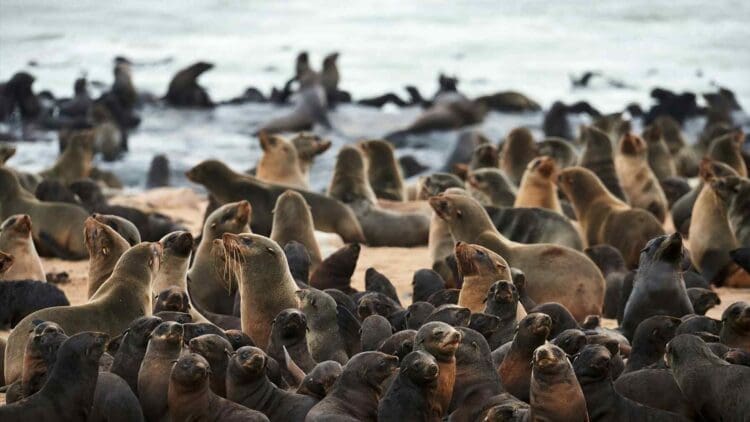

Offshore wind developments are reshaping regional marine wildlife in the North Sea.
These projects are essential to meeting the ever-rising demands and climate goals. Yet, wind capacity expansion is much slower than anticipated, which is why consumption outpaces generation.
Several obstacles account for the delayed deployment, including concerns about unprecedented impacts on local wildlife.



Will the latest findings on altered seal behavior affect the future of potential offshore wind projects?
How meeting climate goals has gotten harder
Smart computing and manufacturing are continuously transforming the world’s industries.
Nations near the North Sea region are becoming major hubs for growing AI data centers and heavy industry.
These developments are driving massive, uninterrupted demand for power.
Regional consumption is nearing hundreds of terawatt-hours annually, straining and even outpacing local grid infrastructure.
This is where the meeting of binding climate targets becomes complex.
Some international pacts, like the Esbjerg and Ostend Declarations, legally require achieving climate neutrality by 2050.
The dedicated countries also pledged to slash carbon emissions by at least 55% by 2030. These are measured against 1990 levels.
To meet these targets, grid decarbonization must occur almost instantaneously while energy demand rapidly increases.
Governments have therefore selected offshore wind as their primary strategic asset to strike a balance.
Unfortunately, rapid, large-scale deployment has been challenging due to several factors. This is despite the benefits of harnessing stronger, more consistent winds.
The obstacles to offshore wind expansion
Current treaties require scaling up North Sea offshore wind capacity to at least 120 GW by 2030. By 2050, capacity should be 300 GW.
However, approximately only 37 GW is currently online. This is because new large-scale wind investments must overcome significant challenges.
Project timelines are often delayed due to economic, industrial, and environmental hurdles.
For instance, inflation increases material costs and stalls massive capital investments.
Bigger installations require a higher volume of critical minerals. Extraction is invasive, and manufacturing is energy-intensive.
Furthermore, there is a significant global shortage of green infrastructure minerals. Supply chain bottlenecks can further delay deployment.
Complex connections of offshore wind farms to mainland grids can be time-consuming.
Another reason for delays is growing concerns about unpredictable long-term impacts on nature.
However, research indicates that these man-made structures benefit some species. Ocean Oculus, a marine communications consultancy, believes this could shift broader marine policies.
Some seals are exploiting offshore wind farms
Marine biologist Dr. Deborah Russell led the primary research. She is a post-doctoral research fellow at the Scottish Oceans Institute at the University of St Andrews.
The study “Offshore wind farms become magnets for hungry seals” was published in Science.
The research team attached GPS tags to track harbor and gray seals in the North Sea.
They discovered that the seals were swimming through the wind farms in precise, geometric patterns.
It turns out the local mammals were hunting, as the offshore turbines altered the ecosystem.
The “reef effect” created ideal hunting grounds
Turbines’ underwater foundations become highly effective artificial reefs.
The “reef effect” increased mussel, barnacle, and crustacean colonies. In turn, the sudden growth of marine life rapidly attracted schools of fish.
The abundance of prey made hunting predictable, attracting the seals.
One seal was found navigating a subsea pipeline for 10 days. Others traveled in straight lines to systematically check turbines for food.
These findings prove that renewable energy infrastructure does not operate in isolation from nature.
Instead, offshore wind is shifting ecosystems in ways that researchers are only starting to comprehend.
While accurate predictions of potential impact are limited, policymakers will have to learn to adapt. This is especially vital as nations rush to scale offshore capacity.
Continued analysis and responsible management will be essential to balance energy demand with marine conservation.