
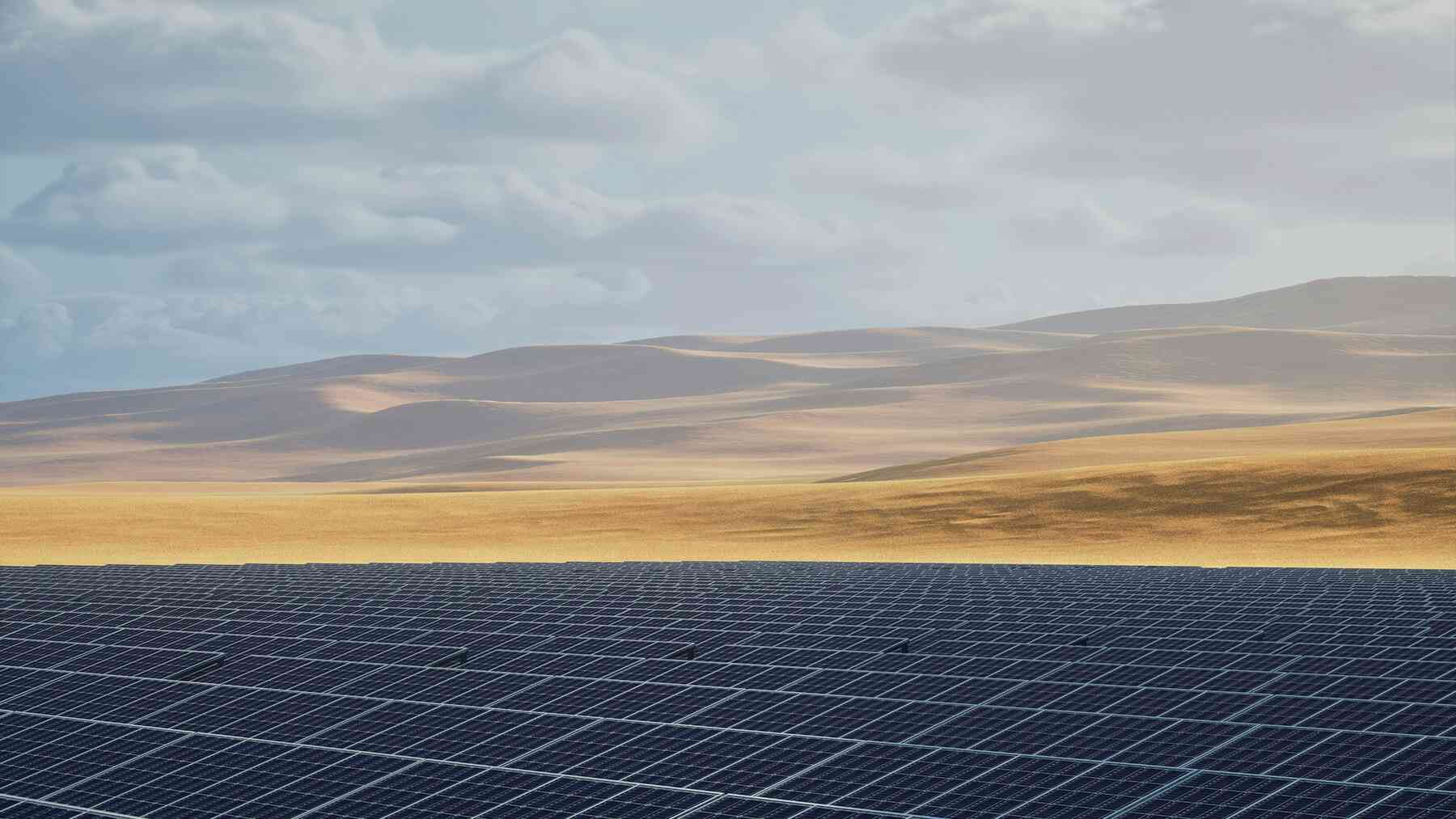
Installing 7 million solar panels in the desert seemed like a good idea until they started changing the climate around them
 Credits: Edited image
Major solar panel installations are taking over deserts to meet clean energy targets.
Globally, nations are heavily investing in green projects to offset carbon emissions.
As usable land becomes scarce, local communities frequently oppose utility-scale expansion.
Her work focuses on making complex topics accessible, informative, and relevant for readers across different areas of interest.
China turned to its vast arid deserts as a solution, and then the environment began to change.
How are these millions of panels changing the desert climate, and what does it mean for future developments?
How scarcity and backlash slow the transition
Tight climate deadlines are rapidly approaching.
Nations are racing against time to triple renewable capacity as a result.
Solar power is driving these efforts.
However, utility-scale projects require nearly tenfold the land per unit of power compared to fossil fuel plants.
Globally, this massive footprint has triggered a land rush.
Now, green energy goals are competing with agriculture, conservation, and local communities.
Developers seek flat, cleared spaces. This is why high-quality farmland is increasingly being converted into solar plants.
This expansion raises concerns about long-term food security and the loss of rural economies.
Consequently, local opposition has sharply risen.
Locals argue that these vast installations ruin the aesthetic value of natural countryside and historic landscapes.
Others are concerned about the drop in residential property values.
Furthermore, local communities often only enjoy fragmented benefits.
The vocal public backlash makes it difficult for new projects, stalling progress in climate targets.
China’s massive clean energy mandate
China is facing a dual challenge.
The nation has hit a record 10.4 trillion kilowatt-hours in annual electricity consumption.
This surge is driven by a major boom in electric vehicles, 5G infrastructure, and advanced manufacturing.
Simultaneously, Beijing must meet strict climate mandates that peak carbon emissions before achieving net-zero.
To overcome both challenges, massive, utility-scale solar installations are the only viable path forward.
However, the government had to pivot its strategy due to land scarcity and local pushback.
The solution lay in China’s northern and western territories with vast stretches of desert.
Remote deserts enabled the country to rapidly deploy millions of solar panels.
Additionally, expansion could occur without competing for agricultural land or disrupting communities.
But researchers soon discovered that the massive infrastructure was transforming the local climate.
The Central Asia Climate Portal highlights the findings of a 10-year study based on the Talatan Solar Park.
Millions of solar panels changed the desert microclimate
The installation of 7 million solar panels at the Talatan Solar Park fundamentally altered the environment.
The giant arrays serve as physical shields against the harsh desert sun.
By providing permanent shade, the local microclimate was completely rewritten.
Scientists tracked the park from 2011 to 2020, and measured three ecosystem services:
- Carbon sequestration
- Sand fixation
- Soil retention
Three mechanisms that drove positive changes
The permanent shade of the arrays significantly lowered the desert’s average ground temperatures.
Lower surface temperatures promoted higher moisture retention by slowing water evaporation.
The millions of panels also served as windbreaks.
As wind speed near the ground was reduced, the topsoil experienced less erosion.
The improved soil conditions led to a drastic transformation of the barren landscape.
Microorganisms were flourishing, enabling plant life to grow back naturally.
This effectively reversed desertification. Additionally, this shift was not confined to the park’s boundaries.
The study proved that the benefits extend up to 1,640 feet outside the solar park.
The Talatan Solar Park demonstrates the benefits of turning to arid desert regions for large-scale solar expansions.
By using remote deserts, project developers completely avoid local conflicts.
More importantly, these vast arrays prove that renewable infrastructure can reshape local climates for the better.
Massive solar plants can therefore generate high volumes of clean energy and restore the most fragile ecosystems.
Anke Maree is a writer with a clear and engaging editorial style. Her work focuses on making complex topics accessible, informative, and relevant for readers across different areas of interest.
