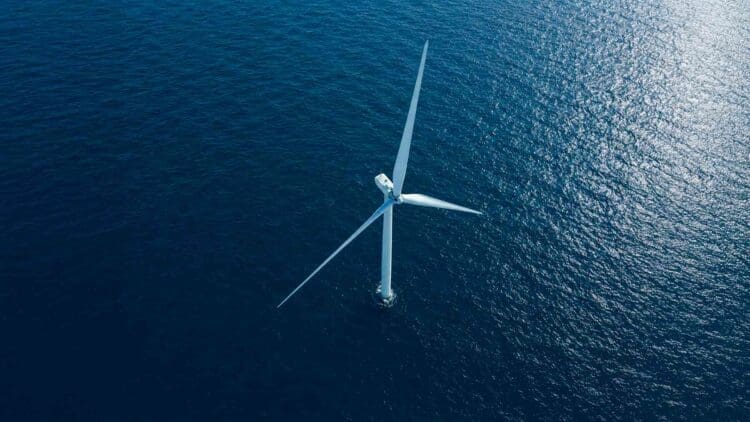

The fate of global offshore wind lies in the hands of the world’s governments.
Wind power plays a fundamental role in the world’s decarbonization efforts and securing grid stability.
While capacity has rapidly expanded, a major regulatory bottleneck could derail the growth momentum.


Currently, 25 gigawatts of planned wind projects have been halted.
Why are these wind farms not able to continue development, and how will it affect the world?
How wind became the backbone of a decarbonized energy system
Globally, nations are committed to carbon reduction targets.
Offshore wind energy has become a vital pillar for these goals.
Major offshore wind farms produce high volumes of emission-free electricity.
To permanently decouple industrial growth from fossil fuels, marine turbines must be scaled up.
This establishes offshore wind as a primary catalyst for the world’s sector electrification.
Additionally, utility-scale wind power is a vital structural support to stabilize the global grid.
Complete electrification, digitalization, and rapid urbanization are surging electricity consumption.
Offshore wind’s reliable high-capacity output will help meet these rising demands.
Furthermore, major deployment will safeguard the world’s networks against power fluctuations and unexpected blackouts.
The proven physical scale and immense geographic versatility have made offshore wind projects highly essential.
Recent fossil fuel shocks and energy crises have made this renewable resource even more crucial.
Despite these factors, global expansion is facing significant challenges.
A short-lived success story for global wind
The wind sector has achieved substantial growth over the past year.
In 2025, 9.3 GW of new offshore capacity was successfully connected to regional power grids.
It marked the third-highest annual installation growth in history.
This pushed the total global offshore wind capacity to 92.5 GW.
These major expansions prove the technical readiness and scalability of modern offshore energy infrastructure.
This rapid growth must continue to combat worsening economic instability.
Recent fossil fuel supply shocks have triggered substantial international energy crises.
Expensive import costs have left nations vulnerable to electricity inflation and supply shortages.
Wind infrastructure serves as a direct barrier against these unpredictable international market shocks.
Domestic wind generation offers long-term financial protection and national energy security.
Yet, a report from the Global Wind Energy Council (GWEC) shows that nearly 25 GW of consented projects are frozen.
This has severely downgraded the mid-term outlook for the world’s wind deployment.
Ready-to-build projects are facing structural bottlenecks
Major offshore wind projects are being halted due to regulatory hurdles.
The 25 GW of projects have official consent and legal development permission.
Yet, developers cannot make final investment decisions due to significant administrative gridlocks.
The barriers to offshore development progress
The main obstacle is an extremely slow grid connection approval process.
Thousands of turbines are structurally stranded in coastal waters due to long connection timelines to the regional transmission networks.
Furthermore, government auction models are poorly structured. This actively deters essential private investments.
Several national procurement systems mainly focus on short-term, lowest nominal pricing.
This framework ignores major supply chain limitations and increases the inflation of raw materials.
Developers are inevitably left to face significant financial risks that make projects unbankable.
These risks are further compounded by unstable subsidy arrangements and delayed state auction outcomes.
Governments must begin to streamline permitting and reform procurement rules. Otherwise, these major offshore assets will remain financially paralyzed.
The industry has the technology and knowledge to scale future grids. Unfortunately, bureaucratic passivity has rendered the process flawed.
The world’s offshore wind crisis is entirely fixable.
But governments are running out of time to save these frozen 25 GW of wind projects.
The only way to secure energy independence is to fast-track grid connection and reform broken auction frameworks. Otherwise, the world will have to face permanent climate stagnation.
Anke Maree is a writer with a clear and engaging editorial style. Her work focuses on making complex topics accessible, informative, and relevant for readers across different areas of interest.