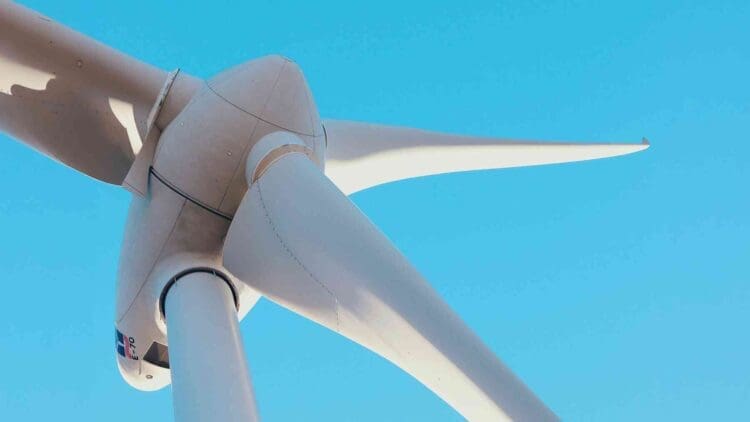

Global decarbonization requires wind turbines that have maximum efficiency.
The renewable energy transition cannot be completed without high outputs to meet rising electricity demands.
Yet, traditional infrastructure’s power limits have been based on flawed mathematical models for a century.




Now, a Penn State student has made a breakthrough that corrects this foundational error.
What does the student’s new equation entail, and how could it change wind turbine designs in the future?
How to meet unprecedented demand in the age of electricity
Worldwide, electricity consumption has been increasing at the fastest pace in a decade.
This surge is driven by rapid industrialization, a growing electric-vehicle fleet, and power-hungry AI data centers.
The International Energy Agency projects that global demand will reach over 29,000 terawatt-hours by the end of 2026.
Data center demand is growing by 15% annually and is projected to double by 2030.
This places immense localized pressure on regional grids.
To relieve this strain, wind power is emerging as a vital backbone for meeting this major growth.
In 2025, global wind installation achieved a record after adding 165 GW of new capacity.
This addition was a 40% increase from the previous year.
The cumulative capacity worldwide now sits at 1,299 GW. This is enough to cover over 11% of electricity demand.
Wind power has large-scale generation and geographical versatility.
Despite this, turbines still do not operate at maximum efficiency.
The high cost of underperforming wind turbines
Clean energy requires massive long-term capital investments to strengthen energy security. This includes modern wind turbines.
However, when a turbine presents even 1% of underperformance, the energy deficit is staggering.
When considered across a utility-scale wind farm, the inefficiency is even greater.
That minor inefficiency translates to millions of kilowatt-hours of lost power annually.
This directly lowers the revenue required to fund future renewable projects.
Furthermore, inefficient generation compromises grid reliability.
If wind output is too low during peak hours, operators turn to fossil fuel plants to prevent blackouts.
Consequently, global decarbonization goals are actively delayed.
To counterbalance the energy losses, developers construct more turbines.
This expansion necessitates bigger physical footprints. This intensifies public opposition and ecological disruption.
While wind energy continues to rapidly expand, the physical infrastructure still faces an invisible bottleneck.
Fortunately, an engineering student from The Pennsylvania State University overcame this by solving an old math problem.
Cracking Glauert’s century-old limitation
Engineers have been developing alternative turbine designs to address efficiency.
Yet, the fundamental flaw can be traced back to British aerodynamicist Hermann Glauert’s formula.
He created the method to calculate wind turbine efficiency in 1926.
The problem was that his model treated turbines as abstract concepts instead of physical machines.
This standard formula has ignored downwind thrust and root bending moments for a century.
Penn State aerospace engineering undergraduate student Divya Tyagi solved this hundred-year-old dilemma.
The undergraduate honors thesis earned her the prestigious Anthony E. Wolk Award.
Tyagi is now focusing on her graduate research. Perhaps her groundwork should be combined with MIT’s new physics-based rotor aerodynamics for a new generation of highly efficient turbines?
Anke Maree is a writer with a clear and engaging editorial style. Her work focuses on making complex topics accessible, informative, and relevant for readers across different areas of interest.