
An Indian factory is turning the shells around cashew nuts into marine fuel, and waste from one of the world’s favorite snacks has already powered a commercial ship
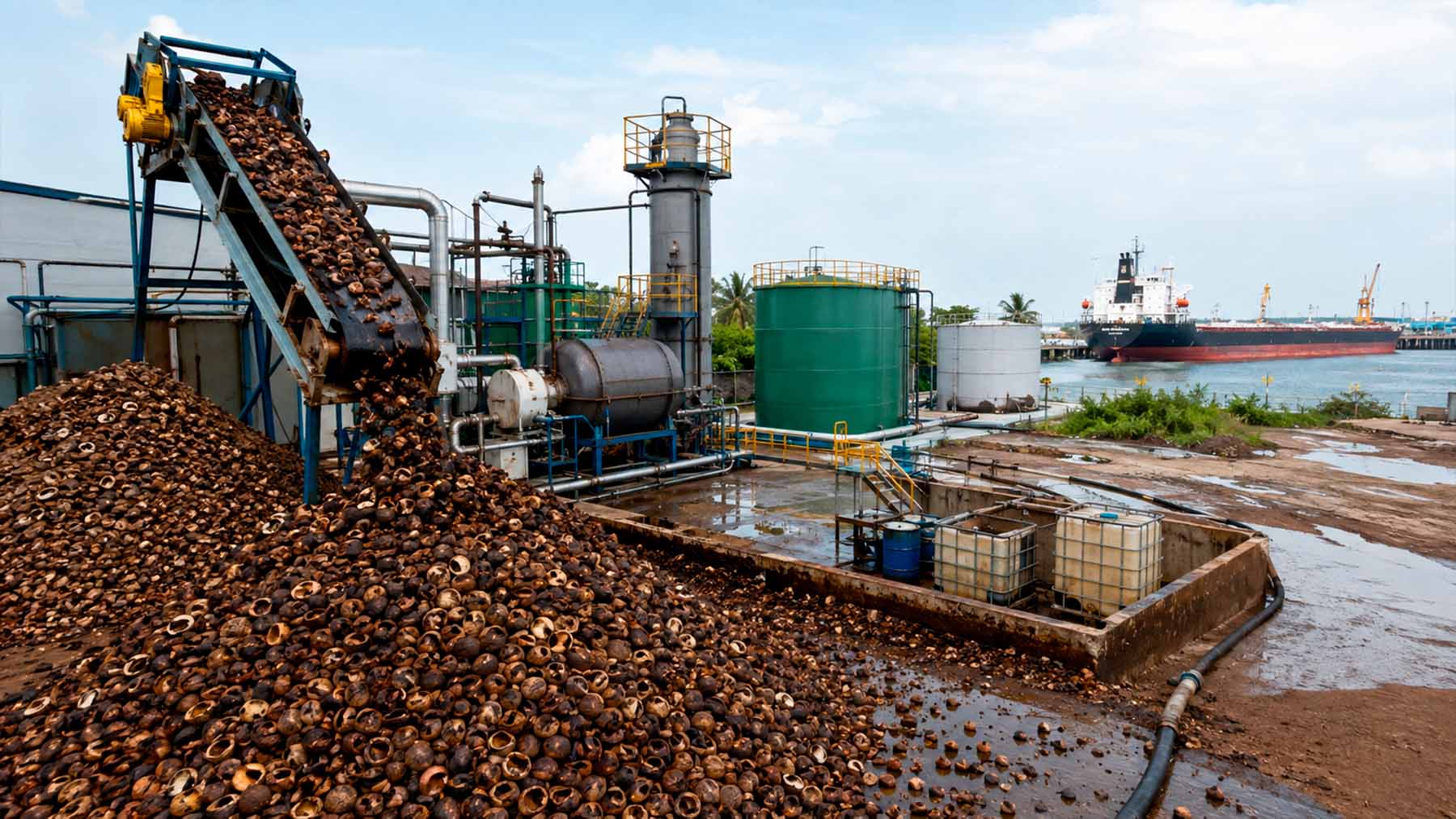 Image generated with artificial intelligence
A breakthrough in India demonstrates how localized agricultural waste replaces fossil fuels across global supply chains.
Worldwide, several sectors remain inherently hard to decarbonize, particularly marine shipping.
Meanwhile, residues from agricultural processes are emitting substantial amounts of greenhouse gases.
Ship & Bunker highlights the plant’s strategic location, as the surrounding region has a high concentration of cashew processing facilities.
Instead of burning or leaving the waste to decompose, this abundant biomass is being transformed into high-value green energy.
Will this agricultural waste conversion help hard-to-abate sectors finally lower their carbon footprints?
How maritime shipping remains difficult to decarbonize
Nations worldwide are racing to meet International Maritime Organization climate regulations mandating widespread decarbonization.
This requires the replacement of fossil fuels with clean alternatives.
However, this remains difficult for several global sectors, such as maritime shipping, due to unique operational obstacles.
These vessels need immense energy density to travel thousands of miles across the ocean without having to stop.
While electrification is being pushed globally, current battery systems are not ideal for maritime vessels.
Cargo capacity is already limited, and the extremely heavy and bulky batteries take up valuable space.
Nearly 90% of global trade is carried by international shipping.
Unfortunately, it also accounts for roughly 3% of the world’s greenhouse gas emissions.
Transitioning to other cleaner alternatives remains challenging.
In-service vessels are designed to run up to 30 years. Retrofitting or replacing this fleet will cost hundreds of billions of dollars.
Furthermore, synthetic fuel options face infrastructure bottlenecks.
The challenge of finding a suitable alternative fuel
Green hydrogen and ammonia are some of the most widely discussed synthetic options.
Despite many nations achieving major milestones in producing these fuels, their deployment faces supply chain challenges.
Cryogenic storage at -423°F is needed for hydrogen.
Ammonia is toxic and requires specialized double-walled piping and revised safety protocols across ports worldwide.
It is projected that it will cost up to $120 billion over the next decade to bridge this infrastructure gap.
Instead, attention is shifting to drop-in biofuels due to low energy conversion efficiency and high production costs of synthetic options.
Yet, viable bio-feedstocks also face their own technical challenges.
Untreated biomass residues, like cashew nut shells, experience high reactivity and sludging.
As a result, fuel injectors are clogged, pumps seize, and engines fail.
Additional challenges include high corrosion risks and fuel blending instability.
To overcome this, MASH Makes created a new process where agri-waste is converted into a stable drop-in marine fuel.
Using cashew waste to create high-value green energy
Agricultural processing results in significant waste, which emits high volumes of greenhouse gas emissions.
This issue is being addressed by repurposing these residues.
In a village near Hebri, India, a facility is converting cashew waste into marine fuels.
Ship & Bunker highlights the plant’s strategic location, as the surrounding region has a high concentration of cashew processing facilities.
Almost 2,000 metric tons of cashew residues are processed monthly.
The marine fuel conversion process
Cashew press cakes are directly sourced from local processing units.
The waste is added to modular reactors, and is heated at temperatures up to 1,022°F without oxygen (pyrolysis).
The resulting products are raw bio-oil, biochar, and syngas.
The bio-oil undergoes thermochemical processing to neutralize problematic molecules. It also eliminates water emulsion problems and prevents polymerization.
The refined non-corrosive bio-oil can be blended into standard Very Low Sulfur Fuel Oil or Marine Gas Oil.
In addition to creating a high-value drop-in marine fuel, the biochar is used to enhance soil quality and store carbon.
MASH Makes’ cashew waste conversion thus delivers an immediate, climate-positive alternative to fossil fuels.
The bio-oil has been validated in-lab and real-world ocean trials on commercial shipping vessels.
The project is set to move forward with commercial deployment.
Ultimately, expanding these agri-waste processing plants globally will accelerate maritime shipping decarbonization.
Anke Maree is a writer with a clear and engaging editorial style. Her work focuses on making complex topics accessible, informative, and relevant for readers across different areas of interest.
