
Germany’s 1.8-MW vertical solar farm leaves over 90% of its land available for organic seed farming
 Grüne Sachwerte
A solar farm in Germany uses vertical panels to address land-use conflicts with local agriculture.
The nation is continuously expanding its renewable energy capacity to meet rising power demand and climate neutrality targets.
However, traditional photovoltaic installations require vast acreage and often trigger land competition, sparking immense opposition.
Her work focuses on making complex topics accessible, informative, and relevant for readers across different areas of interest.
As a result, developers are now turning to unique dual-use engineering solutions.
How do alternative layouts help rural landscapes boost green power capacity while preserving farming operations?
How Germany is powering an industrial shift amid soaring electricity consumption
Germany’s domestic power demand is surging.
This unprecedented growth is fueled by a growing electric vehicle fleet, data centers, and heating electrification.
The nation’s data center capacity has already exceeded 2,730 megawatts.
Heating electrification is also adding millions of new heat pumps each year.
As Germany tries to meet this rising demand, it is simultaneously under pressure to reach climate neutrality by 2045.
This pressure stems from strict legal mandates, such as the Climate Protection Act.
To satisfy both is a daunting challenge, but not impossible.
Rapid renewable energy capacity deployment is key to meeting both requirements.
Solar energy, in particular, is highly advantageous in this mission.
Large-scale photovoltaic power provides the speed and modular scalability required to expand clean generation quickly.
Unfortunately, in a densely populated country such as Germany, this strategy faces significant spatial bottlenecks.
Most importantly, the solar sector has historically faced significant opposition from rural agricultural economies.
The longstanding clash with standard solar generation
Conventional solar installations have historically triggered significant tension with the agriculture sector.
These ground-mounted panels require massive, continuous acreage for development.
Fertile farmland often offers the best site conditions and is permanently transformed into industrial energy zones.
Rural communities and farmers strongly oppose projects that use up productive arable land and displace local food production.
Furthermore, traditional arrays seal the soil beneath them and block heavy machinery.
This renders standard farming operations impossible across entire tracts.
Traditional photovoltaic power production also introduces major grid and market challenges.
South-facing panels concentrate electricity output during midday hours.
This massive surge floods the grid when energy demand is low.
As a result, midday experiences price drops, forced curtailment, and market congestion.
Fortunately, engineering innovators have developed dual-use agrivoltaics to resolve these mounting conflicts.
Next2Sun is one of the pioneers tackling land scarcity and grid saturation at the same time.
Their secret is mounting bifacial solar modules vertically.
Rural farmland’s transformation into a dual-use power station
Agrivoltaics is moving into a new frontier using unique panel layouts to maximize benefits.
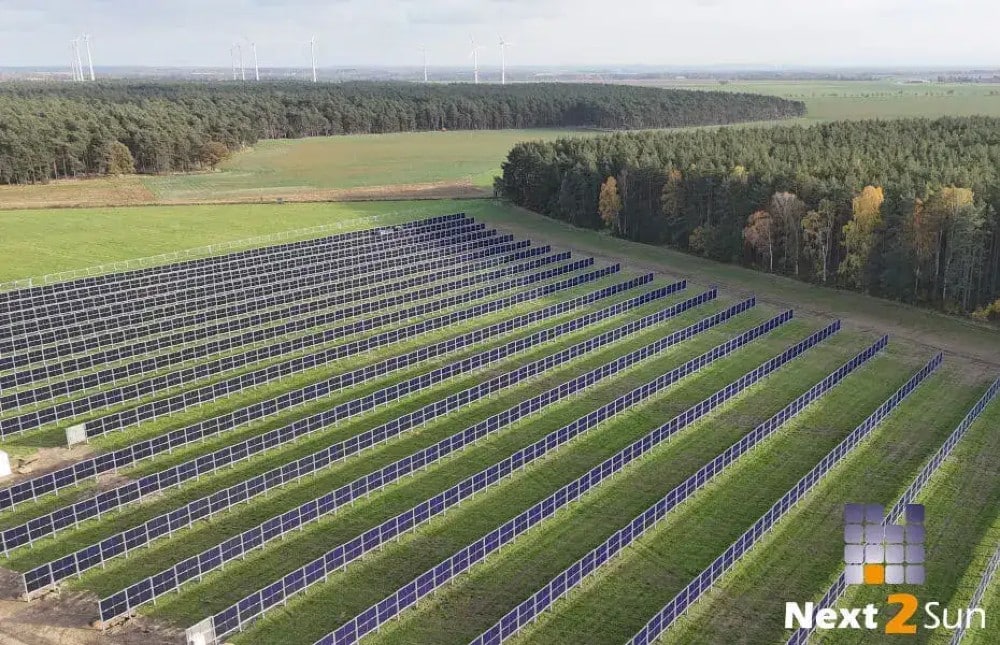
Next2Sun’s innovative panels were deployed at the Krauscha Agri-Solar Park in Saxony, Germany.
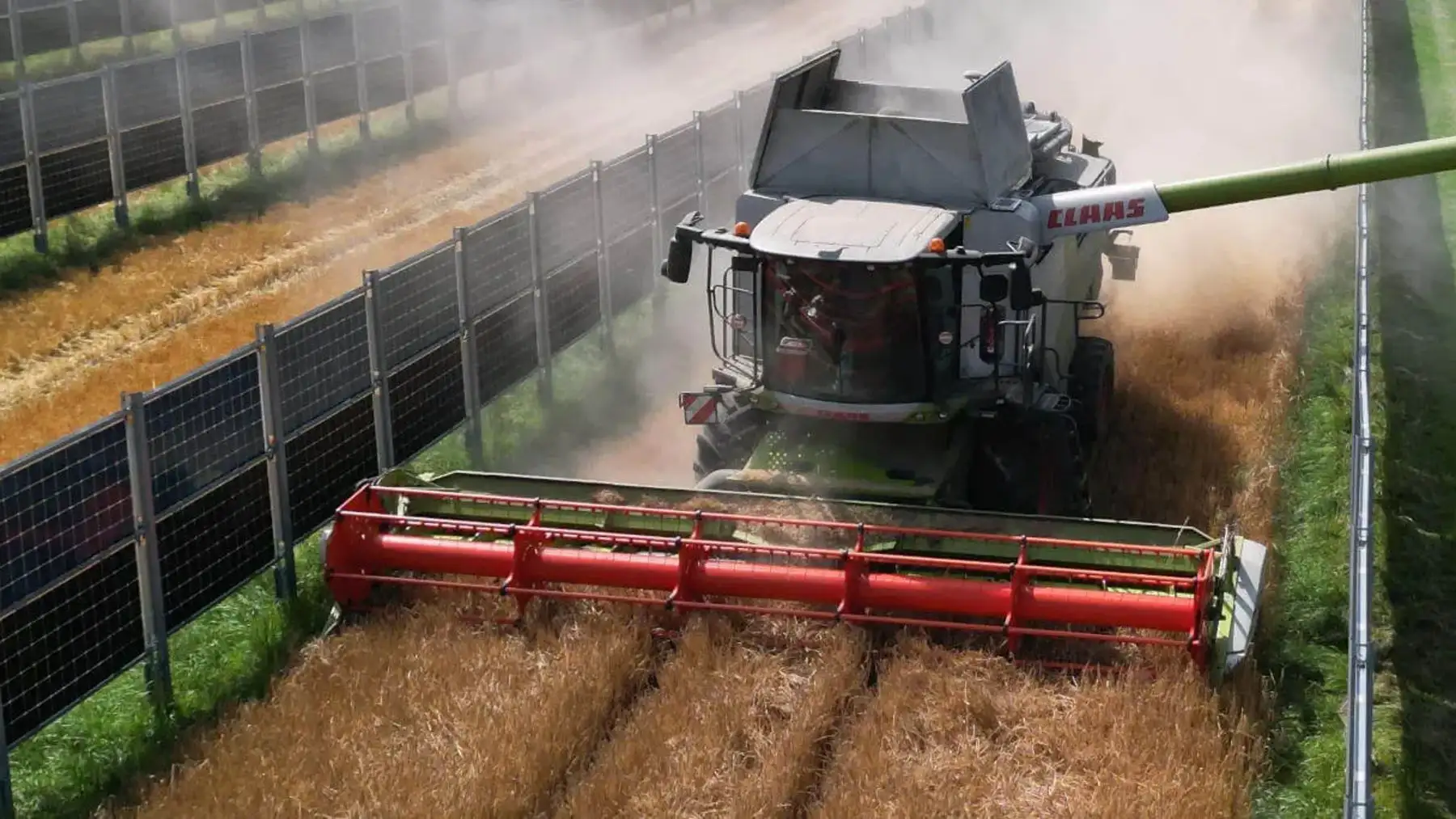
The 1.8-MW installation consists of vertical, double-sided, glass-glass bifacial panels placed in long, parallel rows.
What makes them unique is that they do not tilt toward the south like standard panels.
Instead, they stand upright like crop fences and face both east and west.
This orientation enables front and back surfaces to capture low-angle morning and afternoon sunlight.
Electricity generation then peaks during high-demand periods, maximizing grid stability.
Major agricultural and ecological benefits
Ground coverage is below 1%. Over 90% of the acreage remains open for organic seed farming.
Heavy tractors and harvesters can operate freely between the rows, as they are 34.4 feet apart.
The orientation also boosts soil and crop protection by reducing evaporation and heat damage.
The Krauscha Agri-Solar Park is currently fully operational and connected to the grid.
The park generates roughly 2,000 megawatt-hours of clean power annually alongside active organic crop production.
It offers a clear blueprint for Germany’s agriculture and energy sectors, proving that the two can coexist.
Ultimately, agrivoltaics has become a valuable strategy to boost green energy capacity without compromising valuable farmland.
Anke Maree is a writer with a clear and engaging editorial style. Her work focuses on making complex topics accessible, informative, and relevant for readers across different areas of interest.
