
ANS Annual Conference opens in Denver with nuclear leaders calling for unified push on deployment
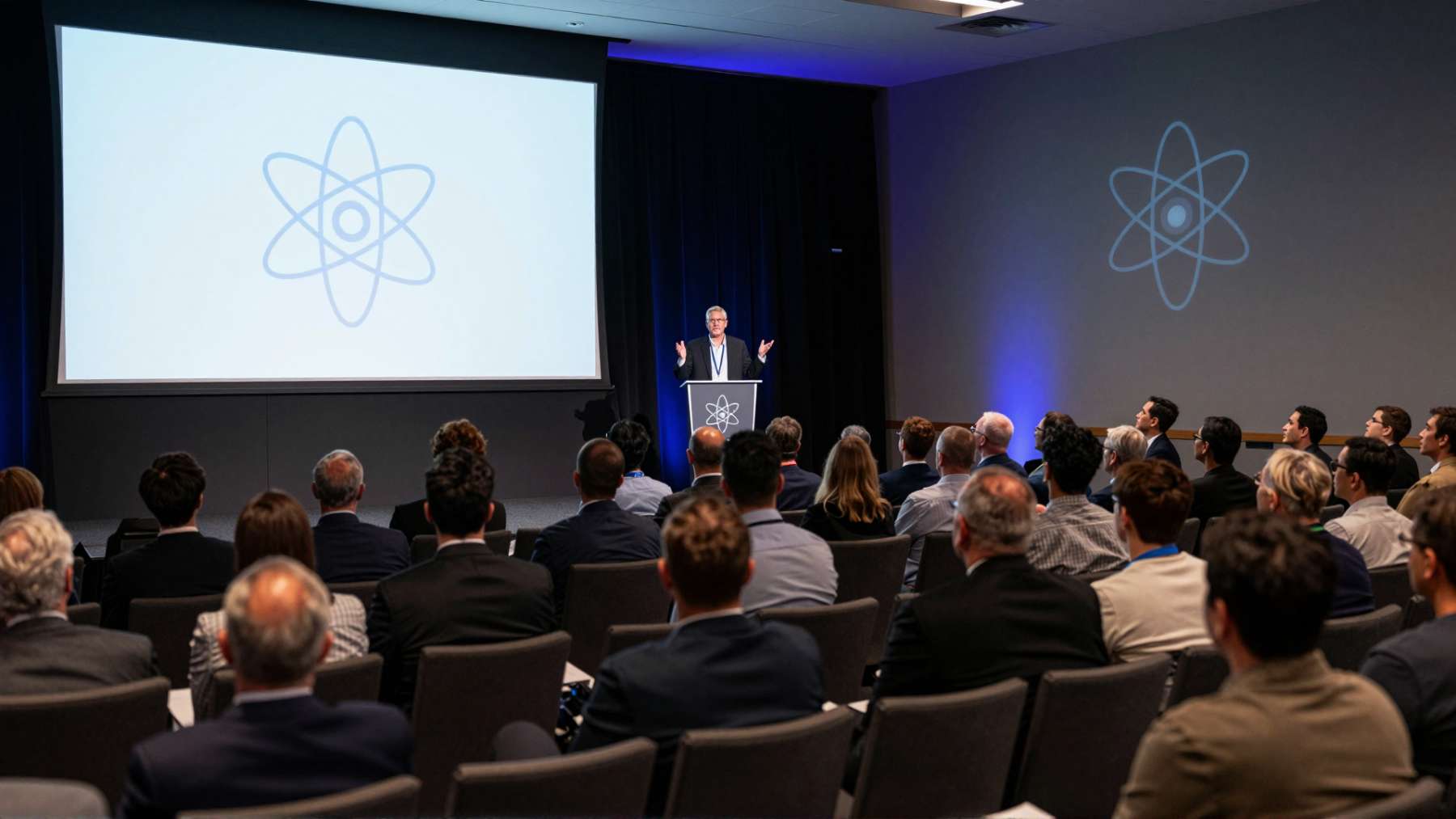
The American Nuclear Society’s Annual Conference opened this week in Denver, Colorado, under the theme “Net Out and Power Up” — and the room it drew matched the ambition of that tagline. Keynote speakers ranged from ANS leadership and the NRC chairman to the director general of ITER, fusion lab directors, and a senior Department of Energy official, all addressing an audience of industry veterans, researchers, students, and policymakers. Together, they made the case that nuclear energy has reached a turning point — one that may not come around again.
Conference opens with call for cross-sector unity
ANS CEO Craig Piercy opened by cutting straight to the core question. “The question before us now is not whether we need more power. We do,” he told the room. “The question is whether we can provide that clean, firm generation at a scalable amount to meet that challenge.” Piercy also addressed a long-running cultural tension between fusion researchers and fission veterans, arguing the moment demands something different from both sides. “We are at our best when we stop thinking of ourselves as competing camps and start recognizing that we are part of the same larger project,” he said.
Roma warns industry against fixating on licensing as the sole bottleneck
Nuclear attorney and conference general chair Amy Roma delivered the morning’s sharpest message, warning against “bottleneck thinking gone wrong” — concentrating resources on the most visible obstacle while the rest of the system quietly fails. Her target was the industry’s tendency to treat NRC licensing as the primary deployment barrier. “If you’re only paying attention to licensing, you’re thinking about the problem wrong,” Roma said. “Your bottleneck is not your NRC licensing. It’s a piece of a much bigger pie that you need to think about holistically.” Supply chain gaps, contract risk, financing structures, and community relationships are the constraints most likely to kill projects, she argued. Roma pointed to Helion Energy’s decision to purchase IP rights and build its own high-voltage capacitor manufacturing line as a model of systems-level thinking.
The ANS Annual Conference is the society’s flagship event, drawing industry veterans, researchers, students, and policymakers together each year.
NRC chairman lists regulatory milestones and defends agency independence
NRC Chairman Ho Nieh did not hedge. “This is the most consequential moment in the history of American nuclear energy in nearly 50 years,” he told the audience. Nieh structured his remarks around three pillars: capability, deployment, and credibility. He catalogued concrete milestones — the 10 CFR Part 53 rule finalized 21 months ahead of schedule, a construction permit for a commercial advanced non-light water reactor issued nine months early, the first-ever restart pathway approved for a permanently shut-down reactor, and license renewals now delivered in 12 months. On credibility, Nieh recounted a foreign minister’s blunt remark to an NRC delegation: “We want a power plant, not a PowerPoint.” He also pushed back on suggestions of political influence, stating, “The NRC is very independent in how it does its technical work.”
ITER and PPPL leaders offer candid assessments of fusion’s progress and gaps
ITER Director General Pietro Barabaschi reported that five of the tokamak’s nine vacuum vessel sectors are now installed in southern France. Progress is real — but Barabaschi was candid: “A future power plant cannot look like ITER.” He welcomed the surge in private fusion investment as evidence the field has finally found the competitive dynamic it was missing.
PPPL Director Steven Cowley offered a precise technical picture: the National Ignition Facility recorded 2 megajoules of laser input and 8.6 megajoules of fusion output. Cowley was measured, though. “Net electricity out? No. Net money in? We’re quite a long way from that.” He noted China is spending roughly three times what the United States spends on fusion, while the U.S. has approximately 50 private fusion companies. “They can’t all be right,” Cowley said. “But they’re all doing interesting things.”
Background: ANS conference context and what comes next
The ANS Annual Conference is the society’s flagship event, drawing industry veterans, researchers, students, and policymakers together each year. The 2026 gathering runs three days in Denver, with two full days of sessions and panels still ahead. The breadth of Monday’s speakers — spanning the NRC, ITER, a national plasma physics laboratory, private fusion companies, and the Department of Energy — reflects how much U.S. nuclear activity has expanded.
Key takeaways from opening day: licensing reform is real but not the only deployment barrier; supply chains, financing, and community trust require equal strategic attention; fusion has made genuine technical progress but commercial electricity generation remains years away; and competitive pressure from China is a concrete factor. ANS’s Nuclear News is providing ongoing coverage for those not attending in person. Updates are available at ans.org/news.

Carlos is an engineer with strong expertise in technical and industrial topics. He previously worked at international companies such as Siemens and is multilingual.
