

Doug Manning spent years building solar projects across Vermont. He has enough panels on his own roof to zero out his electric bill. But standing at his back porch in Lowell — looking out over the 44-acre hayfield where neighbors sled in winter, set off fireworks in summer, and gather for carnivals year-round — he found himself doing something that surprised even him: fighting to stop a solar farm.
This isn’t a story about climate denial. It’s about something more complicated unfolding in a small Vermont town that once said yes to wind power — and is now divided over what clean energy is allowed to cost a community.
A hayfield at the center of everything
The 44-acre parcel at the heart of this dispute is not just farmland. For Lowell residents, it functions as the town square they never officially built. Families sled its slopes in winter, gather for carnivals when the weather warms, and watch fireworks above it in summer. The town’s only school and its clerk’s office sit directly across the street. For a community of roughly 800 people, the field is woven into daily life in ways that resist easy measurement.


Northland Solar wants to change that. The company is seeking permits to install nearly 5 megawatts of solar panels on the site — enough to power about 1,500 homes. The land is largely flat, sits adjacent to a road, and borders a substation that makes grid connection relatively straightforward. The farm family that owns the property, the Raboins, has been in the process of selling since last year.
The town that said yes to wind — and no to solar
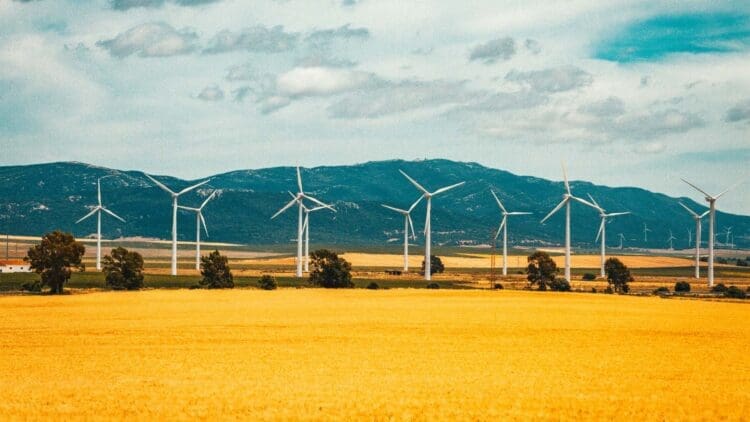
Lowell is not a town that reflexively rejects clean energy. In 2010, residents voted to welcome more than 20 wind turbines on a nearby ridgeline. The 63-MW Kingdom Community Wind project promised to ease rising property taxes — and has delivered. It generated roughly $600,000 in payments to the town in 2025 alone, saving residents like Mike Tetreault and his wife around $9,000 in property taxes last year.
The proposed solar farm offers nothing close to that. According to testimony before the Public Utility Commission, the project would pay approximately $20,000 in state property taxes annually, plus a smaller municipal amount. For many residents, that gap isn’t a minor detail — it’s the core of the argument.
Before the wind vote, Green Mountain Power held multiple community meetings and explicitly promised to withdraw if residents said no. No equivalent engagement preceded the solar proposal. Because energy-permitting decisions happen at the state level, a town vote wouldn’t be binding regardless. Many who backed the turbines now feel the solar project is simply being imposed on them.
Vermont’s clean energy math — and who pays the price
Vermont has set some of the most ambitious renewable energy targets in the country. Renewables, including credits, covered roughly 75% of the state’s electricity generation in 2024. Closing the remaining gap requires building fast. The trade group Renewable Energy Vermont estimates the state needs 60 to 80 megawatts of new solar annually over the next four years, while Vermont’s Public Service Department puts the figure at 42 to 50 megawatts per year. Either way, community resistance threatens to slow that pipeline considerably.
That resistance isn’t unique to Vermont. At least 498 renewable energy projects were contested across 49 states at the end of 2024 — a 32% increase from the prior year, according to Columbia University’s Sabin Center for Climate Change Law. Kerrick Johnson, commissioner of the Vermont Public Service Department, named the tension plainly: “We want solar, we want to be able to do it — but not look at it here.”
The farmland debate: real threat or red herring?
Some Vermont legislators have tried to translate community resistance into law. Republican lawmakers introduced bills that would ban solar installations on more than five acres of “primary agricultural soils” — a federally defined category covering roughly one-sixth of Vermont’s land.
The farmland concern is not invented. Modeling by the American Farmland Trust projects that development could consume 41,200 acres of Vermont farmland between 2016 and 2040. But according to a letter from Renewable Energy Vermont’s Peter Sterling to the state legislature, 97% of that loss will come from housing and commercial construction — not solar. Rooftop installations exist as an alternative, though they carry real costs: rooftop projects can run 50% more than ground-mounted solar, and parking-lot canopies can cost double. Climate writer Bill McKibben points to agrivoltaics — systems where crops or grazing animals coexist with panels — as evidence that framing energy and food production as competing interests is often a false choice.
Competing visions for the same patch of land
Mike Tetreault grew up on a dairy farm across the street from the hayfield. In 2023, he and his wife tried to buy the Raboin property for $165,000, intending to keep it in agricultural use. The solar company’s offer was reportedly around $280,000. Tetreault couldn’t compete.
That frustration surfaced when the town voted on whether to spend $50,000 hiring a lawyer to fight the project. The result: 86 to 86, a dead tie. Officials ultimately found unallocated budget funds to hire an attorney anyway. The select board, the school, and a local cemetery have all formally intervened against the project before the Public Utility Commission, which is expected to rule before summer. One bed-and-breakfast owner sold her property after learning the solar farm would border her flower fields. The new owner, Damien Walker, moved from Phoenix partly to escape climate risk and sees things differently. “It’s not the worst thing in the world to be in proximity to a big electrical generator,” he said.
What Lowell is really asking
The fight in Lowell is not really about solar panels. It is about who decides what a community sacrifices — and whether the people bearing the cost have any meaningful say. Lowell said yes to wind because it was asked, heard, and because the terms made local sense. The solar proposal arrived differently. That difference may matter as much as the project itself.
As more communities face similar decisions, the question worth sitting with is this: Can a clean energy transition sustain broad public support if the communities hosting it feel they had no real choice? In Lowell, that question remains open.

Carlos is an engineer with strong expertise in technical and industrial topics. He previously worked at international companies such as Siemens and speaks Spanish, German, English, and Italian.