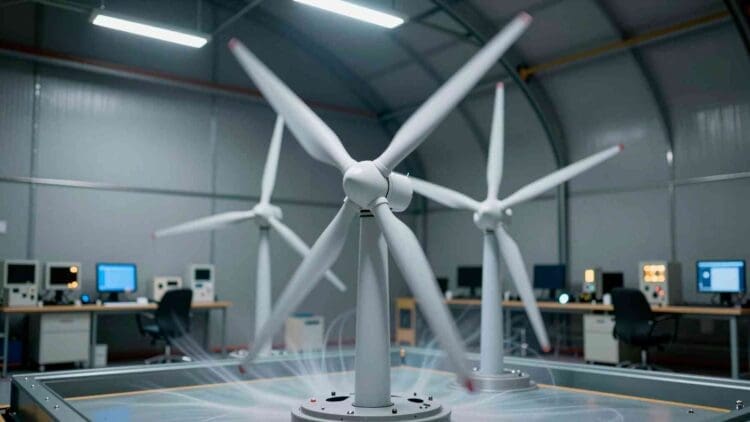

Opposite-spinning rotors could make small urban wind turbines far more powerful — and new wind tunnel data shows how close engineers are.
Small wind turbines have long had trouble competing—not with massive offshore arrays, but with the solar panels spreading across nearby rooftops. Lower efficiency, higher per-unit costs, and chaotic urban airflows have kept them a niche option for most people.
One proposed fix is deceptively simple: add a second rotor spinning in the opposite direction, connecting both to a single generator with no gearbox. The design recovers energy that a single rotor leaves swirling in its wake while cutting the mechanical complexity that typically drives up cost and maintenance. A team of engineers brought a 1.6-meter prototype to a wind tunnel facility in Nantes, France, to test that idea under controlled conditions.

Why small wind turbines keep falling short
Small wind turbines serve households, farms, remote communities, and hybrid energy systems. They’ve consistently struggled, though—less aerodynamically refined than large utility-scale turbines, and that gap pushes up the cost of every kilowatt-hour they produce.
Solar panels have made that gap harder to overlook. Studies suggest small wind turbines can outperform photovoltaic systems at specific high-wind sites, but the economics rarely favor low-resource locations. Urban environments add further difficulty: noise, vibration, and rotor size constraints all chip away at an already thin performance margin. That persistent efficiency shortfall is what pushes researchers beyond conventional single-rotor designs.
The counter-rotating concept: Two rotors, one generator, no gearbox
The counter-rotating dual-rotor wind turbine (CR-DRWT) places a second rotor behind the first, spinning in the opposite direction. The rear rotor recovers energy left in the swirling wake that a single rotor simply discards.
The double rotational armature design connects both rotors to a single generator—one rotor to the stator and the other to the rotor—eliminating the gearbox and bevel gears entirely. Relative motion between the two spinning components drives power generation directly. The payoff: doubled direct-drive power, minimal starting torque, and reduced noise and vibration.
Theory backs the approach. Classical analysis extended to dual-rotor systems suggests a counter-rotating configuration can exceed the single-rotor Betz limit of CP = 0.59, with some models projecting peak values above 0.64.
Inside the wind tunnel: What the Nantes tests revealed
The prototype tested at CSTB in Nantes had a rotor diameter of 1.6 meters, with both rotors separated by 0.39 rotor diameters. Wind speeds ran from 4 to 15 m/s in 1 m/s increments, with independent sensors tracking rotor RPM and blade pitch angle.
The turbine self-started reliably at 3.5 m/s. At 15 m/s, it reached a maximum electrical output of 1,014 W and a peak power coefficient of 0.33 — an improvement over prior versions, according to the researchers. Stable operation required a specific startup sequence: the downstream rotor was released first, allowed to reach an operating point, and only then did the upstream rotor engage.
Modeling the machine: Extending the BEM framework
The team extended an existing blade element momentum model to handle the double rotational armature constraint—both rotors must produce equal torque to maintain equilibrium. Across most of the wind speed range, the model matched experimental power output and CP values well.
One discrepancy appeared above 11 m/s, where the measured upstream rotor RPM plateaued at roughly 1,050 RPM while the model predicted a continued increase. The researchers attributed this most likely to a pulse-counting limitation in the data acquisition code rather than any physical ceiling on rotor speed.
How much better could it get? The optimization picture
The team swept 121 combinations of upstream and downstream rotor pitch angles. The best configuration—approximately 9.8° pitch for the upstream rotor and 0.6° for the downstream—yielded a predicted annual energy production of 2,150 kWh and a theoretical maximum CP of 0.51.
The pattern held consistently: optimization favored a high-efficiency downstream rotor operating at high CP while the upstream rotor accepted reduced individual efficiency. Optimized aerodynamic power at 15 m/s reaches 2,251 W, above the current generator’s rated capacity of 1,400 W. Generator redesign, not blade geometry, is now the binding constraint.
What comes next for compact urban wind
The Nantes results establish a credible experimental baseline, but several steps remain before this design moves from wind tunnel to rooftop. CFD simulations are the immediate priority, since BEM models can’t capture three-dimensional flow effects around two closely spaced rotors.
The downstream rotor currently mirrors the upstream one. Designing blade geometry specifically for the turbulent, swirling wake the rear rotor actually operates in could unlock additional gains. Reynolds number limitations also deserve attention—the tests ran at Reynolds numbers between 25,000 and 200,000, substantially lower than real-world conditions. Field testing under actual atmospheric conditions will ultimately determine whether the gearbox-free CR-DRWT can deliver durably and economically enough to compete where small wind turbines have always struggled most.
Kelly is an experienced writer with 15 years of experience exploring the big stories that shape our world, from tech breakthroughs and space exploration to climate, energy, and the fascinating quirks of science. She has a talent for turning complex ideas into sharp, memorable insights that stay with readers long after they’ve finished reading.