
Washington researchers have found a surprisingly simple way to turn old wind turbine blades into even stronger plastics
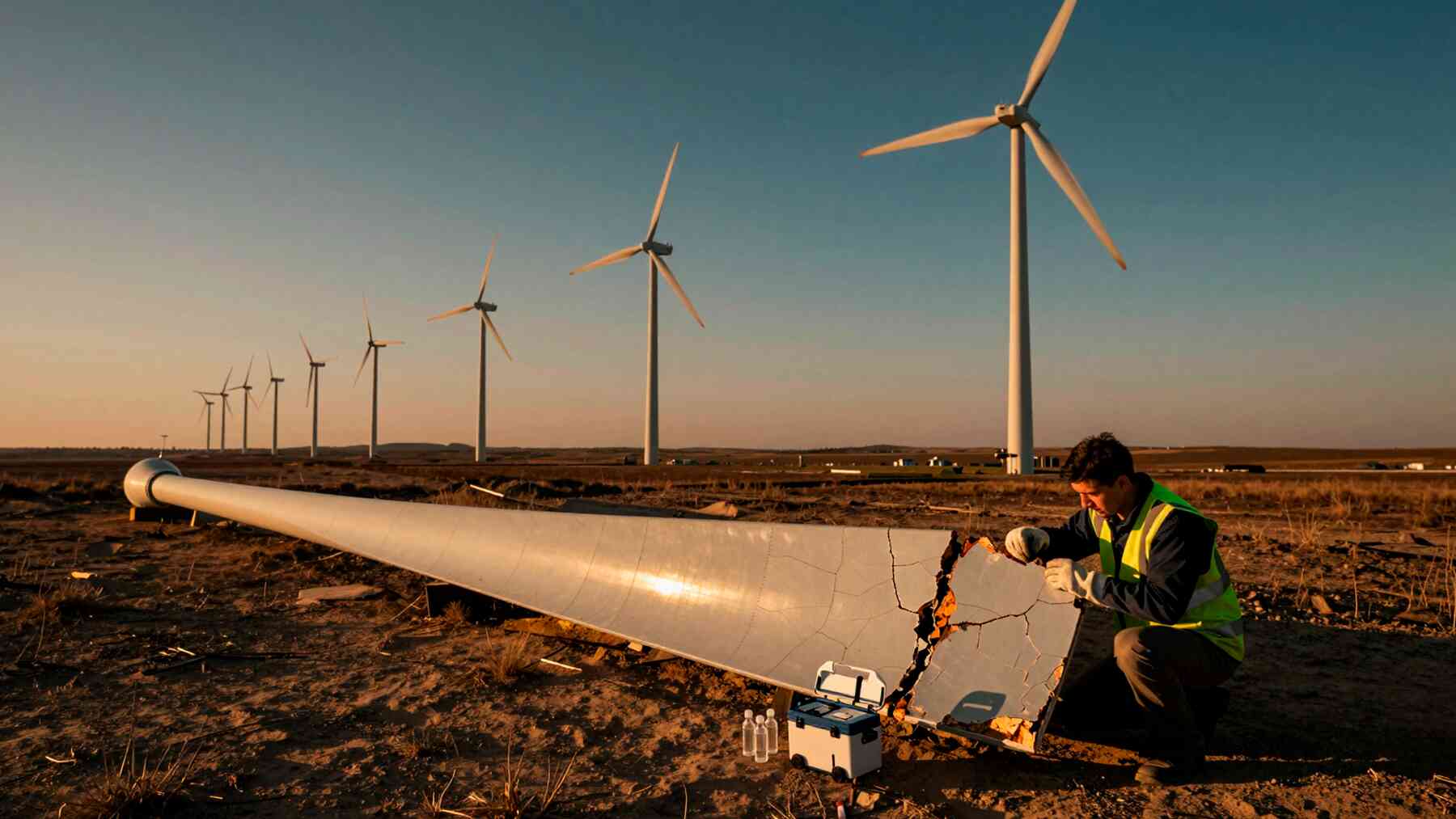
Millions of wind turbine blades are approaching the end of their useful lives with nowhere to go — too tough to break down, too large to ignore. Now, researchers at Washington State University say they’ve found a way to recycle that material without harsh chemicals, recovering glass fibers and resins that can be built into plastics stronger than the originals.
Their findings, published April 3 by the Washington State University, describe a low-toxicity process that may offer a practical path forward for one of renewable energy’s most stubborn waste problems.
A new recycling process for wind turbine blades
The WSU team’s approach centers on glass fiber-reinforced polymer, or GFRP — the dominant material in most commercial wind turbine blades. Their study, published April 3, 2025, describes cutting blade material into roughly two-inch blocks, then soaking them in a solution of zinc acetate — an organic salt also found in throat lozenges and food additives — dissolved in pressurized, superheated water for about two hours.
The team is also working with WSU’s Office of Commercialization toward developing wind turbine blade materials that are fully recyclable from the start.
That mild bath breaks down the polymer network enough to free usable glass fibers and resins. Rather than fully separating those components, the team blended the recovered mixture directly with thermoplastics, producing composite materials containing up to 70% recycled GFRP by weight.
“It works very well, especially considering the mild conditions that we applied,” said Cheng Hao, a former graduate student and co-first author on the paper. “The solvent is a green solvent, and also the temperature is acceptable for this purpose.”
Why wind turbine blades have been so difficult to recycle
The core problem is chemical. Most wind turbine blades are built with thermoset composites — materials cured during manufacturing and permanently set. Unlike thermoplastics, which can be melted and reprocessed, thermosets resist being returned to their original components, making conventional recycling methods largely ineffective.
The timing sharpens the problem. The first generation of modern composite wind turbines, built in the 1990s, is now reaching the end of its operational life — a wave of retiring equipment with no widely adopted disposal solution in place.
GFRP accounts for roughly two-thirds of a turbine blade’s total weight. Blade manufacturing itself wastes about 15% of GFRP material, meaning the waste stream begins well before any turbine ever spins.
Performance gains from recycled materials
The results from the WSU lab suggest the recovered material isn’t merely reusable — it performs well enough to be genuinely valuable. When researchers blended recycled GFRP into nylon plastic and tested the result, the composite was more than three times stronger and more than eight times stiffer than nylon alone.
Those gains come from the glass fibers, which reinforce the surrounding plastic matrix. Because the WSU method preserves fiber integrity under mild processing conditions, the recovered material retains enough structural quality to meaningfully improve the host plastic. The approach also extends to polypropylene and high-density polyethylene — the plastics used in everyday products like milk jugs and shampoo bottles — which broadens the potential market for recycled blade material considerably.
One additional detail improves the economics. Most of the zinc acetate catalyst can be recovered and reused through simple filtration after each processing cycle. “The ease of the catalyst recovery enhances the overall sustainability and cost-effectiveness of the method,” said Jinwen Zhang, the study’s corresponding author and a professor in WSU’s School of Mechanical and Materials Engineering.
Scalability, next steps, and broader context
The research team describes the method as both scalable and cost-effective, suited to handling the large volumes of GFRP waste the wind industry is beginning to generate. Zhang framed the urgency plainly: “As wind energy grows, recycling and reusing wind turbine waste is becoming increasingly urgent. This recycling method is scalable, cost-effective, and environmentally friendly, providing a sustainable solution for reusing large quantities of glass fiber reinforced waste.”
Current work focuses on reducing the pressurization requirements of the process — lowering that threshold would make the method simpler and less capital-intensive at industrial scale, an important gap between laboratory results and real-world deployment.
The team is also working with WSU’s Office of Commercialization toward developing wind turbine blade materials that are fully recyclable from the start. That would address the disposal problem before blades are ever manufactured. Funding came from the U.S. Department of Energy’s Office of Energy Efficiency and Renewable Energy, reflecting federal interest in durable solutions to wind energy’s growing waste challenge.
Key takeaways
The WSU study offers a concrete, low-toxicity method for recycling one of renewable energy’s most persistent waste materials. GFRP, which makes up the bulk of wind turbine blades and has historically resisted recycling due to its thermoset chemistry, can be broken down in a mild zinc acetate solution and blended directly into stronger thermoplastic composites.
The recovered material performs well — significantly improving the strength and stiffness of common plastics. The catalyst can be recovered and reused, keeping costs manageable. With the first generation of composite turbines now retiring and blade manufacturing waste adding to the volume, the need for scalable recycling solutions is real and growing. This method, still under development, represents a meaningful step toward meeting that need.

Carlos is an engineer with strong expertise in technical and industrial topics. He previously worked at international companies such as Siemens and is multilingual.
