
MIT engineers publish new physics-based rotor aerodynamics model that corrects century-old wind turbine theory
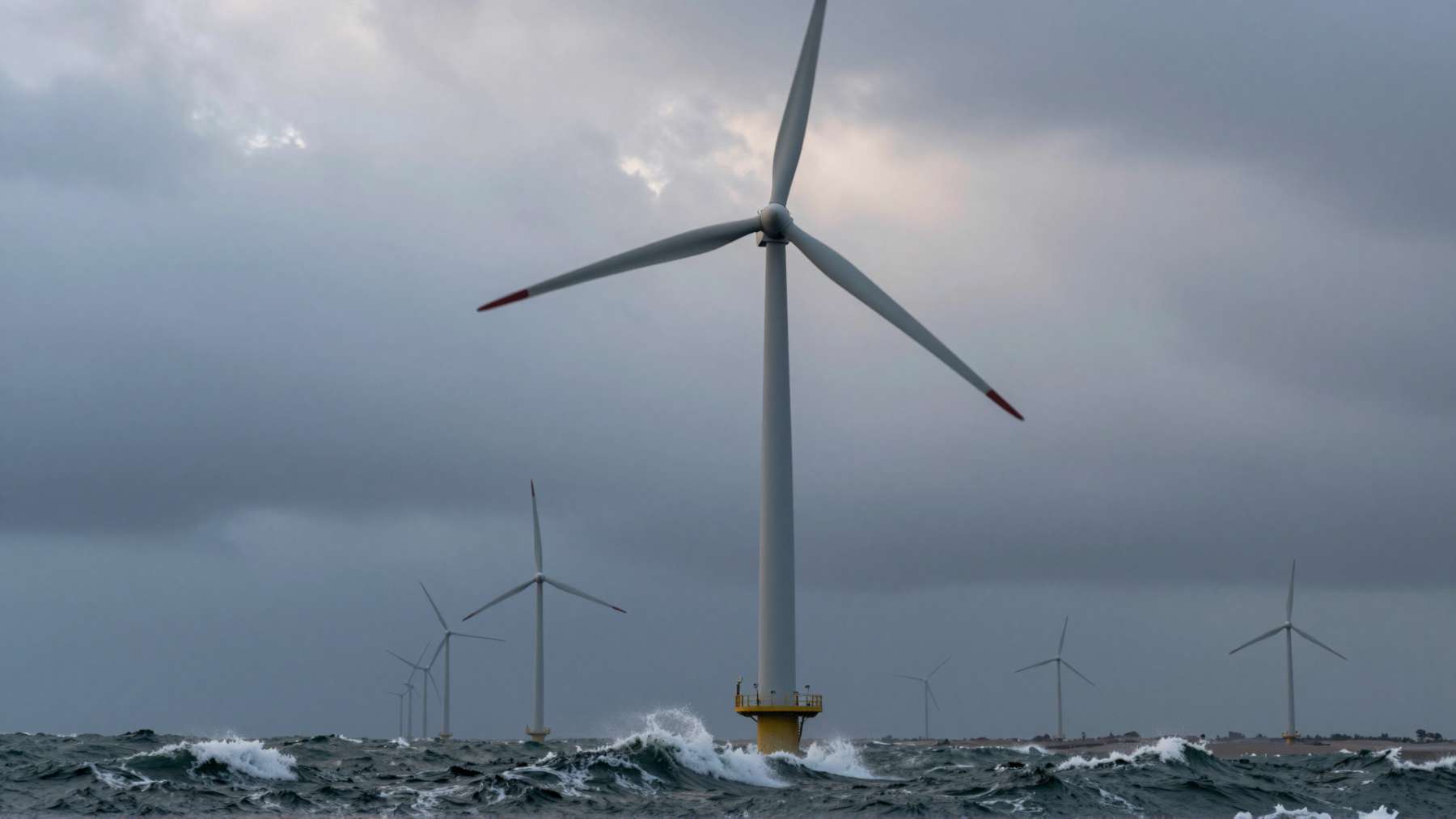 AI-made
For more than a century, engineers designing wind turbines and propellers have relied on a mathematical model that, under certain common conditions, doesn’t just lose accuracy — it gets the physics fundamentally wrong. Now, MIT researchers say they’ve built something to replace it.
A team at MIT has published a new physics-based model of rotor aerodynamics that works where the old theory breaks down — including the operating conditions closest to peak turbine performance.
New Model Published in Nature Communications
The unified momentum model appeared in Nature Communications on August 21, 2024, in an open-access paper authored by MIT postdoc Jaime Liew, doctoral student Kirby Heck, and Professor Michael Howland, the Esther and Harold E. Edgerton Assistant Professor of Civil and Environmental Engineering. It applies to any rotor interacting with a fluid — a wind turbine extracting energy from airflow, or a ship and aircraft propeller pushing energy into it. Howland puts it simply: “The theory works in both directions.” The model is also freely available as an open-source software package on GitHub.
“Within 10 percent of that operational set point that we think maximizes power, the theory completely deteriorates and doesn’t work,” Howland says.
Why the Existing Momentum Theory Falls Short
Classical momentum theory dates to the late 19th century. From it, physicist Albert Betz calculated in 1920 that no turbine can extract more than 59.3 percent of the kinetic energy in incoming wind — a ceiling known as the Betz limit that has guided turbine design ever since.
The trouble is that the theory breaks down under conditions engineers encounter all the time. At higher blade rotation speeds or steeper blade angles, it doesn’t merely underestimate thrust force — it predicts the force will decrease when experiments consistently show it keeps rising. “It’s not just quantitatively wrong, it’s qualitatively wrong,” Howland says.
Failure also occurs whenever the rotor isn’t perfectly aligned with incoming airflow. Howland calls that misalignment “ubiquitous” on wind farms, where turbines continuously adjust to shifting wind directions. To compensate, engineers have historically patched the original equations with empirical correction factors — adjustments grounded in wind tunnel experience but lacking any theoretical basis.
How the Unified Momentum Model Was Developed and Validated
To build a more reliable model, the team used detailed computational fluid dynamics simulations to examine exactly how airflow interacts with a spinning rotor. A key finding involved a flawed assumption baked into the original theory: that pressure behind the rotor recovers to ambient levels a short distance downstream. That assumption becomes increasingly inaccurate as thrust force rises — right near the operating point the Betz limit identifies as optimal.
“Within 10 percent of that operational set point that we think maximizes power, the theory completely deteriorates and doesn’t work,” Howland says.
For rotor misalignment, the team incorporated three-dimensional wing-lift equations originally developed for aerospace applications. Those refinements, taken together, produced the unified momentum model. Validation against computational fluid dynamics results has been completed; wind tunnel and field tests are ongoing but not yet published.
Practical Effects on Wind Farm Design and Operation
One immediate application is real-time turbine control. Wind farm operators constantly adjust turbine orientation, blade angle, and rotation speed to maximize output — and the new model can optimize all of those parameters simultaneously, without relying on empirical corrections. Crucially, those control improvements can be deployed on existing hardware with no physical modifications required.
The model also revises the Betz limit upward by a few percent. Modest in absolute terms, but meaningful for a number treated as fixed for a century. More significantly, it extends the concept to cover misaligned turbine configurations, something the original Betz formulation cannot do at all. The same physics also apply to aircraft and ship propellers and to hydrokinetic turbines in tidal or river flows, though that wasn’t the team’s primary focus.
Funding and Broader Context
The research was supported by the National Science Foundation and Siemens Gamesa Renewable Energy. It builds on Howland’s 2022 work, which showed that deliberately misaligning certain turbines within a wind farm reduces wake interference and improves total farm output — findings that exposed the limits of existing empirical models and directly motivated this theoretical effort.
The unified momentum model is downloadable now as an open-source package on GitHub, ready for turbine designers, farm operators, and researchers. Howland frames the broader goal plainly: to move wind energy research “more aggressively in the development of the wind capacity and reliability necessary to respond to climate change.” A century-old formula with known, fundamental flaws now has a physics-based replacement — accurate, free to use, and ready to deploy.

Carlos is an engineer with strong expertise in technical and industrial topics. He previously worked at international companies such as Siemens and is multilingual.
