
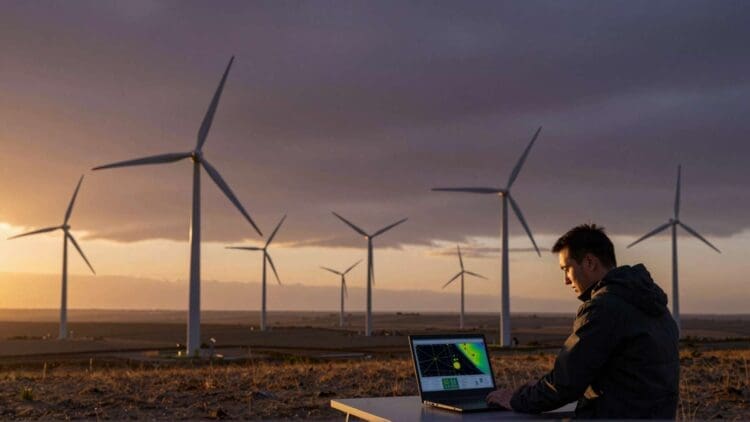

A team of researchers has developed deep-learning surrogate models that can replicate the outputs of mesoscale wind farm simulations at a fraction of their usual computational cost. The study, published as a preprint in Wind Energy Science, introduces models that predict wind power losses and wind speed deficits produced by different turbine layouts — results that would otherwise require running full physics-based Weather Research and Forecasting simulations for each candidate design.
New surrogate models replicate costly wind simulations
The new models work by combining two types of input: atmospheric data from free-stream WRF simulations and information about turbine layout configurations. From those inputs, they predict the spatial power fields that WRF would generate if its wind farm parameterization were fully activated. The result is a system that can evaluate how a given arrangement of turbines affects wind power output and wake propagation — without re-running the underlying physics model from scratch.
The study’s core goal is practical. Regional wind energy planners often need to compare dozens or more candidate layouts before committing to a design, and these surrogate models are built specifically to make that kind of rapid, iterative screening feasible.



Why full mesoscale simulations are too slow for planning
Wind farms are getting bigger. Turbine capacities are increasing, and as individual farms grow, their downwind wake effects extend farther — sometimes interfering with neighboring farms across considerable distances. That makes inter-farm wake modeling an increasingly important part of the planning process.
Mesoscale weather models with wind farm parameterizations, such as WRF, have become the standard tool for capturing these long-distance wake interactions. They offer a level of physical detail that simpler engineering models cannot match. But that fidelity comes at a cost.
Running a full mesoscale simulation for every candidate layout is computationally prohibitive. At the regional planning stage, where the number of configurations under consideration can be large, the time and resources required make exhaustive simulation-based comparisons impractical. Surrogate models address this bottleneck directly — by learning to mimic simulation outputs, they can deliver comparable predictions without triggering a new full-physics model run each time.
Two model architectures tested: deterministic and probabilistic
The research team tested two broad classes of surrogate model. The first used convolutional neural networks based on a U-Net architecture. These deterministic models produced strong accuracy when evaluated against two unseen test scenarios — cases the models had not encountered during training.
The second class introduced probabilistic modeling through diffusion-based architectures, generating predictive ensembles rather than single-point estimates. This allows them to characterize uncertainty in their predictions. Among the variants tested, a residual diffusion model stood out: it learns the error of the deterministic U-Net prediction and uses that information to improve its own output, yielding more accurate point estimates and better bias control at the farm level.
For uncertainty quantification specifically, the Denoising Diffusion Probabilistic Model — DDPM — produced the best-calibrated ensembles among all probabilistic approaches tested. Calibration here refers to how well the model’s expressed uncertainty matches the actual spread of outcomes, a key quality for any tool used in risk-aware decision-making.
Performance factors and sensitivity findings
Not all configurations of the U-Net performed equally. The researchers found that model accuracy was sensitive to several choices made during development, and two of those choices proved especially consequential.
One was the choice of predictand — what the model is actually trying to predict. Models trained to predict capacity factor behaved differently from those predicting normalized power output, and the choice influenced overall accuracy. The combination of atmospheric predictors also mattered. The team tested various combinations of wind speed, wind direction, turbulence intensity, and temperature as inputs, with performance varying depending on which variables were included. Input selection, in other words, is a meaningful design decision rather than a trivial one.
The number of training scenarios and the type of loss function applied during training shaped results as well. Despite this sensitivity to configuration choices, both deterministic and probabilistic models performed well at two levels of aggregation — individual grid cells and wind farm totals. That consistency across scales is relevant for planning applications, where local and regional accuracy are both essential.
Implications for wind energy planning and uncertainty-aware assessment
The study’s findings carry direct implications for how regional wind energy assessments could be conducted. The authors conclude that deep-learning surrogates can enable rapid, cost-effective screening of candidate wind farm layouts — a capability currently limited by the computational demands of full mesoscale simulations.
Probabilistic models add something that single deterministic runs cannot provide: a structured way to quantify and communicate uncertainty at the planning stage. That matters when comparing layouts whose performance differences may fall within a range of uncertainty rather than being clearly separable.
The approach is also positioned as integrable into broader regional optimization workflows, where many layout configurations must be evaluated in sequence or in parallel. Its particular value lies in contexts where computational resources constrain how many WRF runs are feasible. The research demonstrates that deep-learning surrogates can closely replicate mesoscale wind simulation outputs, that both deterministic and probabilistic architectures are viable, and that the method offers a practical path toward faster, more affordable, uncertainty-aware regional wind energy planning.

Carlos is an engineer with strong expertise in technical and industrial topics. He previously worked at international companies such as Siemens and speaks Spanish, German, English, and Italian.