
In Florida, a solar farm splits water into hydrogen and oxygen, stores the hydrogen in tanks, and burns it after the sun goes down
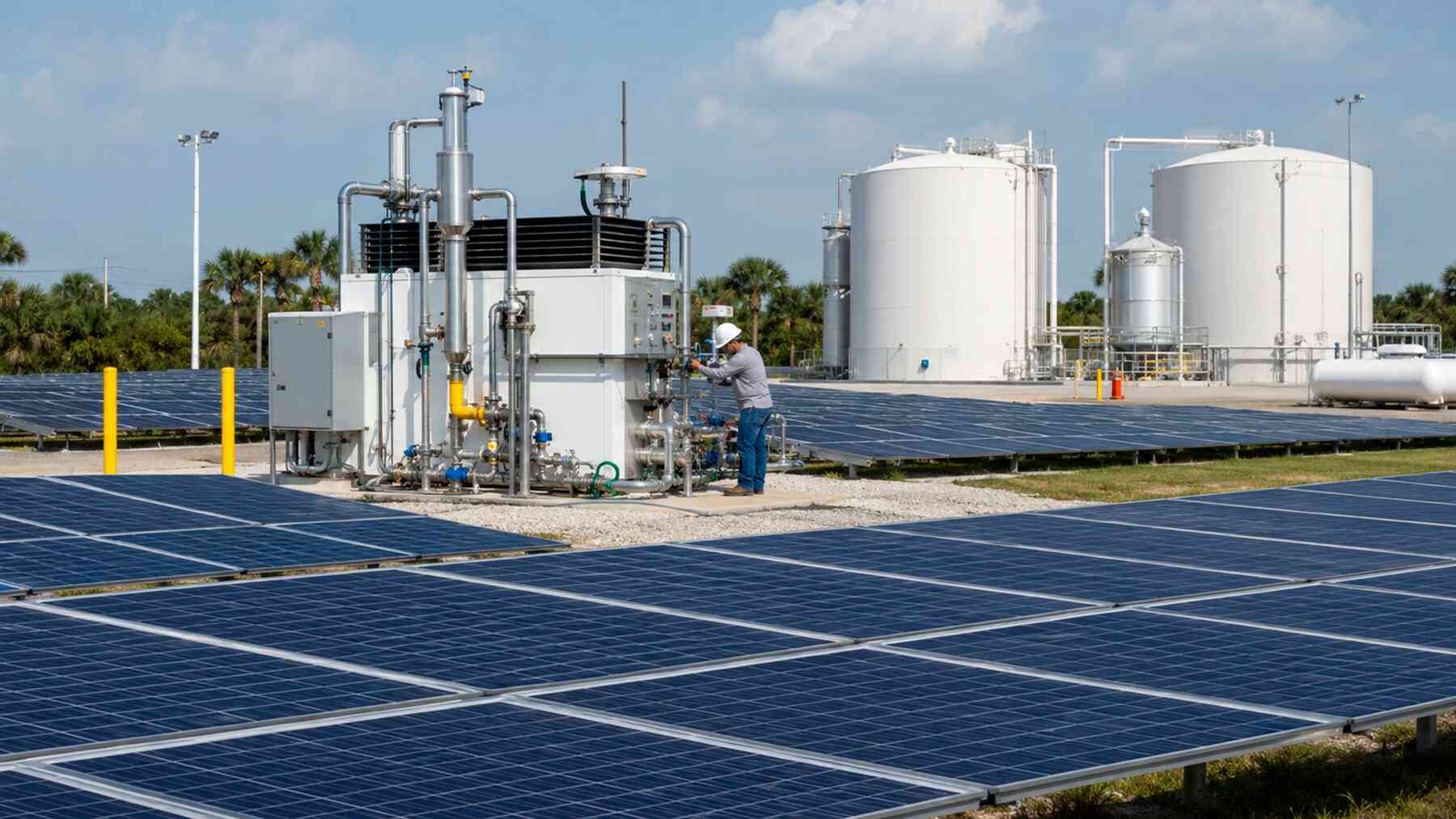 Credits: AI-made
Florida is home to a unique multi-purpose facility with a solar farm that does more than produce hydrogen.
Rising global electricity demand is necessitating a rapid expansion in renewable infrastructure.
Solar power is leading this growth, but its intermittent nature continues to present challenges.
Ultimately, the project paves the way for national utilities to successfully decarbonize existing gas fleets by upgrading existing infrastructure.
To help grids shift away from fossil fuels, highly scalable energy storage is required.
Could this facility in Florida finally help pave the way to achieving net-zero worldwide?
How solar is leading the global clean energy transition
Major economies and industries are increasingly adopting digitization.
This has led to a substantial increase in loads, straining regional power grids worldwide.
To prevent utilities from falling back on fossil fuels for backup electricity, renewable energy must urgently expand.
This way, nations have a better chance of meeting demand while simultaneously working toward achieving net-zero targets.
The renewable source leading the charge is solar power.
In one year, global solar generation increased by 636 terawatt-hours, a new record high.
Consequently, the source met 75% of the total net increase in the world’s electricity demand.
Favorable economics have driven this surge. Over the past decade, the technology became 90% more affordable.
This made utility-scale deployment highly cost-competitive with fossil fuel facilities.
Furthermore, projects are incredibly scalable to meet varying clean energy needs.
However, while it has become a key strategy in the energy transition, it still faces a primary obstacle.
Slowed progress due to chemical battery limitations
Solar energy’s greatest challenge is intermittency.
Seasonal changes, weather patterns that are becoming more unpredictable, and day-night cycles all contribute to this issue.
This volatility leads to a mismatch between clean power generation and when consumers use more electricity.
This consumption often peaks during the evenings. Grids are then forced to seek alternative sources.
To prevent grid instability, this gap must be bridged without compromising decarbonization goals.
Consequently, several nations began investing in solar and chemical battery energy storage systems.
These systems have proven highly efficient in balancing daily grid fluctuations.
Yet, chemical batteries offer short-term storage, presenting another limitation to overcome.
Most large-scale systems only discharge up to eight hours.
Additionally, chemical batteries experience more rapid degradation under extreme conditions.
Modern society is becoming more dependent on reliable, year-round clean energy.
To meet long-duration, high-capacity storage needs, Duke Energy turned to both solar and hydrogen.
A multi-purpose solar and hydrogen facility
Green hydrogen facilities are rapidly expanding.
However, a facility that handles the entire lifecycle on one site is unique.
This is what Duke Energy Florida’s first-of-its-kind system, the DeBary facility in Volusia County, does.
An integrated process with simple stages
A 74.5-MW solar farm powers two 1-MW electrolyzer units.
Solar energy splits water into oxygen, which is released into the atmosphere, and hydrogen gas.
The gas is captured, compressed, and added to on-site reinforced storage containers.
The gas does not lose its charge or degrade over time and is stored for days, weeks, or even seasons.
When electricity demand peaks, the stored hydrogen gas is released.
It is fed into an on-site combustion turbine, which burns the gas to produce electricity.
The turbine was upgraded with GE Vernova technology. The upgrade can either be scaled up to 100% green hydrogen or run a blend of it with natural gas.
The DeBary facility serves as an important backup system during peak evening hours.
Florida’s customers will enjoy a stronger and more reliable local grid with a much greener footprint.
The combination of solar power, localized storage, and clean combustion will effectively break the reliance on fossil fuels. Ultimately, the project paves the way for national utilities to successfully decarbonize existing gas fleets by upgrading existing infrastructure.
Anke Maree is a writer with a clear and engaging editorial style. Her work focuses on making complex topics accessible, informative, and relevant for readers across different areas of interest.
