
Fraunhofer IWES develops remote diagnostic tool for wind turbine power converter faults using converter control data
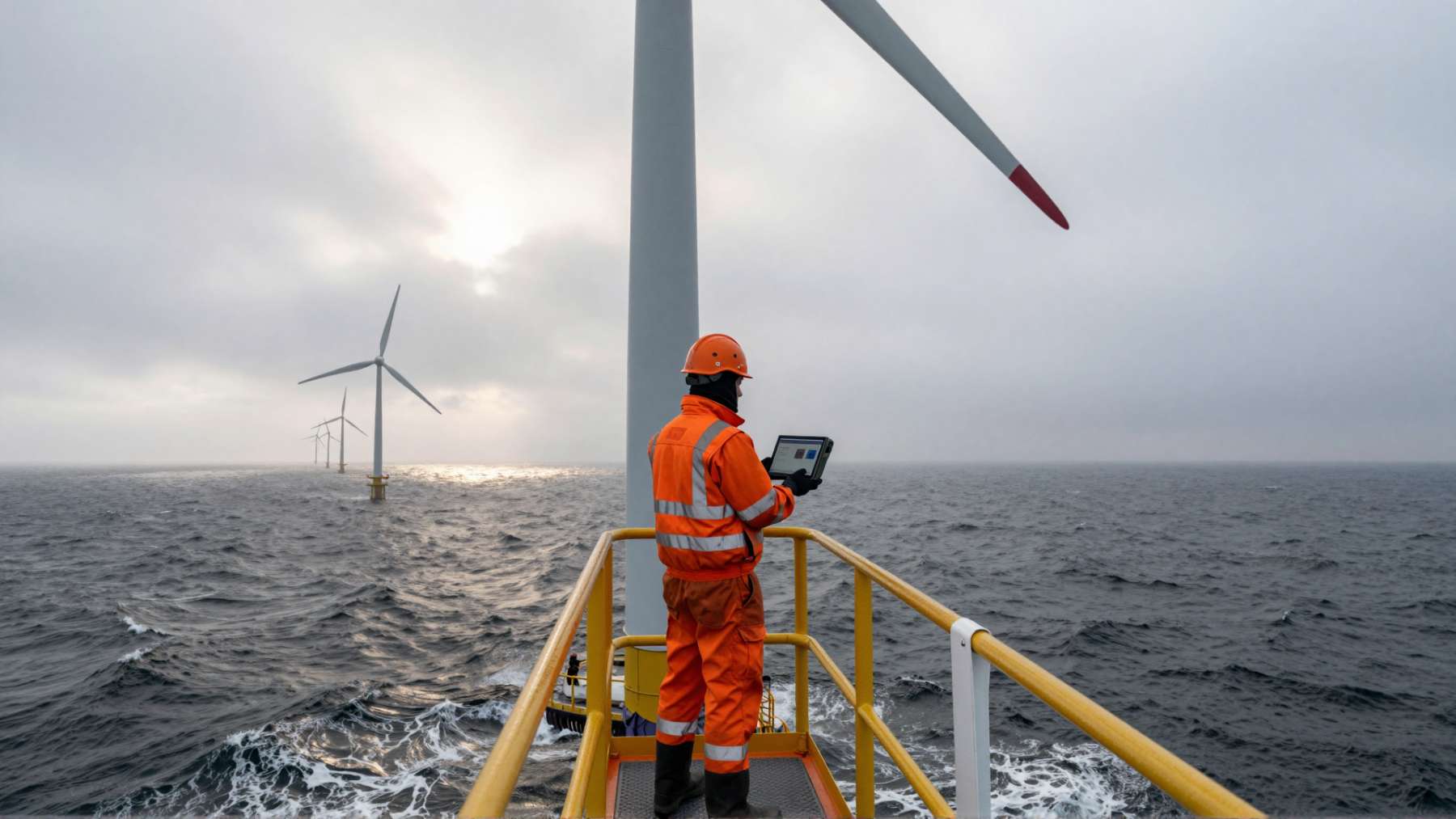 AI-made
When an offshore wind turbine shuts down due to a power converter fault, maintenance teams often have to visit more than once — first to assess the problem, then to fix it. Researchers at Fraunhofer IWES say they may have a way to change that. A new study published in Wind Energy Science presents a remote diagnostic workflow that uses data already recorded by converter control systems to classify fault severity before anyone sets foot on the turbine — reaching 89% accuracy with just four variables.
Study overview and findings
The study classifies converter-related turbine shutdowns as either short (under one hour) or long (one hour or more). That binary distinction matters because longer standstills typically signal more serious damage, and knowing the likely severity before dispatching a crew can change how maintenance teams prepare.
The dataset came from an offshore North Sea wind farm and covered roughly 100 converter fault events across approximately two years of operation — a small sample by machine learning standards, something the authors acknowledge directly. Even so, the results held up: a four-feature decision tree model achieved an accuracy of 0.89 and an F1 score of 0.86 in cross-validated testing.
Prototype approaches exist — covering semiconductor temperature, DC-link capacitor health, and humidity-related degradation — but none has reached market readiness.
The team deliberately chose interpretable methods — decision trees and logistic regression — rather than more opaque alternatives. Every decision node can be inspected and explained, which matters when the output is meant to guide real maintenance decisions.
Why power converter faults are a persistent problem
Power converters rank among the most failure-prone subsystems in wind turbines, onshore and offshore alike. According to data cited in the study, the failure rate sits at 0.21 converter system failures per MW of converter capacity per year — a figure that has remained stubbornly high despite incremental improvements.
What makes this particularly costly is the multi-visit problem. Technicians often cannot determine the failure mode or identify which spare parts are needed until they are physically at the turbine, meaning one visit to assess and another to repair — doubling travel time and extending downtime. The economic stakes grow with turbine size. Larger turbines generate more lost revenue per hour offline, and offshore sites layer on logistical complexity: weather windows, vessel availability, and transit time all push the duration higher.
Unlike mechanical drivetrain components, power converters still lack a commercially available condition monitoring system. Prototype approaches exist — covering semiconductor temperature, DC-link capacitor health, and humidity-related degradation — but none has reached market readiness.
How the diagnostic method works
The researchers drew from three data sources. High-resolution fast logs sampled at 4.5 kHz captured a 550-millisecond window around each fault trigger — from 350 ms before to 200 ms after. One-minute-resolution operating data covered a seven-day window on either side of each event. Fault flags extracted from converter event logs provided binary indicators of specific fault conditions active at the moment of each trigger.
From these sources, 864 features were engineered. A three-stage reduction process then cut that number down: low-variance features were removed first, highly correlated ones filtered out next, and a decision-tree inclusion-rate filter applied across 400 random subsamples brought the set to 34. Retaining only the features with the most extreme logistic regression coefficients reduced it further to four. Low-resolution operating data contributed little predictive value; the fast logs and converter fault flags did most of the work.
Implications for wind turbine maintenance
The practical goal here is improving the first-time fix rate — the share of maintenance visits where technicians resolve the problem fully on the first trip. Right now, that rate is undermined by uncertainty. Without knowing fault severity in advance, crews may arrive unprepared for what they find.
A remote severity assessment, delivered before anyone travels to the turbine, could shift that calculus considerably. Technicians who know whether a fault is likely minor or serious can bring appropriate spare parts and allocate resources accordingly. The authors suggest this could meaningfully reduce total downtime, particularly at offshore sites where each visit is expensive and weather-dependent.
The limitations are stated plainly. Roughly 100 fault events is a restricted basis for broad generalization, and validation across different turbine types and larger fleets will be necessary before the method could be deployed at scale.
The study frames this as a first step. The same data-driven approach could, in principle, be extended to identify specific failure modes remotely and predict which spare parts will be needed — moving from severity classification toward something closer to full pre-visit diagnosis.
Key takeaways
Fraunhofer IWES has demonstrated that converter control data already recorded by offshore wind turbines can support remote fault severity classification with meaningful accuracy. The four-feature decision tree model achieved 89% accuracy and an F1 score of 0.86 on roughly 100 fault events from a North Sea wind farm. Fast logs and converter fault flags drove the predictive performance; low-resolution SCADA-style data added little. The method is designed to be interpretable and practically deployable, with the explicit aim of reducing multi-visit maintenance cycles. Broader validation across larger and more varied turbine fleets remains the necessary next step before real-world adoption.

Carlos is an engineer with strong expertise in technical and industrial topics. He previously worked at international companies such as Siemens and is multilingual.
