
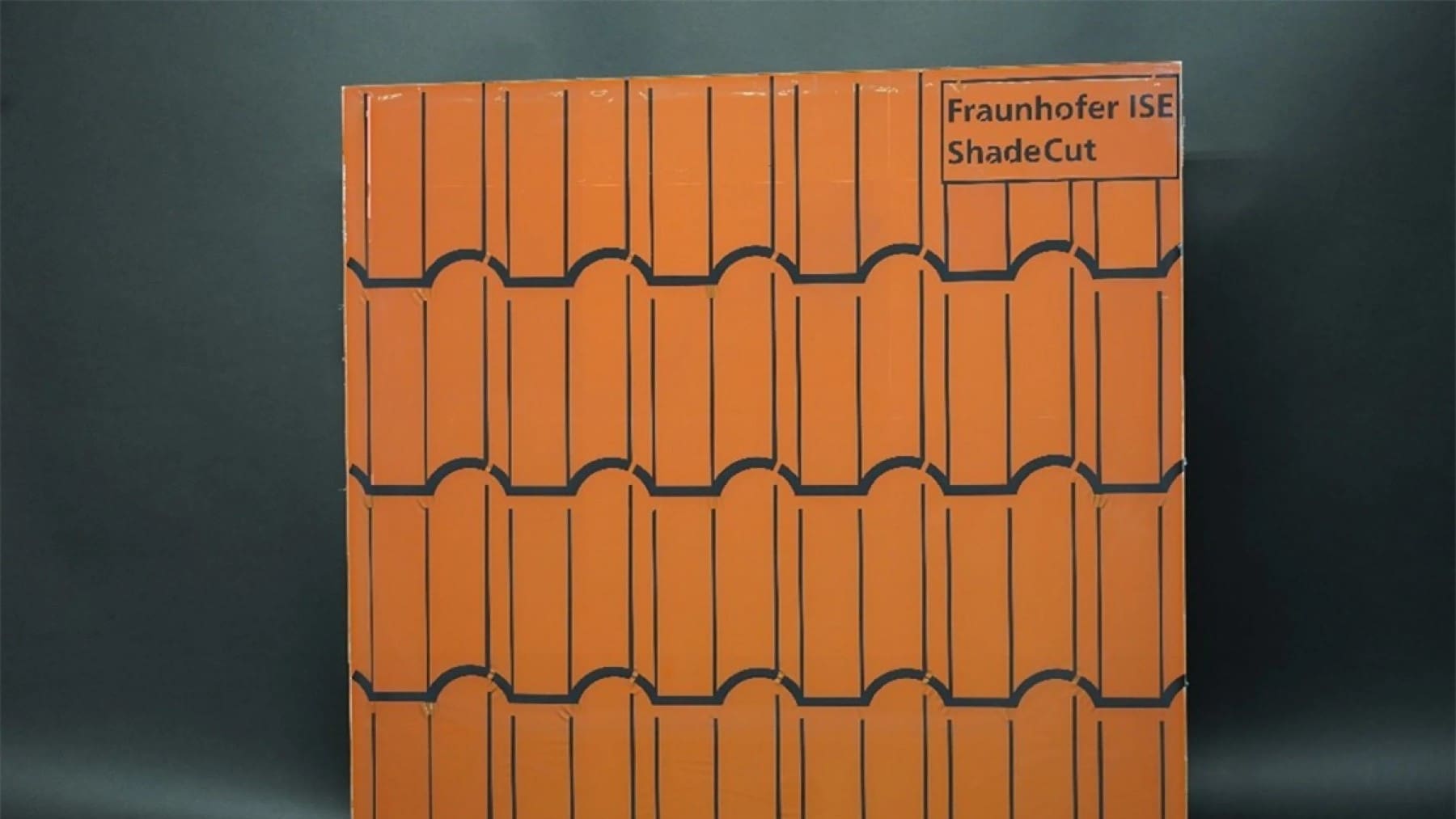
Fraunhofer’s new ShadeCut film lets solar panels mimic roof tiles and masonry while keeping 95% of their power output
 Credits: Marco Ernst / Fraunhofer ISE
 Solar panels have looked more or less the same for decades — dark, flat rectangles that generate clean energy but rarely win design awards. For historic buildings, ornate rooftops, and architecturally sensitive urban spaces, that visual bluntness has been a real barrier to wider adoption.
Now, researchers at Germany’s Fraunhofer ISE say they’ve developed a way to make panels blend into their surroundings — mimicking roof tiles, masonry, or custom patterns — while retaining up to 95% of their power output.
Colored film, almost no power loss
The core of the technology is a colored film that adheres directly to the surface of a solar panel. Developed by Fraunhofer ISE, a German research institute focused on solar energy systems, ShadeCut allows panels to mimic masonry, roof tiles, company logos, and intricate custom patterns — without sacrificing meaningful energy output.
MorphoColor instead employs a 3D photonic structure on the glass surface — a geometry designed specifically to maximize transmission rather than scatter it.
That last part is where the technology sets itself apart. Traditional coloring methods typically rely on diffusing foils that scatter incoming light in multiple directions, cutting efficiency by as much as 50%. ShadeCut panels, by contrast, retain up to 95% of their original power output.
The technology builds on Fraunhofer’s earlier MorphoColor coating, first introduced in a 2021 paper published in the IEEE Journal of Photovoltaics. ShadeCut is the next step — taking that coating science and reformatting it as a practical film applicable to panels already in the field, not just those coming off a production line. Dr. Martin Heinrich, who leads photovoltaics integration at the institute, has pointed to facades, rooftops, and even railings of historic buildings as prime use cases: places where solar potential exists but visual sensitivity has kept installations off the table.
The physics behind the illusion
What allows ShadeCut to avoid the usual efficiency penalty comes down to how MorphoColor interacts with light at a structural level.
Most colored surfaces reflect a broad range of wavelengths, which means a significant share of usable solar energy never reaches the cells. MorphoColor takes the opposite approach, using a highly selective thin-film stack engineered to reflect only an extremely narrow wavelength range — just the slice of the visible spectrum that produces the color you see. Everything else passes straight through to the photovoltaic cells underneath.
The precision required involves a phenomenon called destructive interference. The individual layers within the thin-film stack are measured with enough exactness that unwanted reflections — light that would otherwise bounce away as wasted energy — cancel each other out as their waves collide. Specialized transition layers within the stack also prevent light from bouncing around internally, reducing reflection losses further and keeping photons moving toward the solar cells rather than away from them.
The contrast with conventional diffusing foils is worth noting. Scattering light in all directions might seem like it broadens coverage, but it dilutes the intensity hitting the cells. MorphoColor instead employs a 3D photonic structure on the glass surface — a geometry designed specifically to maximize transmission rather than scatter it.
From lab coating to laser-cut film
The jump from a laboratory coating to a deployable product required more than scaling up production. The technology had to be reformatted into something flexible enough to work with existing hardware.
ShadeCut achieves this by adapting MorphoColor into a film applied directly to already-installed panels. Retrofitting is far more economical and logistically realistic than requiring entirely new installations — particularly for building owners who want to upgrade visually without replacing functional systems.
Laser cutting adds another dimension. Because the film can be cut with high precision, designers and architects aren’t limited to solid color fields. Complex multilayered designs, lettering, patterns, and branded graphics can all be applied to a module’s surface with the kind of accuracy that architectural and heritage applications demand. Dr. Heinrich has specifically highlighted historic buildings as a compelling target, noting that facades and railings on protected structures often face strict visual preservation requirements. A solar panel that genuinely blends into surrounding stonework — rather than sitting on top of it as an obvious modern addition — changes the regulatory and aesthetic calculus considerably.
Where disguised solar panels could show up next
The most immediate applications are likely in residential and commercial buildings where aesthetic objections have historically slowed solar adoption. The potential reach, though, extends well beyond private rooftops.
Public infrastructure represents a large and largely untapped surface area. Bus shelters, freeway overpasses, airport terminals, and transit stations all offer significant solar exposure, and many are subject to design standards or community input that has previously made conventional panel installations contentious. Panels that can match surrounding materials or carry custom graphics could shift those conversations in meaningful ways.
Heritage and landmark buildings present a particularly significant opportunity. In many jurisdictions, installing visible solar panels on protected structures is either prohibited or requires lengthy approval processes. ShadeCut could give preservation boards a viable path to approving installations that would otherwise be rejected on visual grounds — a niche that’s small by volume but high in symbolic importance for the technology’s credibility.
The remaining milestone is commercialization. Fraunhofer ISE hasn’t announced a specific timeline for when ShadeCut will be widely available, and the gap between a working research prototype and a product that builders, architects, and installers can readily access is rarely short. What to watch for next is whether the institute moves toward licensing the technology to panel manufacturers or pursues a more direct route to market — a decision that will largely determine how quickly ShadeCut moves from demonstration projects to rooftops and facades at scale.

Carlos is an engineer with strong expertise in technical and industrial topics. He previously worked at international companies such as Siemens and is multilingual.
