
A German wind farm started digging foundations for 19 turbines where no archaeological site was known, then one turbine pad suddenly gave up more than 150 amber beads and the jewelry of a Bronze Age woman buried beneath the landscape for thousands of years
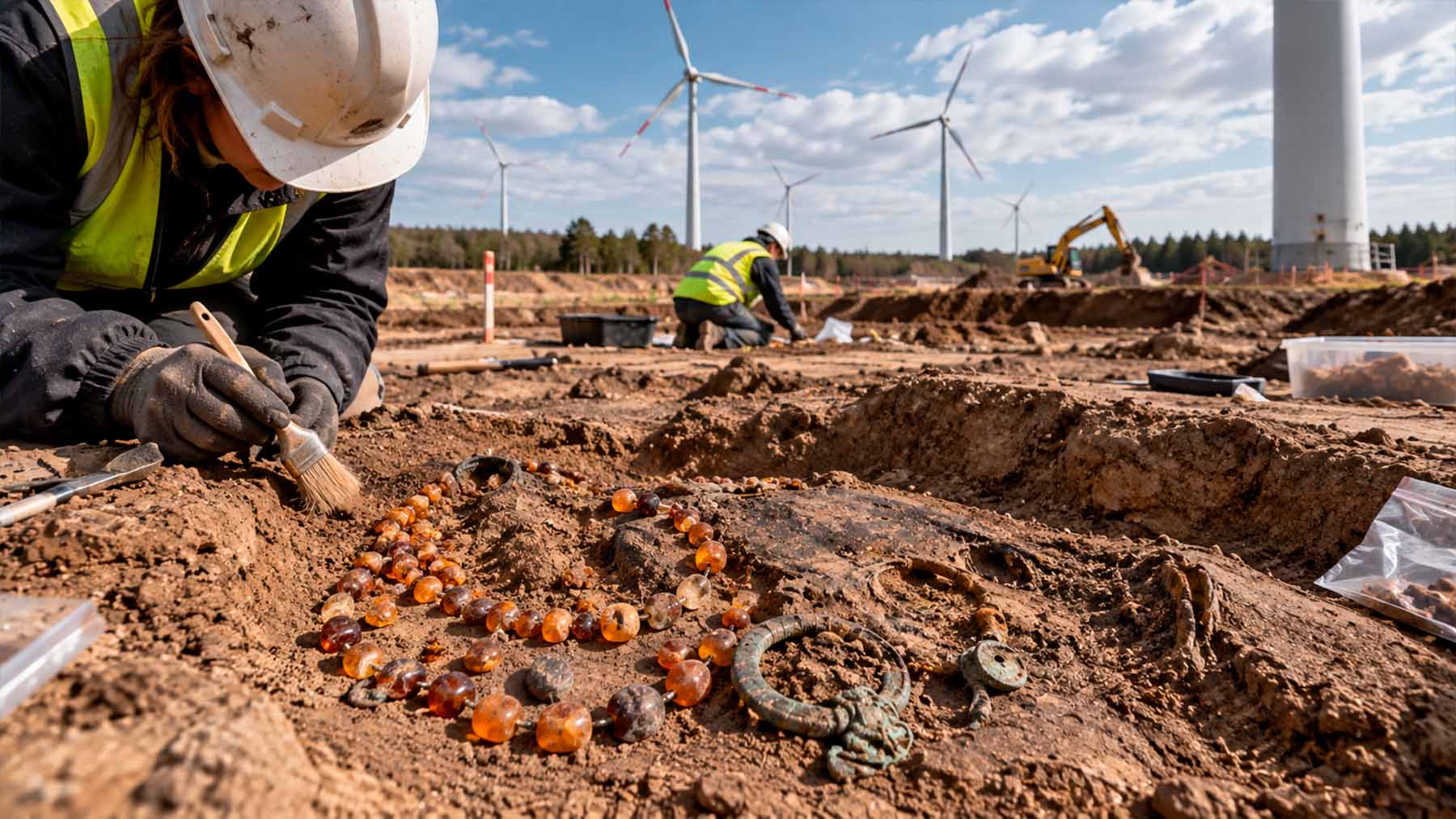 Image generated with artificial intelligence
The future accidentally collided with the past on a wind farm in Germany.
European nations like Germany are rushing to meet strict international climate regulations in the digital era.
The development stage often reshapes the landscape to ensure clean power can be secured for millions of people.
For example, Germany’s electricity demand has skyrocketed due to the rapid adoption of data centers and advanced technological infrastructure.
While many oppose this transformation, it can sometimes unearth deeply hidden layers of human history.
What unexpected artifacts did the German developers discover beneath the turbine pads?
How the digital age has transformed Germany’s energy needs
The world has experienced a variety of significant eras throughout history.
Many generations refer to some of those times as the greatest ever. However, there is no argument that the digital era is the one that has changed society the quickest.
This contemporary period is driven by cloud computing, artificial intelligence, widespread internet connectivity, and digital technology.
Beyond streamlining several operations and boosting convenience globally, it has also fundamentally changed energy requirements.
For example, Germany’s electricity demand has skyrocketed due to the rapid adoption of data centers and advanced technological infrastructure.
More than 2 percent of the nation’s power is consumed by data centers.
This surge in electricity consumption complicates national and international climate efforts.
Germany has an interim target of a 65 percent reduction in emissions by 2030 compared to 1990 levels.
Conventional power infrastructure cannot sustain higher power loads and clean mandates without violating emission limits.
This makes rapid renewable energy expansion a necessity.
When the need for green capacity growth faces local challenges
Wind energy has become a core pillar in meeting Germany’s ever-rising electricity demand.
Onshore development can be rapidly scaled across open terrain to provide high generation capacity.
But as wind technology increases in scale, it requires vast tracts of land to accommodate a wider-sweeping range.
The installation phase and access to the infrastructure also demand extensive acreage.
The need for such a large land footprint has often triggered strong community pushback, especially in Germany.
Noise pollution and aesthetic unpleasantness near rural vistas often lead to declining property values.
Beyond this, these projects also cause land fragmentation, intensifying public resistance.
This opposition has led to lengthy approval procedures and local zoning regulations.
However, once in a while, these utility-scale projects can end up unearthing historically significant findings.
This was the case with the wind farm project near Wolfenbüttel.
The State Office for Heritage Management of Lower Saxony oversaw the entire event.
The hidden treasure of the past beneath the wind farm of the future
When massive wind farm construction uncovers hidden pieces of history, the next steps must be carefully considered.
Heavy excavators were digging into the earth for foundation laying when the machinery struck a dense deposit of artifacts.
The developers handled the situation responsibly.
Excavation was paused at the turbine pad and heritage authorities were notified.
The Lower Saxony State Office for Heritage Management performed a block-lifting process to remove fragile items encased in earth.
Consequently, extraction could be done under controlled laboratory conditions.
The safe recovery of artifacts
Elite Bronze Age jewelry dating between 1,500 and 1,300 BC was uncovered.
It belonged to at least three high-ranking females, and featured:
- Arm spirals
- Sheet metal ornaments
- Decorated neck collars
- Disc pins
One necklace was strung with over 156 amber beads, making it the largest single Bronze Age amber find in Lower Saxony.
It highlights ancient long-distance trade networks connecting distant regions with Northern Europe.
Roman-era pits and 6th-millenium BC farming structures were also uncovered.
After the valuable artifacts were safely recovered, the wind farm resumed its construction, and the project was successfully completed.
Ultimately, this event proved that utility-scale wind projects can do more than provide high-capacity energy and meet climate targets.
Anke Maree is a writer with a clear and engaging editorial style. Her work focuses on making complex topics accessible, informative, and relevant for readers across different areas of interest.
