
Germany is erecting a 1,180-foot wind turbine in a former coal-mining region and will raise it like a telescope because no conventional crane can reach that high
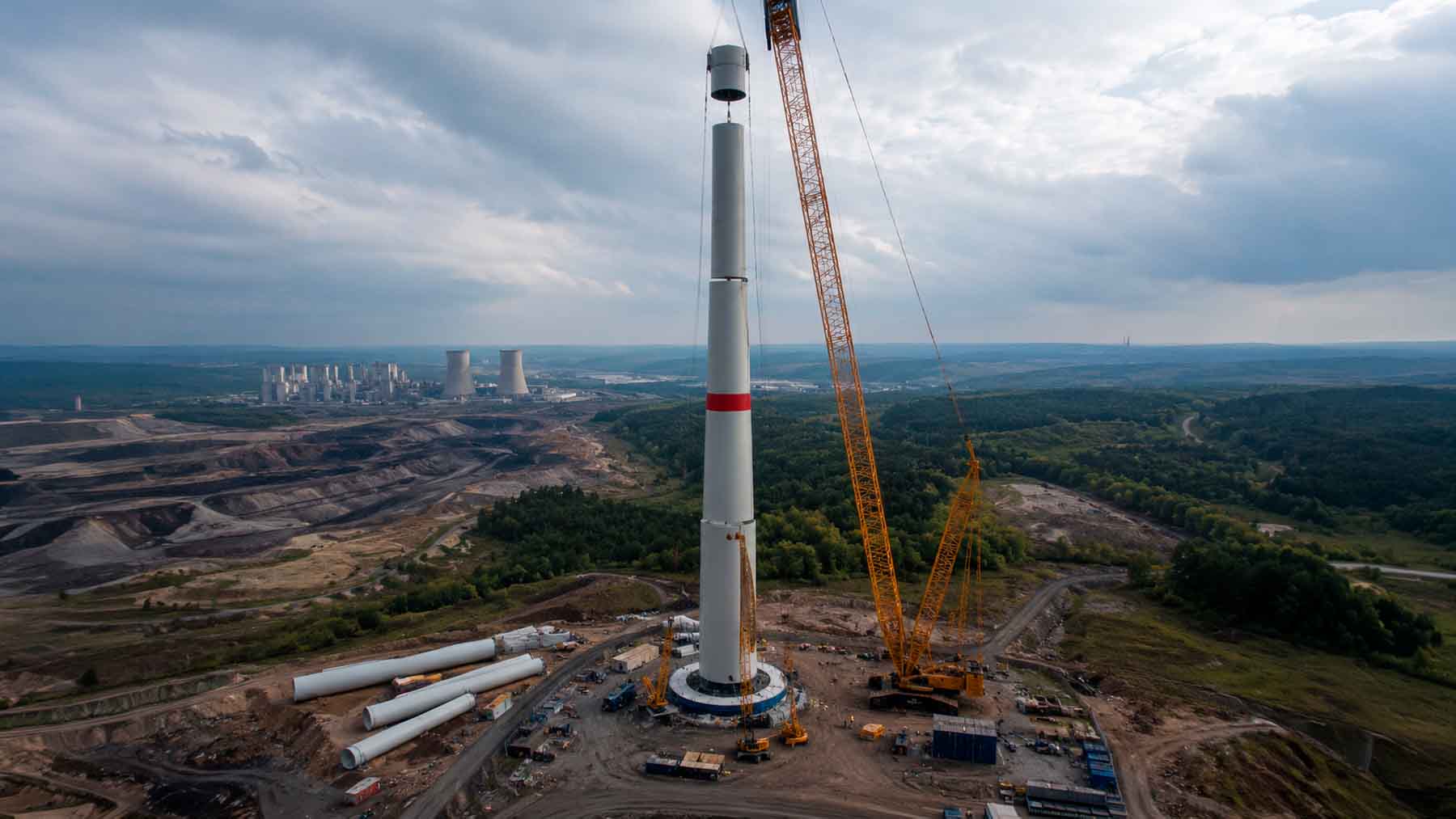 Image generated with artificial intelligence
Germany is transforming an old coal-mining region into a green hub with a giant wind turbine.
Globally, electricity consumption is surging at a significant pace.
To meet these demands while adhering to vital climate mandates, untapped sources of clean power are needed.
Ultimately, by erecting bigger turbines to harness stronger winds, former industrial centers can secure localized renewable power for many years.
In Germany, developers are turning to stronger winds by building taller structures.
Will this high-altitude shift reshape onshore energy production to help meet rapidly growing renewable energy needs?
How traditional renewable energy sources hit limitations
The global energy gap is growing significantly.
An imbalance between total energy supply and demand causes this gap.
Currently, global electricity consumption is outpacing the rate of new green power generation.
Utility operators tend to bridge this gap with fossil-fuel combustion.
These ongoing carbon-intensive processes particularly slow progress in achieving climate targets.
As industrial and transport electrification continue, and data centers expand, the problem is projected to worsen.
While traditional solar and onshore wind have greatly grown in capacity, they face complex physical barriers.
Solar facilities have an average capacity factor ranging between just 15% and 25%.
Meanwhile, conventional wind turbines operate in high-friction areas where wind speeds are lowered by up to 40%.
Some nations are densely populated, like Germany.
In these regions, the majority of land is reserved for agriculture or is under thick forest cover.
With limited land and low capacity factors, developers require alternative solutions.
Seeking new heights to meet demands and goals
In December 2025, Germany officially integrated the EU RED III directive into its domestic legislation.
Under this directive, EU members are to foster a more supportive regulatory framework for renewable energy production.
This is essential to overcome challenges presented by parties opposing green policies and projects. An example includes the far-right Alternative for Germany (AfD) party.
The nation’s Climate Change Act legally mandates cutting greenhouse gas emissions by 65% compared to 1990 levels.
Furthermore, Germany aims for climate neutrality by 2045.
This requires rapid decarbonization while meeting the surging national electricity demand.
Meeting these ambitious targets with limited space for green capacity growth is challenging.
As a result, the nation’s developers are turning to wind turbines, but at much higher altitudes.
At heights above 1,000 feet, wind speeds are up to 50% faster and more consistent.
Consequently, Germany’s Federal Agency for Breakthrough Innovation, SPRIND, has invested in a high-altitude wind turbine.
Constructing the world’s largest wind turbine
Germany’s old coal mine sites are actively being transformed into green energy hubs.
The historic coal-mining heartland, Brandenburg’s Lusatia region, is set to host the pilot project in Schipkau.
The wind turbine will reach a height of 1,198 feet, becoming the tallest turbine in the world.
Its primary purpose is to harvest strong, uninterrupted high-altitude winds.
This way, it aims to double the annual electricity yield compared to traditional onshore wind turbine models.
It will produce an estimated 30 to 33 GWh annually, which can power approximately 7,500 households.
However, the tall tower cannot be constructed with conventional mobile cranes.
Overcoming construction limits with a telescopic lattice tower system
Engineering firm GICON developed a telescopic system.
Using standard cranes, turbine components are assembled near the ground at heights of roughly 490 feet.
Once the generator and upper rotor are mounted, the inner tower is jacked upward like a telescope. This is done using an internal hydraulic system.
This enables the efficient deployment of record-breaking structures without needing specialized cranes.
This high-altitude wind turbine will facilitate multi-tier land use on a single footprint.
Solar panels, conventional turbines, and high-altitude rotors will be able to operate simultaneously without competing land claims.
For land-constrained nations such as Germany, this layered strategy will maximize green energy density.
Ultimately, by erecting bigger turbines to harness stronger winds, former industrial centers can secure localized renewable power for many years.
Anke Maree is a writer with a clear and engaging editorial style. Her work focuses on making complex topics accessible, informative, and relevant for readers across different areas of interest.
