
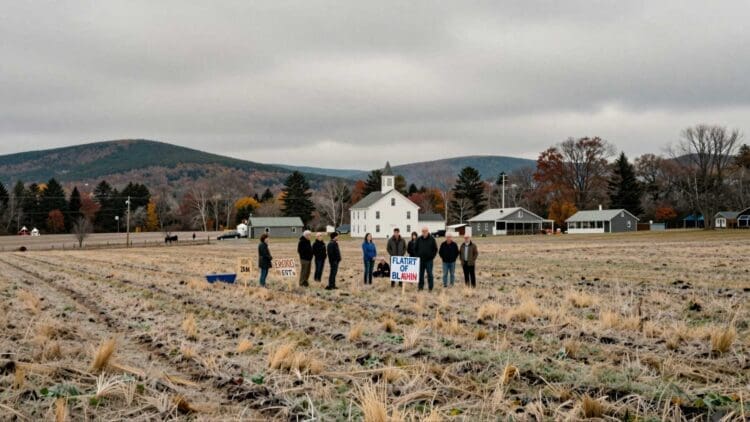

A proposed solar farm is dividing a Vermont town of roughly 800 people — and the opposition isn’t coming from climate skeptics. Northland Solar has filed for permits to build a nearly 5-megawatt installation on a 44-acre hayfield in Lowell, Vermont, a field residents use for sledding, carnivals, and summer fireworks. The select board, the local school, and a cemetery have all formally intervened against the project before the Vermont Public Utility Commission, which is expected to rule before summer 2025.
Solar permit application triggers formal opposition in Lowell
Northland Solar is seeking state permits to install nearly 5 megawatts of solar panels on the 44-acre Raboin family parcel in Lowell. The Raboins have been selling since 2023, and the site’s flat terrain, road access, and proximity to a substation make it a strong candidate for grid-connected solar development.
The opposition came quickly — and formally. Lowell’s select board, its only school, and a local cemetery have all filed as intervenors against the project before the Vermont Public Utility Commission. A ruling is expected before summer 2025, meaning the town’s fate could be settled before any broader public debate has had real time to develop.


Low tax revenue and lack of community consultation cited as key causes of opposition
For many residents, the numbers frame the argument clearly. Lowell’s existing 63-megawatt wind project generates roughly $600,000 in annual payments — money that has meaningfully reduced property tax burdens. The proposed solar farm, by contrast, would pay approximately $20,000 in annual state property taxes, plus a smaller municipal amount. Residents don’t treat that gap as a technicality. It is the central grievance.
The process itself has drawn sharp criticism. Before Lowell voted to approve wind turbines in 2010, Green Mountain Power held multiple community meetings and pledged to walk away if residents said no. Nothing comparable preceded the solar proposal. Because energy permitting is decided at the state level, a town vote on the solar project would carry no legal weight regardless — so residents who once supported the wind turbines say this project feels imposed rather than negotiated, a distinction that carries real weight in a tight-knit community.
Opposition affects project timeline amid Vermont’s renewable energy targets
Vermont covered roughly 75% of its electricity generation from renewables in 2024, but reaching its remaining targets requires adding new capacity quickly. Renewable Energy Vermont estimates the state needs 60 to 80 megawatts of new solar annually over the next four years; Vermont’s Public Service Department puts the figure at 42 to 50 megawatts per year. Either way, local resistance threatens to slow that pipeline considerably.
Lowell is not an isolated case. At least 498 renewable energy projects were contested across 49 states at the end of 2024 — a 32% increase from the prior year, according to Columbia University’s Sabin Center for Climate Change Law. Vermont’s Public Service Department commissioner acknowledged the tension directly, describing a pattern where communities support solar in principle, just not where they can see it.
Background: Lowell’s wind precedent, farmland concerns, and competing land offers
The 2010 wind vote remains the benchmark against which Lowell residents measure everything that has followed. Green Mountain Power’s approach — community meetings, a genuine withdrawal pledge — produced a yes vote and a project that has delivered tangible financial returns. That history shapes how residents read the solar proposal’s arrival, and not favorably.
Farmland protection has entered the conversation too. Republican state legislators have introduced bills that would prohibit solar installations on more than five acres of primary agricultural soils. Renewable Energy Vermont counters that 97% of projected Vermont farmland loss through 2040 will come from housing and commercial construction, not solar development.
The personal stakes are equally concrete. In 2023, a local resident offered $165,000 for the Raboin parcel to keep it in agricultural use; Northland Solar’s offer was reportedly around $280,000. The resident could not compete. When the town voted on whether to spend $50,000 hiring a lawyer to oppose the project, the result was an 86–86 tie. Officials subsequently identified unallocated budget funds and retained an attorney anyway.
Key takeaways
The Lowell dispute turns on financial equity, process, and land use — three issues that don’t resolve neatly. The proposed solar farm would generate a fraction of the tax revenue the wind project provides. It arrived without the community engagement that made the wind vote feel legitimate. And it would replace a field residents treat as shared public space.
The PUC will weigh those concerns against Vermont’s statewide clean energy obligations. Whatever the commission decides, the case points to a broader challenge: as renewable energy development accelerates, the communities closest to new infrastructure may bear costs that state-level policy does not fully account for.

Carlos is an engineer with strong expertise in technical and industrial topics. He previously worked at international companies such as Siemens and speaks Spanish, German, English, and Italian.