
Named ‘Luna,’ this sea dragon sails the ocean in a figure-eight pattern, generating enough clean energy to power 1,000 homes
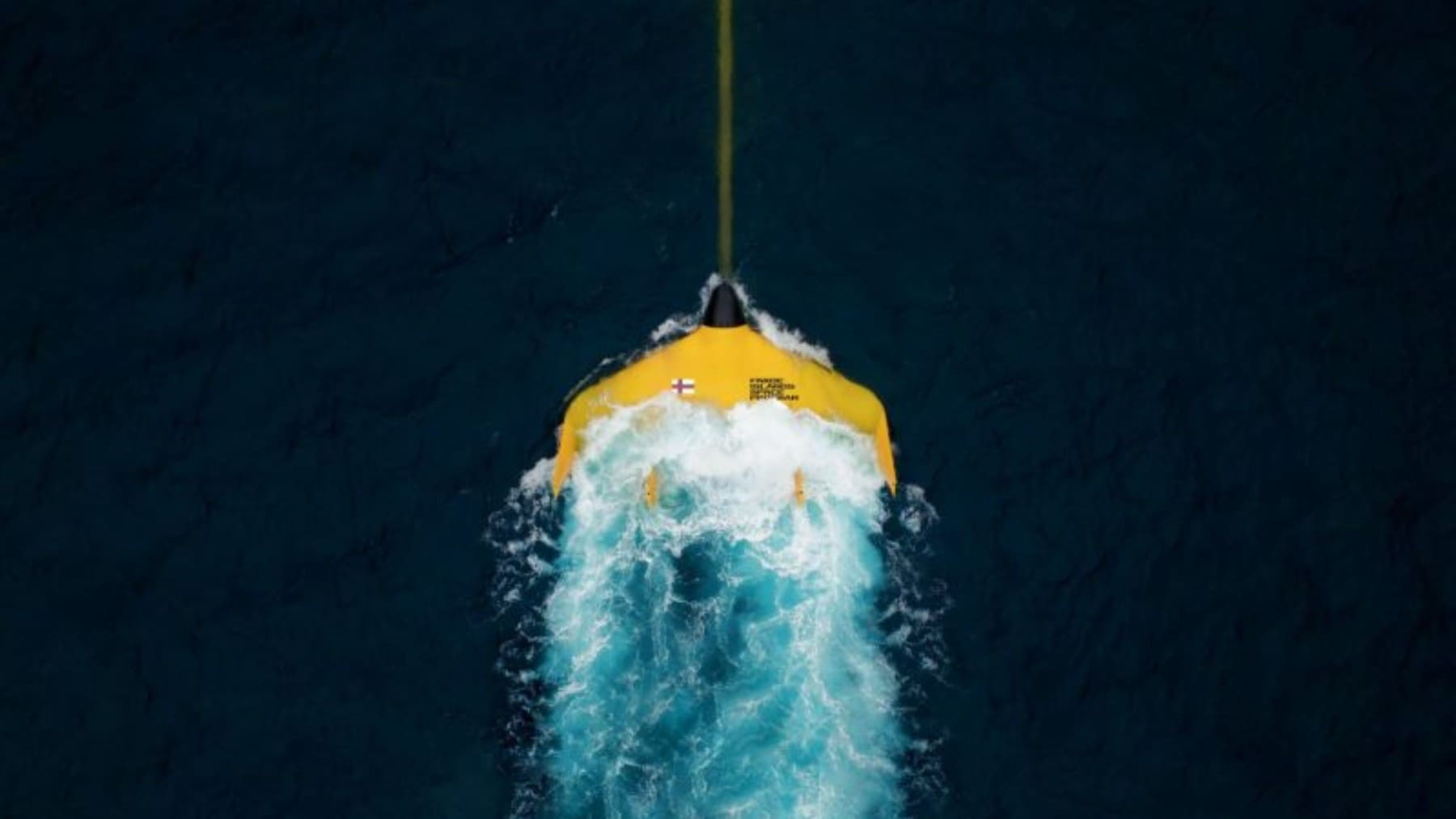 Credits: SKF/Minesto
The ocean offers highly predictable energy, and the Luna could soon harness it to power the world.
International climate targets have become stricter ever since the digital revolution.
The need for 24/7 connectivity has pushed the global electricity consumption to an unprecedented high.
Her work focuses on making complex topics accessible, informative, and relevant for readers across different areas of interest.
Renewable energy sources can satisfy these higher energy needs up to a limited degree.
Will the Luna be able to bridge the gap by generating enough ocean power?
How the digital shift has slowed climate goal progress
Widespread digitization has been years in the making.
Yet, for many, it may seem as if everything has gone digital overnight, especially during the global pandemic.
E-commerce, online banking, and remote work became essential to keep economies from collapsing.
Today, several of the world’s sectors are adopting digital networks to simplify operations.
Cloud computing, AI, and data centers have now become integral to society.
However, all of this has also transformed global energy needs.
Modernized systems function continuously and cannot endure temporary power interruptions.
This has led to a historic surge in electricity usage worldwide.
Consequently, meeting international climate targets has become more complex.
Global warming began to accelerate, as grid operators often turn back to fossil fuels.
To address this, climate mandates had to become significantly stricter.
National governments and tech companies are pressured to offset carbon emissions immediately.
Yet, conventional clean energy deployment may no longer be enough.
Trying to bridge a widening energy gap
Renewable energy capacity growth is rapidly being outpaced by modern consumption.
Solar and wind infrastructure is reaching major installation goals worldwide.
Yet, their total generation is being strained by surging digital demand.
The result is an unsustainable structural bottleneck for regional grids.
Intermittency is a persistent problem of solar and wind energy.
Even with large-scale battery storage systems, grids only receive temporary relief.
Accelerated climate change has triggered significantly volatile weather events.
These extreme conditions impact solar and wind production, as well as battery life.
Structural failures lead to lower output and electricity, widening the energy gap further.
To achieve global decarbonization while meeting power demand, developers must think outside the box.
For Minesto, this meant turning to the untapped potential of the sea.
The company engineered a unique device that generates electricity from ocean energy.
Its flagship model was recently upgraded, and Open Energy Information tracked its latest milestones.
The Luna and its figure-eight power generation pattern
Tidal energy relies on the invisible ocean currents and holds immense power potential.
To unlock it, Minesto created Luna, a flagship Dragon 12 tidal energy system.
It looks like an airplane, but it weighs 31 tons and has a 39-foot wingspan.
The technology is entirely underwater and is tethered to the seabed.
Its design enables functioning in low-flow tidal locations.
It moves with hydrodynamic lift forces of the ocean and is steered by an autonomous onboard control system.
Luna “flies” through the water using a predetermined figure-eight pattern.
The benefits of this continuous trajectory
The pattern travels an outer dimension of approximately 230 feet.
Furthermore, it enables a travel speed several times faster than the current speed.
The faster speed pushes a high volume of water through the turbine.
Consequently, electricity production is significantly multiplied.
The power is grid-ready thanks to the onboard direct-drive generator.
A seabed cable transmits the energy directly to the shore.
Recently, Minesto extended Luna’s subsea steel tether by 33 feet.
The structural upgrade marked a major milestone, as the device can now fly through stronger ocean currents.
The flow velocities increased, triggering a 25% performance boost in electricity production.
Its verified results show that predictable tidal energy can effectively scale to meet stricter climate goals. However, continued innovation will be needed to bridge the global energy gap.
Anke Maree is a writer with a clear and engaging editorial style. Her work focuses on making complex topics accessible, informative, and relevant for readers across different areas of interest.
