
Microphones listened to 13 Midwest solar farms for 17 weeks, and 10 of 13 grassland bird species were more likely to show up there than in the crop fields next door
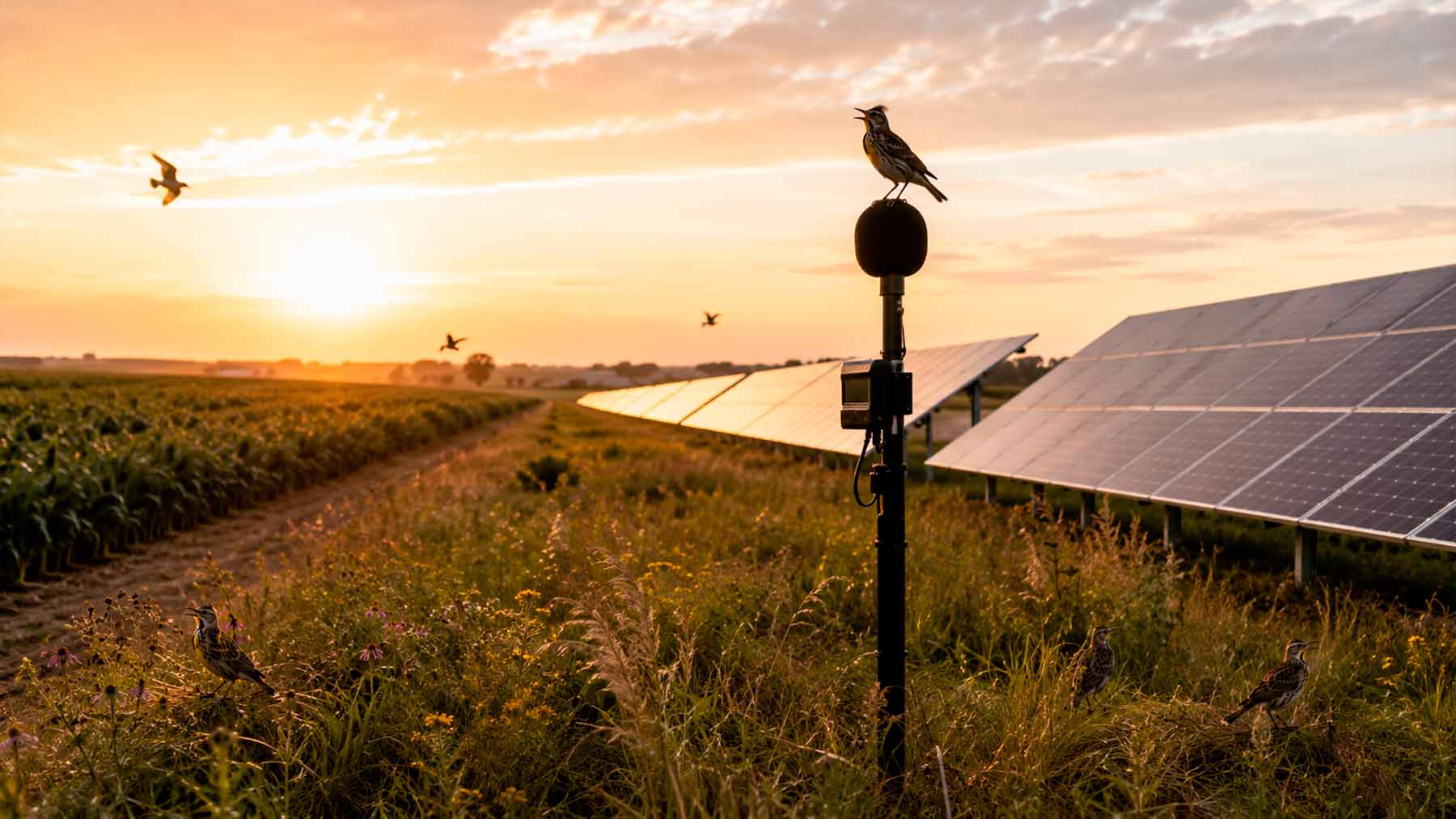 Image generated with artificial intelligence
Solar farms in the Midwest can successfully co-exist with native wildlife when using specific site designs.
Clean energy is booming across the United States to meet the ever-rising electricity demands.
While this is vital, it does come at a major spatial cost, increasing the risk of habitat displacement.
The latest research, however, reveals that local species can benefit more from these farms than traditional agricultural fields.
The latest research, however, reveals that local species can benefit more from these farms than traditional agricultural fields.
Can clean power expansion and habitat conservation truly synchronize?
How green capacity changed as American demand surges
The United States’ national power requirements have fundamentally changed.
The widespread expansion of digital networks and smart technology has caused a sharp rise in electricity consumption.
America’s total usage has reached 4,195 billion kilowatt-hours, and it continues to increase.
This is driven by industrial electrification, electric vehicles, and all AI-associated infrastructure.
For the first time on record, business electricity usage is predicted to outpace household usage.
Consequently, regional power grids are struggling to keep up nationwide.
Sudden fluctuations are becoming more apparent, increasing the risk of blackouts.
To prevent this, the U.S. electric sector is actively scaling up clean energy generation.
The EIA predicts that 86 gigawatts of large-scale capacity will be added to the grid.
Solar energy will account for more than half of these new additions.
Beyond meeting the nation’s immense power needs, it will also bring America closer to achieving its climate goals.
The greater the goal, the greater the risk of sacrifice
The U.S. has set very clear climate targets for 2030.
The nation aims to reduce greenhouse gas emissions by up to 52% below 2005 levels.
Scaling up solar infrastructure is vital to meet this climate goal.
But this ambitious mission comes with a major land cost.
Large amounts of new capacity must be added annually, which requires vast stretches of land.
Standard developments require hundreds or thousands of acres. This increases land-use competition, especially with agriculture.
Additional concerns come from environmental groups.
They argue that these clean energy goals must not come at the expense of habitat conservation.
When diverse rural landscapes are transformed to host thousands of solar arrays, local ecosystems can be disrupted.
While these concerns are accurate, they do not always have to be true.
Researchers conducted a study based on 13 Midwestern solar facilities.
The goal was to prove that they can support more wildlife than agricultural fields.
Midwestern solar farms became the more popular choice
Across various regions and sites, wildlife can interact differently with clean energy installations.
The 13 solar installations in the Midwest exemplified this.
The sites were compared with nearby crop fields, including maize and soy farms.
From May to September, over 17 weeks, the researchers tracked bird populations using passive acoustic monitoring.
The difference in terrain yielded clear results
The solar farms supported more grassland bird species than the agricultural fields.
From week to week, the bird populations showcased greater community stability at the panels.
Conversely, the farming control fields had much higher turnovers, as species constantly came and went.
Ten out of thirteen grassland species had a higher probability of staying at the solar facilities than the crop fields.
This is because native vegetation was restored beneath and around the panels.
This significantly benefited species like:
- Dickcissel
- Field Sparrow
- Savannah Sparrow
The study’s results demonstrate that green capacity growth does not have to compromise local wildlife.
Future photovoltaic projects can successfully integrate ecological restoration to boost conservation.
Developers are advised to prioritize native vegetation beneath the panels and limit chemical pesticide use.
Instead, sheep can be used to naturally trim overgrowth, which will also help natural soil fertilization.
Ultimately, creating thriving ecovoltaic habitats is key to meeting climate goals and conserving ecosystems.
The study’s findings can be viewed at APA CITE: Walston, L., Hartmann, H., Fox, L., Stanger, M., Steele, S., Narvaez, N., Szoldatits, K., Hogstrom, I., & Macknick, J. (2025). Ecovoltaic Solar Energy Development Can Promote Grassland Bird Communities. Journal of Applied Ecology, 62(12), 3341-3354. https://doi.org/10.1111/1365-2664.70208.
Anke Maree is a writer with a clear and engaging editorial style. Her work focuses on making complex topics accessible, informative, and relevant for readers across different areas of interest.
