
Ultrasonic microphones listened over 12 Midwestern solar farms and found the night was about 50% busier than over the crop fields next door, with hoary bats returning through most of the monitoring season
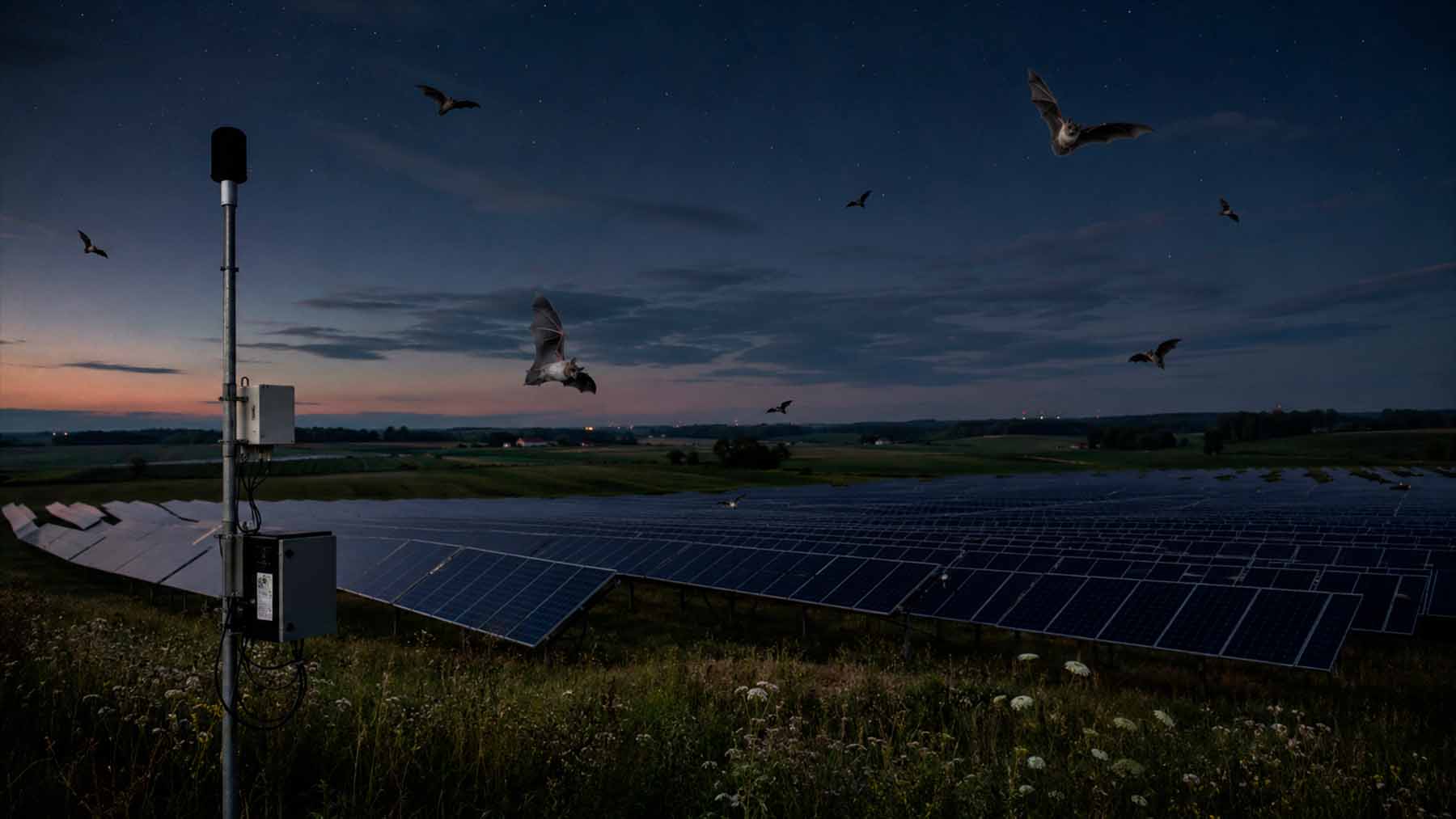 Image generated with artificial intelligence
Solar farms can support more nocturnal wildlife than traditional agricultural fields in the American Midwest.
The United States is actively expanding its green capacity, with a special focus on solar power.
This is essential to meeting surging energy demand sustainably, but requires a balance with biodiversity conservation.
This rapid deployment is important, as industrial and technological demand continues to soar, requiring several gigawatts to keep pace.
Native vegetation is being added to these facilities, prompting research on the effects on local bats.
Will these species benefit from the pollinator-friendly installations, or rather avoid them?
How green power is key to American energy consumption
The United States is becoming more digitized by the day.
This major technological shift is vital to maintain the nation’s competitiveness in the fast-moving international market.
Economic growth is driven by streamlined services, which significantly increase business activity.
While it certainly raises convenience for all, this modern transformation also adds pressure to the U.S. power grid.
Projections from the IEA indicate that electricity demand will reach over 4,200 billion kilowatt-hours.
With cryptocurrency operations becoming the norm, and AI and data centers expanding, this consumption will continue to increase.
Existing power plants are buckling under the immense loads.
New plants can be constructed, but it will take up to ten years. By then, it will be too late to prevent widespread blackouts.
A continued reliance on fossil fuels contradicts the nation’s climate targets anyhow.
As a result, utility-scale renewable infrastructure becomes lifesaving.
Installations such as photovoltaics play a particularly vital role.
Rapidly scaling up to bridge the energy gap
Large-scale solar capacity, paired with giant battery systems, is being quickly deployed to close the growing supply gap.
Developers are aiming to add more than 43 GW of new capacity in one year.
This will represent over half of the grid’s new power generation additions.
The benefit is that these facilities can be planned, constructed, and connected to the regional grid within a short period.
This rapid deployment is important, as industrial and technological demand continues to soar, requiring several gigawatts to keep pace.
However, expanding capacity at this rate does come with challenges.
Across the Midwest and Southwest, millions of acres are being transformed into high-yield photovoltaic plants.
The massive spatial footprint raises concerns about biodiversity loss.
Developers are implementing mitigation efforts, such as local vegetation growth.
But will this be enough to also save native wildlife, especially the nocturnal ones?
A team of researchers decided to explore this concern.
Deciphering bat behavior across Midwest solar farms
The research team from Argonne National Laboratory monitored 12 commercial facilities from 2023 to 2024.
They compared the data to reference agricultural fields across the Midwest.
To determine how many bats frequented the locations, ultrasonic recording equipment was deployed.
The microphones passively recorded bat echolocation calls during the night.
Tracking the nocturnal activity patterns at the solar installations and farm fields
The first half of the monitoring season took place from May to mid-July.
During this time, the solar sites had a 50% higher bat activity rate than the nearby crop fields.
This results from early-season farm tillage, when fields are bare and insect food sources are scarce.
Likewise, the native vegetation at the panels attracted more insects.
There was no evidence of avoidance across the Midwest solar facilities.
Bat activity varied across different species.
Hoary bats had the highest activity for most of the season, followed by big brown bats.
Silver-haired bat activity remained equal across both landscapes.
The study’s findings indicate that it is possible to have green infrastructure coexist with local wildlife.
By integrating native vegetation, biodiversity is restored. Additionally, solar farms are transformed into refuges and foraging grounds.
Ultimately, pollinator-friendly designs pave the way forward to boosting American clean energy while protecting nature.
For more information about the study, please review the APA CITE: Szoldatits, K. E., Walston, L. J., Hartmann, H. M., Fox, L., Stanger, M. E., Steele, S. E., … & Macknick, J. (2025). Bat activity at ecovoltaic solar energy developments in the Midwestern United States. Global Ecology and Conservation, e03864.
Anke Maree is a writer with a clear and engaging editorial style. Her work focuses on making complex topics accessible, informative, and relevant for readers across different areas of interest.
