
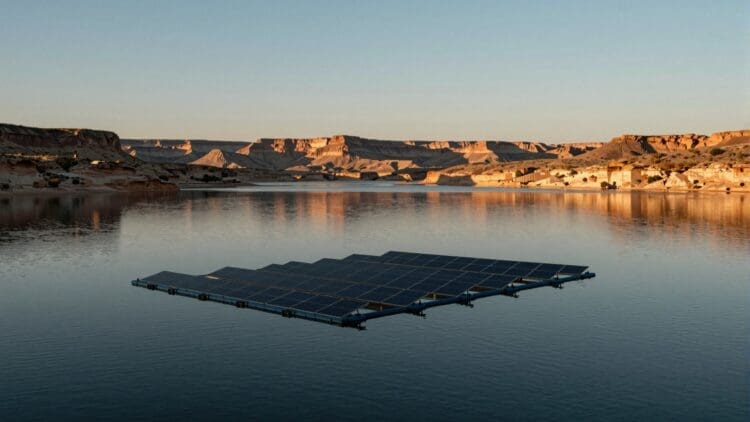

Across the American West and beyond, thousands of federal reservoirs sit quietly under open skies — their surfaces catching sunlight hour after hour, year after year. Most were built to store water or generate hydropower. But a new study from the National Renewable Energy Laboratory suggests these vast stretches of still water may be hiding something else entirely: an energy opportunity that, until now, no one had fully measured.
For the first time, researchers set out to calculate exactly how much solar power could realistically float on those federally controlled waters. What they found surprised even them.
A first-of-its-kind accounting
The study, published in the journal Solar Energy, was led by NREL geospatial scientists Evan Rosenlieb and Marie Rivers, along with senior legal and regulatory analyst Aaron Levine. Their goal was straightforward but unprecedented: apply a novel geospatial method to federally owned or regulated reservoirs and calculate how much floating solar energy each one could realistically support.


Prior estimates of floating solar potential existed, but none had filtered sites against real-world physical conditions. That gap left developers with numbers that looked impressive on paper but offered little practical guidance. The NREL team built those conditions directly into their analysis, and a public-facing tool called AquaPV now lets developers look up specific reservoir details and begin evaluating project feasibility.
The numbers behind the potential
The headline result is significant. Federal reservoirs could host enough floating solar panels to generate up to 1,476 terawatt-hours of electricity per year — enough to power approximately 100 million U.S. homes annually.
Rosenlieb is careful about how that number should be read. “That’s a technical potential,” he explained, meaning the maximum output if every qualifying reservoir were fully covered. Nobody expects that to happen. But even a fraction of that ceiling matters. “Even if you could develop 10% of what we identified,” Rosenlieb said, “that would go a long way.” Ten percent of 1,476 terawatt-hours still represents a substantial contribution to national clean energy targets.
Not every reservoir makes the cut
What separates this study from earlier, broader estimates is its filtering process. Sites where heavy shipping traffic generates wakes strong enough to damage mooring lines or floating infrastructure were excluded outright. Reservoirs that are too cold, too shallow, or have steeply sloping bottoms — which make it difficult to anchor panels securely — were removed as well.
This level of site-specific scrutiny is precisely what earlier analyses lacked. The result is not just a larger number but a more credible and actionable one. Developers using AquaPV are looking at a map of where floating solar could actually be built, not where it might theoretically exist under ideal conditions.
Why water and solar make a natural pair
Floating solar carries advantages that ground-mounted systems simply cannot offer. Panels resting on water don’t compete for scarce land — a real consideration in regions where available terrain is already contested by agriculture, development, or conservation priorities.
The water itself benefits too. Panels shade the surface below them, reducing evaporation and helping conserve water supplies. In drought-prone regions, that dual function could prove especially valuable.
There’s also the pairing with existing hydropower infrastructure to consider. A hybrid system combining floating solar and hydropower could smooth out the gaps each technology faces alone — when drought reduces a reservoir’s water level and cuts hydropower output, floating solar panels can keep generating electricity while the facility waits for conditions to recover.
What comes next for floating solar research
The study is a foundation, not a finish line. Rosenlieb and Levine acknowledge that their current analysis doesn’t yet account for how wildlife and human activity might affect development at specific sites — a limitation they plan to address in follow-up work.
Future research will examine proximity to transmission lines, site-specific development costs, and whether certain locations warrant protection for environmental reasons. The team also plans to expand its geographic scope, evaluating smaller reservoirs, estuaries, and potentially ocean sites.
The domestic industry itself still has considerable ground to cover. As of the study’s publication, no single floating solar project in the United States exceeds 10 megawatts — a figure that underscores just how early-stage this technology remains at home, even as larger installations operate across parts of Asia and Europe.
With a precise baseline now established and a public tool available for developers, the conditions for faster growth are taking shape. Whether the industry moves quickly enough to match the opportunity is the question worth watching.

Carlos is an engineer with strong expertise in technical and industrial topics. He previously worked at international companies such as Siemens and speaks Spanish, German, English, and Italian.