
Taiwan spent two decades building a wind energy fleet ambitious enough to anchor its clean power future. Turbines now dot its coastlines and hillsides, humming through typhoon seasons and feeding a grid hungry for carbon-free electricity.
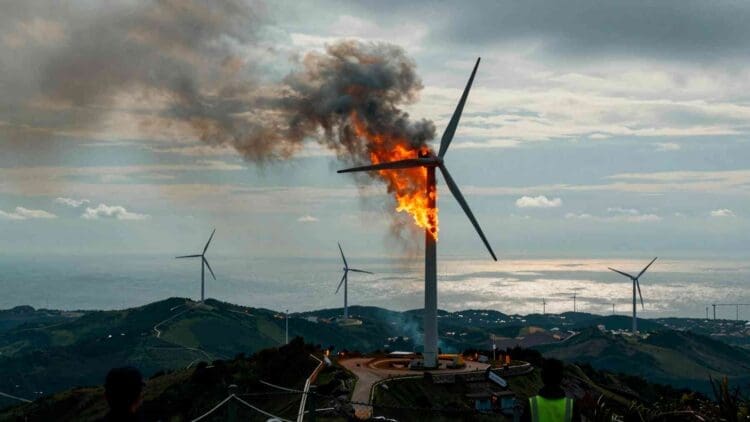
Then one of them caught fire.
The blaze was enough to prompt Premier Cho Jung-tai to act—ordering mandatory safety inspections of any turbine older than 15 years. It was a pointed reminder that the infrastructure powering Taiwan’s green ambitions is quietly aging and that the country may be approaching a reckoning it did not plan for.

A fire that forced a reckoning
The fire broke out at a wind turbine in Taiwan, drawing immediate attention from the highest levels of government. Images of a turbine engulfed in flames — a structure designed to generate clean power — carried unmistakable symbolic weight. For a country that has staked part of its energy future on wind, the sight was difficult to ignore.
Premier Cho Jung-tai responded quickly, announcing mandatory safety inspections of all wind turbines older than 15 years. The speed of that response signaled something important: officials already understood that aging infrastructure was a vulnerability. The fire simply gave them reason to act on it publicly.
The 15-year threshold: why age matters for wind turbines
Wind turbines are engineered to operate for roughly 20 to 25 years. But age is not simply a number—it represents accumulated stress. Rotor blades flex millions of times over their lifespan, and that repeated loading creates microscopic fatigue cracks that can quietly grow.
Environmental exposure compounds the problem. Salt air, UV radiation, and extreme weather — all of which Taiwan experiences in abundance — accelerate wear on blades, nacelles, and tower structures. Bearings degrade. Electrical components become less reliable.
By the 15-year mark, a turbine has typically moved through its most productive years and into a phase where maintenance demands increase noticeably. A component that holds up fine at year ten may behave very differently at year seventeen. Inspections that were once routine become genuinely consequential.
Taiwan’s wind energy buildout—and its aging fleet
Taiwan began developing wind power in earnest in the early 2000s, installing onshore turbines along its western coastline and in mountain passes where wind resources are strong. That early buildout was modest by today’s standards but laid the foundation for everything that followed.
Offshore wind development is now central to the island’s clean energy strategy, with targets aimed at substantially increasing renewable generation capacity in the years ahead. The consequence of that early start, though, is that a portion of the existing fleet has crossed the 15-year threshold. Those older turbines—mostly onshore—are the ones now subject to the premier’s inspection order, and keeping them running safely while building out new capacity presents a dual challenge Taiwan’s energy planners must manage simultaneously.
What the inspection program will involve
The government’s mandate covers turbines that have been operating for more than 15 years. Authorities are expected to assess structural and mechanical condition, looking for fatigue, damage, or deterioration that could pose a safety risk.
Turbines that fail to meet safety standards could face operational restrictions or be taken offline entirely. Decommissioning older units before the end of their theoretical lifespan is a real possibility — one that carries both safety benefits and energy supply implications. The inspections represent a formal acknowledgment that routine maintenance schedules alone may not be sufficient for the oldest units in the fleet, and this government-directed review adds a layer of oversight the industry has not previously faced at this scale in Taiwan.
A broader challenge for renewable energy infrastructure worldwide
Taiwan is not alone in confronting this. Many countries that installed large wind fleets during the early 2000s are now looking at turbines approaching or exceeding the 15-year mark. Europe has a significant stock of aging onshore turbines, and policymakers there have begun debating maintenance standards, repowering strategies, and end-of-life protocols.
Certain questions recur across borders: When does an aging turbine become a liability rather than an asset? Who bears responsibility for inspections and decommissioning? How do you retire old infrastructure without creating gaps in clean energy supply?
Taiwan’s mandatory inspection program may offer a model — or at least a reference point — for how governments can respond proactively rather than waiting for the next fire. As more countries reckon with the natural aging of their first-generation renewable fleets, the policy choices made now will shape both safety outcomes and energy security for years to come.
Kelly is an experienced writer with 15 years of experience exploring the big stories that shape our world, from tech breakthroughs and space exploration to climate, energy, and the fascinating quirks of science. She has a talent for turning complex ideas into sharp, memorable insights that stay with readers long after they’ve finished reading.