
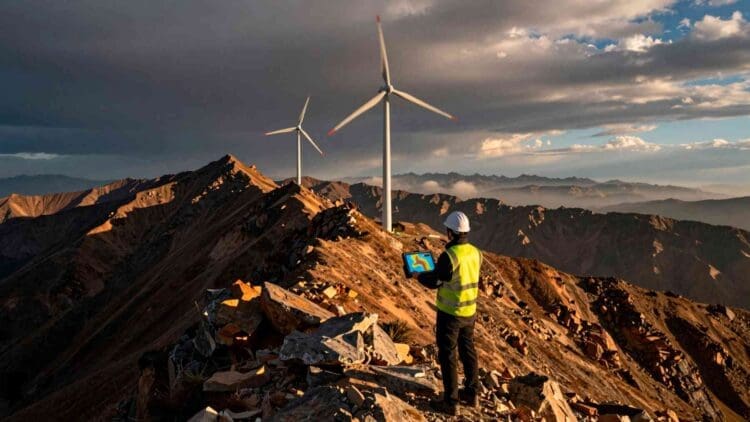

Mountain ridges offer some of the strongest, most consistent wind in the world — and some of the most stubborn engineering headaches. Predicting how air actually moves through rugged, irregular terrain requires simulations so computationally demanding that they can take days to complete, even on high-performance clusters. And even then, the sharp, localized turbulence that complex topography creates often slips through the cracks.
A new framework may be changing that calculus.
The mountain wind problem that has blocked renewable energy
Mountainous terrain is deceptively attractive for wind energy. Ridgelines accelerate airflow, and elevation keeps turbines above the roughest surface drag. But the same features that concentrate wind also fracture it. Sharp peaks, narrow valleys, and irregular slopes generate localized velocity gradients that shift dramatically over short distances — gradients that standard simulation tools struggle to capture cleanly.




Traditional computational fluid dynamics, or CFD, is the established method for modeling these flows. The problem is setup cost. Engineers must build a detailed numerical mesh conforming to the terrain’s irregular surface, a process that demands significant expertise and considerable manual effort.
Once that mesh exists, the iterative solver still needs hours or days of compute time on high-performance clusters. For a wind farm developer evaluating dozens of candidate sites, that timeline compounds quickly — pushing decisions back by weeks or months.
Why existing neural operator approaches fell short
Machine learning offered an obvious shortcut. Neural operators — a class of models designed to learn mappings between function spaces — can, in principle, replace expensive solvers with fast inference. Early approaches delivered on speed. Accuracy was a different story.
The core difficulty is physical. Complex terrain produces sharp, localized wind gradients that require fine-grained resolution to capture, and earlier neural operator models tended to smooth over these features. Predictions looked reasonable on average but missed the localized peaks and drops that matter most for turbine placement.
Generalization was another weak point: models trained on one set of terrain geometries often degraded noticeably when applied to landscapes they had not encountered during training. Speed and accuracy remained stubbornly in tension.
How the new transformer-based dual-attention framework works
The new framework, described in a preprint posted to arXiv, addresses both problems through a dual-attention transformer architecture. The researchers built two concrete instantiations: Patch-solver, which operates on points and requires no mesh, and Patch-GTO, which uses a graph-based structure. Both share the same underlying transformer logic.
Training relied on a large dataset of CFD-generated simulations spanning diverse terrain geometries and inflow conditions. That breadth was deliberate — the goal was a model capable of generalizing, not memorizing.
The mesh-free design of Patch-solver is particularly significant, since removing the requirement for expert-built grids eliminates one of the two major bottlenecks that make traditional CFD slow to deploy. The result is a system capable of predicting steady-state 3D wind fields rapidly while maintaining accuracy competitive with conventional methods.
Performance gains: faster predictions and real-world transfer
The numbers the researchers report are specific. On zero-shot transfer — meaning the model was applied to real-world mountainous sites it had never encountered during training, with no retraining involved — the framework outperformed existing neural operator baselines by 10% in relative error. For a task where generalization has historically been the hardest part, that is a meaningful margin.
The gains grow when sparse observational data enters the picture. Feeding the model sensor readings from just 1% of spatial points reduced prediction error by 16.89% compared to running the same model without that data. Against more advanced neural operator baselines on unseen terrain, the sparse-data version achieved a 32.75% error reduction — a figure that carries real practical weight. Weather station networks already exist across many mountain regions, and 1% spatial coverage is a realistic description of what those networks actually provide.
What this means for wind energy and atmospheric science
The researchers describe their framework as a generalizable computational paradigm, language that signals ambitions well beyond a single application. Wind resource assessment over complex terrain is the immediate target, and the case there is straightforward: faster, more accurate wind modeling could compress the timeline for siting decisions and reduce the development costs that currently make mountainous wind projects harder to finance.
The longer arc points further. The ability to assimilate sparse sensor data suggests a plausible route to operational deployment — where the model runs continuously against live weather station feeds rather than serving as a one-time planning tool. The underlying architecture, built around atmosphere-surface interaction, could also extend to broader questions in regional weather modeling and climate research. Real-world deployment will test claims that benchmarks cannot. But the direction this points is clear.

Carlos is an engineer with strong expertise in technical and industrial topics. He previously worked at international companies such as Siemens and speaks Spanish, German, English, and Italian.