
Thermal drones found roe deer crowding into one corner of a Polish wind farm, but the turbines themselves were not what the animals were trying to avoid
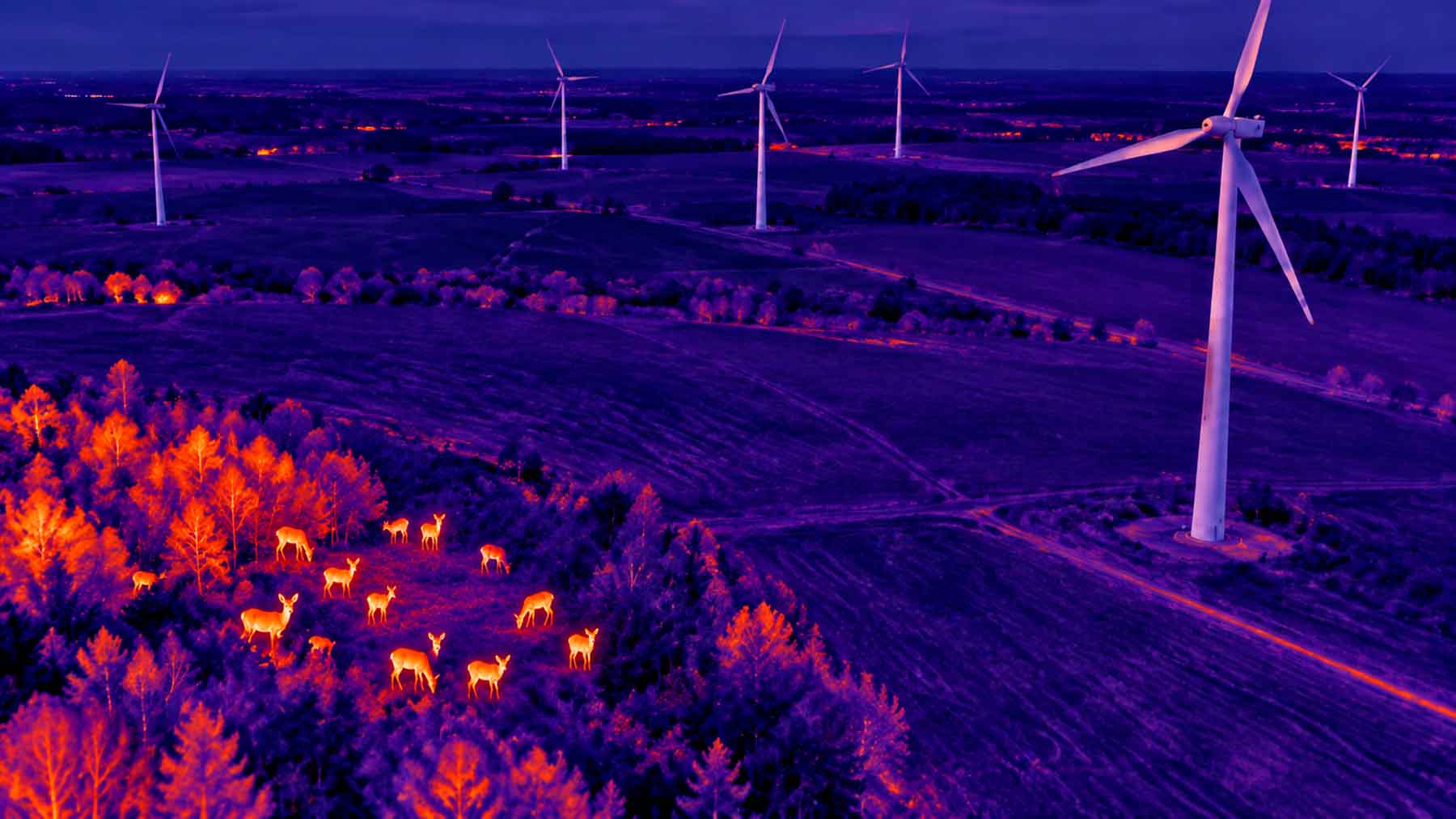 Image generated with artificial intelligence
A Polish wind farm has shown that land mammals like roe deer are also impacted by the enormous infrastructure.
Across many European countries, green capacity growth has raised ecological concerns over terrestrial species.
Wind capacity is rising rapidly at a large scale globally to meet unprecedented electricity demand while offsetting emissions.
Ultimately, proactive wildlife protection planning and management is key to ensuring Poland successfully accelerates its renewable energy transition.
In Poland, researchers addressed these concerns by monitoring roe deer behavior using thermal drones.
What factors caused the observed behavioral changes in these mammals?
How European nations are racing to meet modern power demands sustainably
The European Union (EU) has established strict climate targets under its “Fit for 55” framework.
This mandates reducing net greenhouse gas emissions by 2030 by at least 55% compared to 1990 levels.
For participating European nations, this creates intense regulatory pressure.
The Renewable Energy Directive adds to this pressure, mandating a minimum of 42.5% of renewables in the EU’s energy mix.
But this transition has not come easy to all nations.
Poland, for example, has a significant historical reliance on fossil fuels.
The country has increased its renewable energy footprint, but coal still accounts for over half of its electricity.
This is the highest coal consumption in the EU.
Replacing legacy fossil fuels has proven difficult, as modern domestic and industrial electricity demands continue to rise.
To keep grids stable and provide reliable power, these carbon-intensive fuels usually bridge the supply gap.
Balancing peak demand with decarbonization targets forces Poland to accelerate green expansion.
A growing need for large-scale wind power
Poland’s wind capacity is set to increase, as more turbine contracts are awarded.
Wind power is a core pillar of the country’s green energy strategy and the primary driver of renewable capacity growth.
By offering consistent power production and higher capacity factors, it stabilizes grids during critical times.
Since there is an urgency to boost large-scale wind power growth, Poland has invested in domestic turbine component production.
Beyond replacing fossil fuels, wind installations will help the nation strengthen its national security while lowering electricity costs.
Economically, wind generation will also increase local revenue.
Onshore wind targets have been set, with goals of achieving between 17 to 27 gigawatts by 2030.
But meeting these installed capacity and the EU decarbonization milestones is slowed by ecological challenges.
Utility-scale wind farms require vast tracts of land, often overlapping with natural habitats.
A study was conducted to monitor how terrestrial mammals respond to these giant turbine facilities.
Tracking Polish wildlife behavior with thermal drone technology
Land-based animals showcase different responses to industrial sites across different species.
In central Poland, Michalina Gmaj and Daniel Klich tracked the impacts on local roe deer during the summer.
The study used unmanned Aerial Vehicles (UAVs) equipped with thermal infrared and standard RGB cameras.
Animal distribution inside a wind farm was mapped and compared with a nearby control area.
A breakdown of the behavioral patterns of roe deer
The deer did not actively avoid the wind turbines. However, proximity to human settlements, roads, enclaves, and forests did dictate their movement.
Ambient noise and activity changed the animals’ social spacing.
Furthermore, inside the wind farm zone, the roe deer clustered together much more tightly than in the control areas.
As a result, core activity was almost 50% smaller than that observed in the control zones.
The study’s findings demonstrate that green energy capacity growth must focus more on local ecosystem protection.
While essential in curbing emissions, it should not compromise animal habitats and core activity zones.
These ecological impacts can be reduced or even prevented by integrating wildlife corridors, smart zoning, and acoustic dampening.
Ultimately, proactive wildlife protection planning and management is key to ensuring Poland successfully accelerates its renewable energy transition.
The research can be reviewed with Gmaj, M., Klich, D. Impact of wind farm on summer spatial distribution of roe deer Capreolus capreolus – a UAV-based study in central Poland. Eur J Wildl Res 72, 21 (2026). https://doi.org/10.1007/s10344-026-02060-4
Anke Maree is a writer with a clear and engaging editorial style. Her work focuses on making complex topics accessible, informative, and relevant for readers across different areas of interest.
