
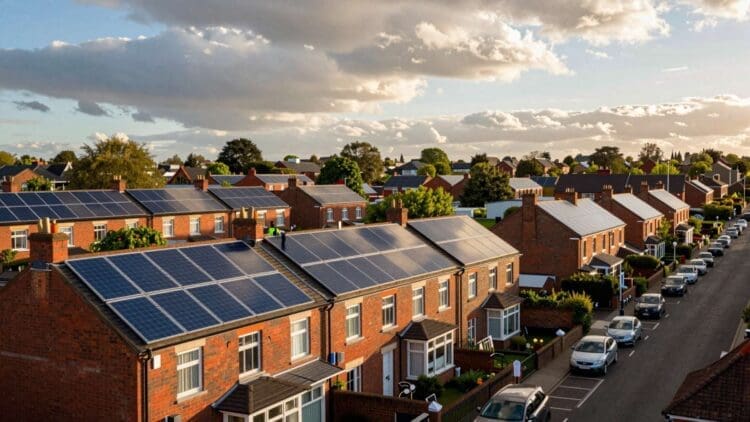

The UK completed 269,000 solar installations in 2025 — the highest total ever recorded in a single calendar year, and 37% more than the year before. Around 95% were rooftop systems fitted on homes, businesses, and other buildings, equivalent to a new rooftop installation every two minutes throughout the year.
Nine of the ten strongest months for solar deployment on record have all occurred within the past year.
UK sets solar installation record in 2025
The 269,000 figure marks a decisive break from previous trends. The UK has seen steady solar growth for years, but a 37% jump in a single year is something more than incremental progress. Around 255,000 of those installations were rooftop systems — approximately 95% of the total.



That rooftop dominance matters. The expansion is not being driven primarily by large utility-scale projects in fields or industrial zones — homes, businesses, and public buildings are becoming active participants in the energy system instead. One installation every two minutes, across an entire year.
War in Iran and fossil fuel volatility drive household uptake
The surge did not occur in isolation. The outbreak of the war in Iran sharpened public awareness of how exposed the UK remains to volatile fossil fuel markets, and that awareness appears to have translated directly into action.
April 2026 alone recorded nearly 23,000 new solar installations. More than half were on residential properties — a clear indication that households are increasingly choosing to generate their own power rather than remain dependent on imported energy. The UK also crossed a notable threshold in March 2026, surpassing 2 million total solar installations for the first time across homes, communities, and solar farms nationwide.
Lower costs and energy savings reinforce the trend
Cost has historically been one of the primary barriers to solar adoption. New annual government figures show the cost of acquiring and installing solar PV has decreased by up to 9% — modest on its own, but that reduction compounds the case for installation when weighed against rising energy bills. Rooftop solar is reported to save families up to £480 a month, making the upfront investment easier to justify for many households.
Government policy is reinforcing these economics on several fronts. The Springwell Solar Farm has been approved and is described as the largest power-producing solar farm in UK history. New homes in England will now be required to include solar panels as standard, embedding solar into the housing stock from the point of construction rather than relying solely on retrofitting. Plug-in solar panels — low-cost units that can be placed on balconies or outdoor spaces — are also being made available in shops, extending access to renters and those without suitable rooftops.
Businesses and public institutions join the expansion
The shift is not confined to households. Businesses and public services are moving toward solar at a notable pace, driven by both cost pressures and energy security concerns.
Numatic International, the manufacturer behind the Henry the Hoover brand, has launched a new solar park at its Somerset factory. The installation is expected to supply around 20% of the factory’s electricity demand — a meaningful reduction in its reliance on the grid.
Mid Cheshire Hospitals NHS Foundation Trust has installed rooftop solar projected to cut its energy bills by around £9,500 a year. Against a hospital’s total operating costs that figure may appear modest, but it reflects a practical, replicable model for public institutions managing constrained budgets. Wren Kitchens, meanwhile, is building what is set to become the UK’s largest factory rooftop solar array. A further 100 schools and colleges are also set to receive rooftop solar this year under Great British Energy’s existing scheme.
What the record means going forward
The 2025 figures establish a new baseline for annual solar deployment in the UK. The record is not simply a number — it reflects a convergence of falling costs, geopolitical pressure, government policy, and growing public appetite for energy independence.
Rooftop solar now accounts for the overwhelming majority of new installations, with households, hospitals, manufacturers, and schools all part of the picture. New homes are required to include solar panels as standard. Costs keep falling. The structural conditions that produced 2025’s record look more likely to persist than to reverse.

Carlos is an engineer with strong expertise in technical and industrial topics. He previously worked at international companies such as Siemens and speaks Spanish, German, English, and Italian.