
In Vienna, a roadside wall is swallowing traffic noise and turning it into enough electricity to power six homes for an entire year
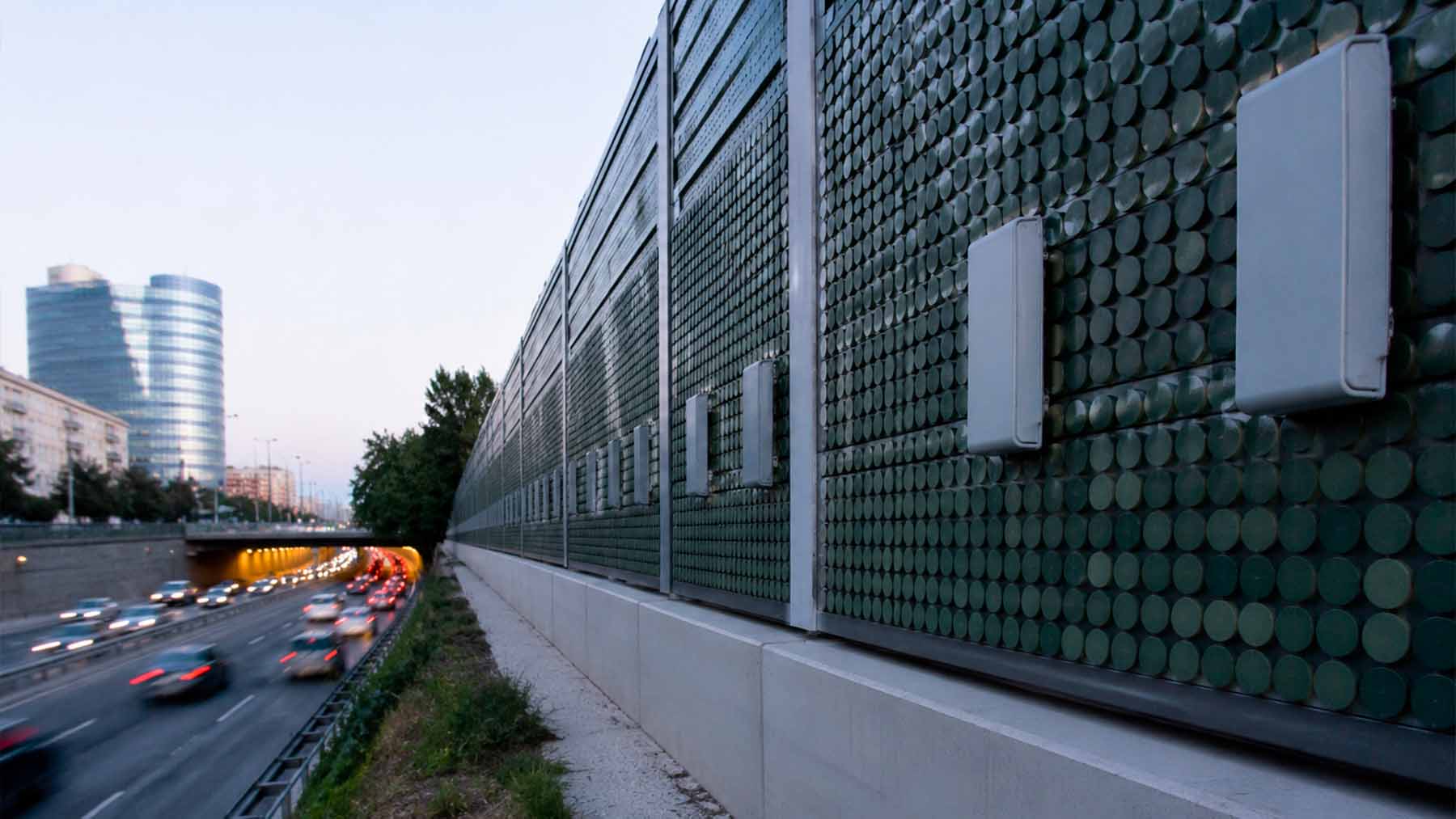 Image generated with artificial intelligence
The city of Vienna has deployed an innovative wall to address traffic noise and clean energy needs.
Worldwide, major cities are becoming increasingly dense, creating a dual challenge.
As space becomes more limited in concrete jungles, expanding renewable infrastructure becomes more complex.
Should the one-year monitoring study prove successful, the multifunctional design can be scaled across several global metropolises.
Meanwhile, the highly concentrated traffic creates an unhealthy level of noise, degrading public health.
Will installing multifunctional infrastructure with unique designs help overcome these typical urban issues globally?
How global urban regions are becoming more tightly packed
Major cities are expanding all over the world.
These regions are highly attractive due to the assurance of an improved lifestyle.
Good schools, better-paying jobs, and modern healthcare are primary factors driving the surge in urban inhabitants.
Currently, over half of the world’s population lives in metropolises.
This figure is set to increase to almost 70% by 2050.
This is because nearly 1.3 million people are moving into cities worldwide each week.
While this trend may drive significant economic growth, it also creates intense competition for physical space.
The denser the city, the more scarce vacant land becomes.
Housing, transportation networks, and essential utilities are squeezed into restricted footprints.
This is why large clean power facilities are rarely an option for land dedication.
In addition to decarbonization challenges, urban regions also experience significant traffic.
As districts experience higher congestion, specific health concerns begin to arise.
The hidden health challenges in cities
Heavy traffic congestion leads to higher road and pedestrian safety risks and increased emission levels.
Fortunately, these challenges are being addressed with innovative infrastructure upgrades.
However, one of the more complex issues is the constant background acoustics generated by traffic.
Traffic noise is more than a nuisance, as prolonged exposure to 55 decibels triggers chronic physiological stress.
Nearby residents and employees can experience higher blood pressure and elevated stress hormone levels.
At night, sleep cycles are disrupted, leading to anxiety, cognitive fatigue, and depression.
Furthermore, it can also contribute to long-term cardiovascular disease.
Since thousands of cars move through cities daily, decreasing urban noise pollution is structurally challenging.
The tall concrete buildings amplify the sounds throughout narrow street corridors.
Traditionally, solid barrier walls would be installed for mitigation, but they cut off communities and block sunlight.
The City of Vienna addressed this by constructing a unique wall design.
Vienna’s noise-blocking, electricity-generating wall
In Vienna-Meidling, the Altmannsdorfer Ast highway creates immense traffic noise.
Local authorities addressed this by installing a barrier made from wood-concrete and aluminum.
However, this wall also acts as a localized power plant.
Creating a quieter, greener environment
The wall reduces noise by roughly 6 decibels without closing off the neighborhood.
Its permeable design preserves natural light, allowing small wildlife and people to pass safely.
Furthermore, 70 solar modules are mounted on the structure.
They provide 19 kWp of capacity, generating enough clean power for six homes each year.
The €402,000 project was co-funded by Wien Energie and the city of Vienna.
The Austrian Institute of Technology optimized the wall’s sound absorption and solar yield.
Acoustic simulations, laboratory measurements, and variant studies were conducted.
Additionally, calculations indicated that the energy generated will offset the project’s carbon footprint within two years.
A one-year monitoring study will be conducted to evaluate the barrier’s real-world efficiency. Panel degradation and long-term impact on urban pollution will be tracked.
After being installed in 2025, Vienna’s solar noise barrier still operates as an active pilot installation.
Should the one-year monitoring study prove successful, the multifunctional design can be scaled across several global metropolises.
Its simultaneous performance in lowering noise pollution while addressing clean energy needs is already impressive.
Ultimately, this innovation can help major cities boost their tranquility while keeping carbon footprints low.
Anke Maree is a writer with a clear and engaging editorial style. Her work focuses on making complex topics accessible, informative, and relevant for readers across different areas of interest.
