
Researchers copied the scales of the world’s whitest beetle into a ceramic that reflects nearly all sunlight and could slash building cooling costs forever
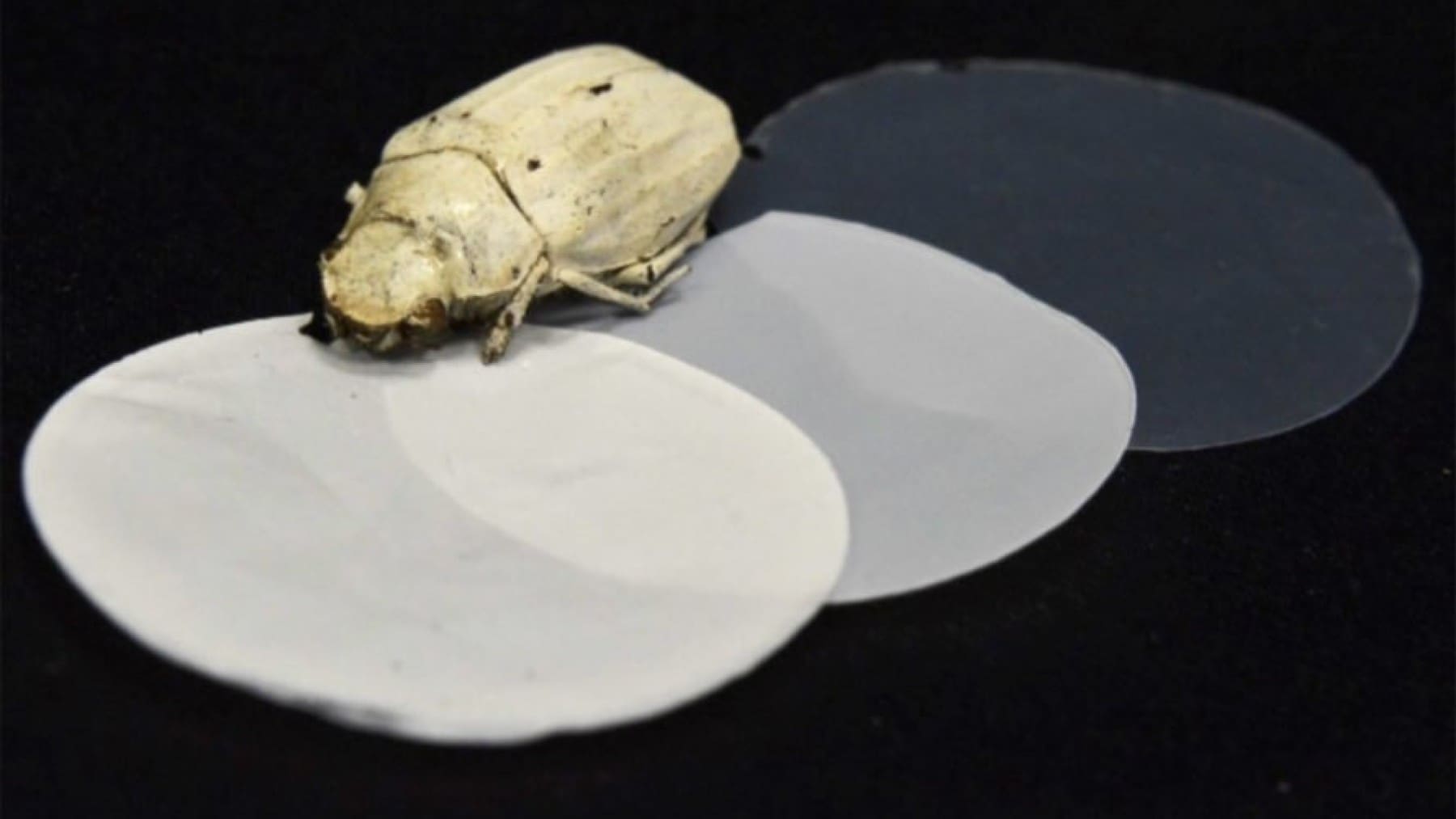 Credits: Cambridge University
 On a sun-baked rooftop in midsummer, keeping the building below cool can consume staggering amounts of energy — a problem that grows harder to ignore as cities heat up. The answer, it turns out, may have been crawling through the undergrowth all along.
Researchers at The Hong Kong Polytechnic University have developed a ceramic material that reflects nearly all incoming sunlight, drawing their design not from an engineering textbook but from the microscopic scales of the world’s whitest beetle.
A beetle’s scales rewritten in ceramic
The Cyphochilus beetle, native to Southeast Asia, is remarkable for one reason: its scales are among the brightest white found anywhere in nature. That whiteness does not come from pigment. It comes from a hierarchically porous internal structure that scatters light with extraordinary efficiency across a broad range of wavelengths — and the scales are thin, yet they outperform many engineered white surfaces.
It also demonstrates self-cleaning ability and favorable recyclability, characteristics that matter for building owners and the broader sustainability case alike.
Prof. Wang Zuankai and his team at The Hong Kong Polytechnic University studied this biological scattering system closely, with a goal of replicating its logic — not its exact chemistry — in a ceramic material. The result is a hierarchically porous ceramic architecture that mirrors the beetle’s light-scattering geometry at a microscopic level.
The findings were published in Science under the title “Hierarchically structured passive radiative cooling ceramic with high solar reflectivity.” The work represents a collaboration between PolyU and the City University of Hong Kong, with Prof. Christopher Chao serving as co-author alongside Prof. Wang.
Near-perfect reflectivity: what 99.6% actually means
Standard white roofing paint reflects roughly 80–90% of sunlight on a good day. The gap between that figure and 99.6% may sound small, but in energy terms it is significant — every additional percentage point of reflectivity means less solar energy absorbed by a building’s surface, and less demand placed on air-conditioning systems below.
The ceramic achieves this through the same hierarchical porous structure inspired by the beetle, scattering incoming light across the full solar spectrum rather than absorbing it or reflecting only select wavelengths. The material is also passive. No electricity, no moving parts, no active control system — it simply reflects sunlight and reduces the heat load entering a building, directly lowering indoor cooling demand.
Breaking the Leidenfrost barrier
The Leidenfrost effect is a well-known obstacle in high-temperature cooling. When a very hot surface contacts water, the liquid instantly vaporizes at the point of contact, forming a thin insulating vapor layer that prevents direct surface contact and dramatically reduces heat transfer. The hotter the surface, the more stubborn the effect becomes.
The cooling ceramic suppresses this through its super-hydrophilic, interconnected porous structure. Water spreads immediately on contact and penetrates through the pores rather than bouncing off on a cushion of vapor. The research reports that this suppression holds at temperatures above 800°C during evaporative cooling — the first time the Leidenfrost effect has been studied within the context of passive radiative cooling materials.
Prof. Wang noted that the hierarchical porous structure — similar to the membrane used in his earlier structured thermal armor research — is the key factor enabling the ceramic to draw in and evaporate liquid so efficiently. That scientific first broadens the design space for future passive cooling materials considerably.
Built for the real world
A material can be scientifically impressive and still fall short outside the laboratory. The research team appears to have anticipated this. The ceramic combines high weather resistance with mechanical robustness — two properties essential for any material expected to sit on a rooftop for years under sun, rain, and wide temperature swings.
It also demonstrates self-cleaning ability and favorable recyclability, characteristics that matter for building owners and the broader sustainability case alike. Fabrication is described as simple, which supports commercial scaling without prohibitive manufacturing costs.
The practical stakes are considerable. In dense, hot urban environments — exactly the kind found across South and Southeast Asia, the Middle East, and increasingly in Southern Europe and the Americas — cooling loads represent a major share of total electricity consumption. A roofing or cladding material that passively cuts that load, without ongoing energy input, could have a measurable effect on city-scale energy use.
What comes next
The ceramic currently sits at the research and early commercialization stage. Prof. Wang’s Research Centre for Nature-Inspired Science and Engineering at PolyU frames this work as part of a longer program: studying natural systems and translating their logic into materials that address real environmental challenges.
The combination of near-perfect solar reflectivity, Leidenfrost suppression, and practical durability in a single material is unusual. Whether it moves from journal pages to rooftops at scale will depend on manufacturing partnerships, cost benchmarking against existing cool-roof products, and field testing across diverse climates. Those are the steps worth watching.

Carlos is an engineer with strong expertise in technical and industrial topics. He previously worked at international companies such as Siemens and is multilingual.
