
Solar panels were laid across a quiet reservoir, and the world beneath the water slowly began to do something no one had planned for
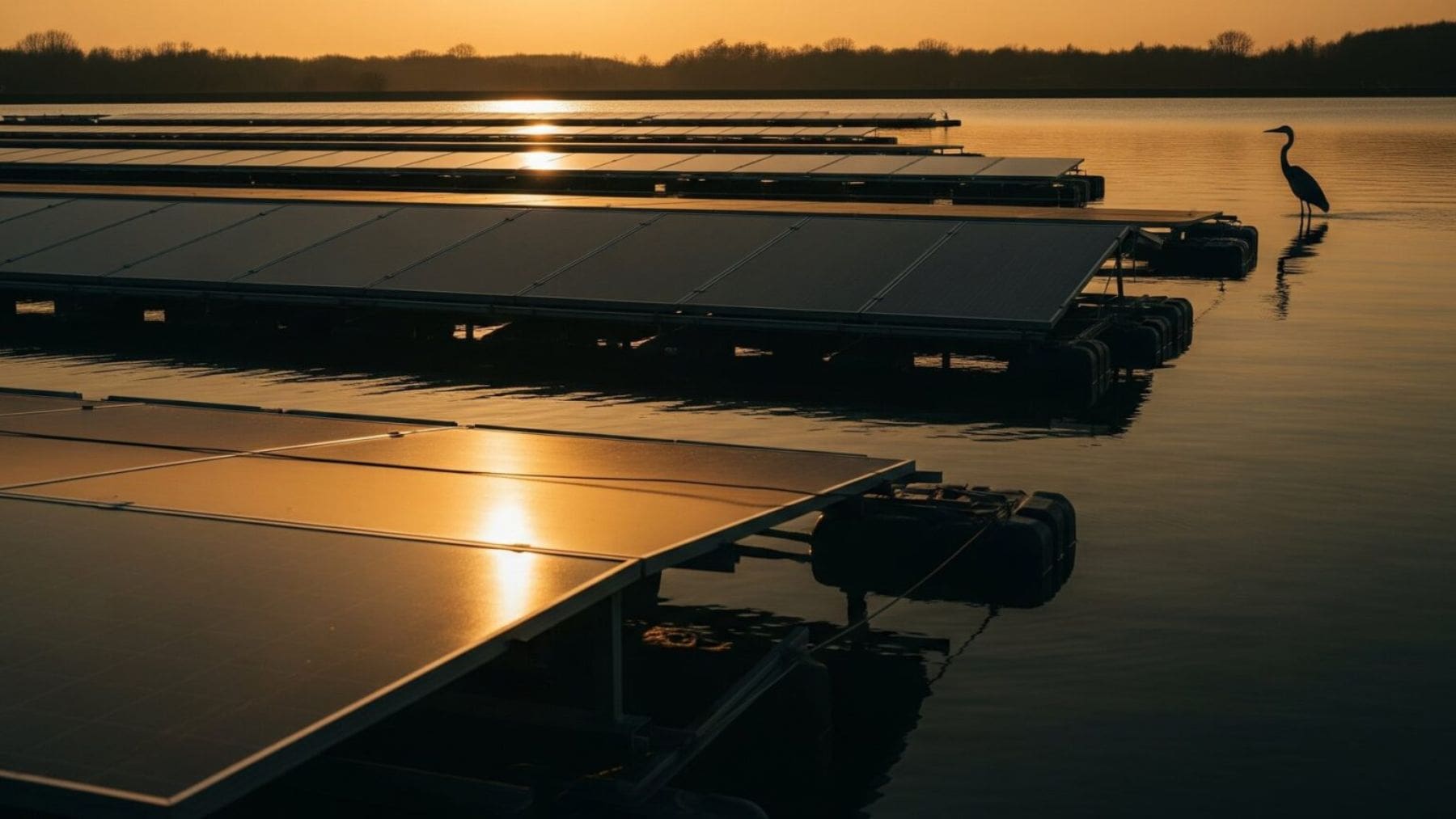
Something strange is happening just beneath the surface of America’s reservoirs. Thousands of dark panels now sit on the water, humming faintly with electricity. Nobody planned what would happen below them, but the underwater world, it turns out, had ideas of its own.
A power plant that floats
The idea sounds almost too clever. Instead of clearing forests or flattening fields to build a solar farm, engineers simply lay the panels on the water.
The reservoir does the heavy lifting, offering a ready made surface and keeping the panels cooler than dry land ever could.
A study by Oregon State University and the US Geological Survey found the systems consistently cooled surface waters and shifted temperatures at different depths.
That cooling is not a small thing. Cooler panels run more efficiently, which gives this approach a quiet edge over rooftop and ground systems.
The scale of the opportunity is hard to grasp. The United States has roughly 26,000 reservoirs of various sizes, covering about 25,000 square miles of water.
That is an enormous blank canvas. Even by conservative estimates, those reservoirs could host projects with capacities of up to 77,000 megawatts.
The potential is staggering, and the technology is spreading fast. But the water was never going to stay a passive stage.
The shadow no one mapped
When a panel floats on a reservoir, it does more than make electricity. It casts a shadow, and that shadow reaches all the way down. Shade changes everything in a body of water.
By blocking light, the panels starve the tiny photosynthetic organisms that drift near the surface. Those microscopic plants are the first link in a long chain.
That chain runs all the way up to the fish an osprey might pluck from the open water at dawn.
Less light can mean less algae for the zooplankton that graze on it. Fewer of those, and there are fewer small fish, and then fewer fish for the birds.
One shadow, and a whole ladder of lives begins to wobble. Scientists call it a cascade of ecological impacts, and they are only starting to trace where it ends.
A hiding place and a trap
Yet not every creature under the panels is losing out. Some are quietly thriving in ways no engineer ever sketched on a blueprint.
The rafts have become a kind of accidental architecture, and the animals are already moving in.
Researchers have watched fish gather beneath the floating arrays, using the dim cover to dodge bigger predators. A shady ledge over open water is excellent protection.
But the same shelter that hides small fish also crowds them together. That makes them easier to find, and an easy meal for the birds that hunt from above.
Scientists have spotted black crowned night herons resting on a floating structure before dawn, and cormorants jostling for the best perch.
The panels have become perches, lookout towers and hunting platforms all at once. So what exactly is this thing the wildlife keeps colonizing?
Floating solar and the reservoir beneath
The technology at the heart of all this has a name: floatovoltaics, solar panels mounted on rafts and anchored to the bed of a lake or reservoir.
Most installations sit on human made water bodies, with the rafts either tethered to the bottom or tied to shore. A study by Oregon State University and the US Geological Survey found the systems consistently cooled surface waters and shifted temperatures at different depths.
The same study warned that those changes introduced fresh variability in how suitable the water stayed for aquatic life.
There is a hopeful side too. The panels can curb harmful algal blooms by cooling the water and cutting the light that feeds them.
For anyone who has watched a toxic green bloom choke a lake, that is a genuinely welcome surprise. Just as ground level solar farms reshape the soil below them, floating arrays are reshaping the water column above their anchors.
And the math is dizzying. Covering 30 percent of US reservoir area could generate 1,900 terawatt hours of energy and save 5.5 trillion gallons of water a year from evaporation.
The water is still writing the story
The honest truth is that scientists do not yet have all the answers. More research is needed to understand the full risks and rewards of dropping a young technology into a living aquatic system.
A reservoir is not a machine. It is a living thing, and living things rarely follow a plan.
Early monitoring offers some comfort. In the first months of operation, fish kept circulating through both shaded and open zones, invertebrates stayed present, and bird activity showed no dramatic shifts.
That is reassuring, but it is still an early chapter in a long book.
The bigger picture feels like an experiment unfolding in real time. Floating solar could power millions of homes and shield precious water in drought stricken states.
Much like the solar farms on land that became unexpected sanctuaries, these water based arrays may shelter far more than electricity.
The fish are still deciding what they make of their new metal canopy. For now they keep swimming, the panels keep generating, and the reservoir holds its breath somewhere in between.

Carlos is an engineer with strong expertise in technical and industrial topics. He previously worked at international companies such as Siemens and is multilingual.
