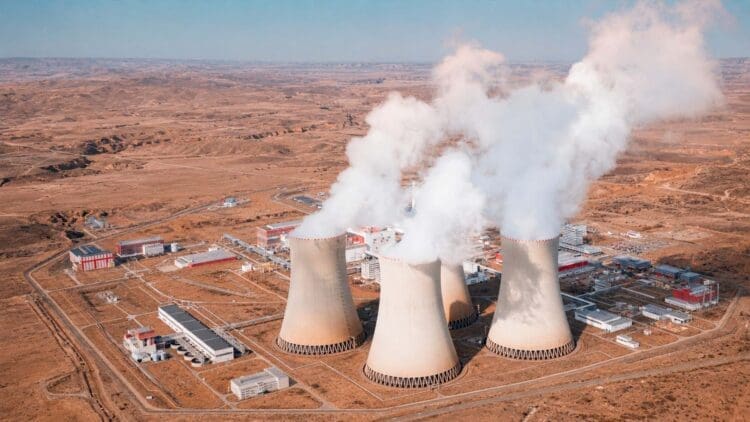

England was ready to secure its energy future with nuclear power.
But then an archaeological mystery was uncovered.
The UK has been stuck in its fossil fuel past for too long. Now, it’s actively transforming its energy portfolio.




The nation has been exploring a variety of green projects, with some providing a glimpse into its rich history.
Will the discovery of ancient sites create a conflict for England’s clean energy goals?
How the UK’s past is shaping the future of its grid
The United Kingdom was one of the first nations to experience the Industrial Revolution.
But this meant a foundation built on coal.
For over a century, the national grid has developed with this “carbon past.” It gave rise to massive, centralized power plants near mines and waterways.
It is difficult to pinpoint exactly when the UK knew that it was time for change, as several factors contributed.
Environmental, economic, and practical reasons drove the preference from coal to gas.
The nation’s gas imports increased. So did its vulnerability to unpredictable supply chains and geopolitical tensions.
As the climate crisis worsened, international climate mandates became stricter.
Now, the UK is actively pursuing its 2050 Net Zero targets while its aging infrastructure is being dismantled.
As it looks toward the future, nuclear power plays an integral role in achieving its goals.
From industrialization to rapid digitalization
The quick rise of the Digital Age has completely changed the world’s energy infrastructure and operations.
The 19th-century grid was built for the Industrial Revolution. The 21st century’s digitalization significantly strained these aging systems.
Digital societies revolve around cloud computing and generative AI.
Now, massive data centers require high-density electricity to maintain stability.
For the UK, this meant investing in a diverse energy portfolio that includes facilities that can provide substantial, consistent output.
Large-scale nuclear power plants formed part of this solution.
However, this level of energy security requires a massive physical footprint.
That is why the Suffolk coastline in England was chosen for the 3.2 GW Sizewell C nuclear plant.
Sizewell C is designed to power 6 million homes. At that capacity, the facility will need approximately 900 acres of land.
Then things became more complex, as a report from Sizewell shows that history was hiding underground.
Uncovering the past underneath a nuclear power plant site
As excavators began to clear the acres designated for Sizewell C, a nationally significant historic discovery was made.
An Anglo-Saxon cemetery from the 6th and 7th centuries was unearthed.
The unique ancient findings at the Sizewell C excavation site
The archaeologists found a high-status grave at the heart of the site, describing it as a “princely” burial.
An elite figure’s remains were buried alongside a second, unknown individual.
Most noteworthy was the presence of a 5-foot-tall horse.
This was a burial tradition reserved for the highest ranks of authority of early medieval society.
The region’s highly acidic soil made site excavation challenging. Skeletal remains had mostly dissolved over the 1,400 years.
The archaeologists had to work with “sand silhouettes” left behind by the bodies.
Fortunately, the artifacts within the grave proved their high status:
- A long sword and multiple spears
- The horse was buried with a fully decorated bridle and harness with copper alloy fittings
- A small metal bowl, a cup, and fragments of ancient textiles represented domestic luxury
This significant discovery may have added complexity to Sizewell C’s construction phase.
But it also highlights a unique synergy.
The multi-billion-dollar energy project’s resources enabled the world to uncover vital history before it was destroyed.
This site shows why there should be a balance between building on the future and preserving the past.
So far, the UK has proven that progress does not have to compromise heritage.
Anke Maree is a writer with a clear and engaging editorial style. Her work focuses on making complex topics accessible, informative, and relevant for readers across different areas of interest.