
China has switched on a gravity battery as tall as the Statue of Liberty, where giant elevators move up and down to store clean energy
 Credits: Energy Vault
A giant gravity battery offers an innovative alternative to clean energy storage.
Global renewable energy capacity has substantially expanded over the past few years.
This trend is set to continue as nations rush to meet fast-approaching international climate target deadlines.
As the world’s weather patterns have become more volatile, this unpredictability regularly destabilizes transmission infrastructure.
However, without adequate energy storage systems, green infrastructure often falls short in stabilizing regional power grids.
Traditional batteries present significant challenges, but will a reimagined design help overcome them?
How global pressures are rising to meet climate deadlines on time
Over the past few decades, the impacts of climate change have become more apparent.
As public and political knowledge of the subject increased, it soon became clear that immediate intervention was needed.
Several nations worldwide adopted the primary mid-century treaty known as the Paris Agreement.
Yet, temperatures continued to rise. It was evident that achieving zero emissions by 2050 could no longer be the sole target.
The most urgent mandate now requires global emissions to drop by half by 2030 to prevent destructive warming.
If nations do not meet these deadlines on time, environmental disruptions are set to worsen.
Furthermore, it would trigger major economic penalties and trade restrictions.
This has forced governments to transition from fossil fuels to green alternatives.
As a result, solar and wind infrastructure is being connected at an unprecedented scale.
Unfortunately, this rapid influx of variable clean energy has led to immediate operational friction.
Conventional energy storage limitations on grids
Solar and wind installations have variable outputs due to their dependence on weather conditions.
As the world’s weather patterns have become more volatile, this unpredictability regularly destabilizes transmission infrastructure.
During extreme power generation spikes, regional grids face immense bottlenecks.
When the weather calms too much, or nighttime approaches, electricity production drops immediately.
Consequently, utilities are left to face higher risks of widespread brownouts unless massive energy storage systems are deployed.
Initially, conventional chemical batteries were deemed the ultimate solution to intermittency issues.
However, at a large scale, they present significant structural drawbacks.
Traditional lithium-ion batteries undergo steady capacity degradation. Replacing chemical cells every few years becomes expensive.
In regions such as China, sprawling battery farms require vast installation space, triggering land-use conflicts.
Intense heat and high humidity also increase the risk of thermal runaway fires.
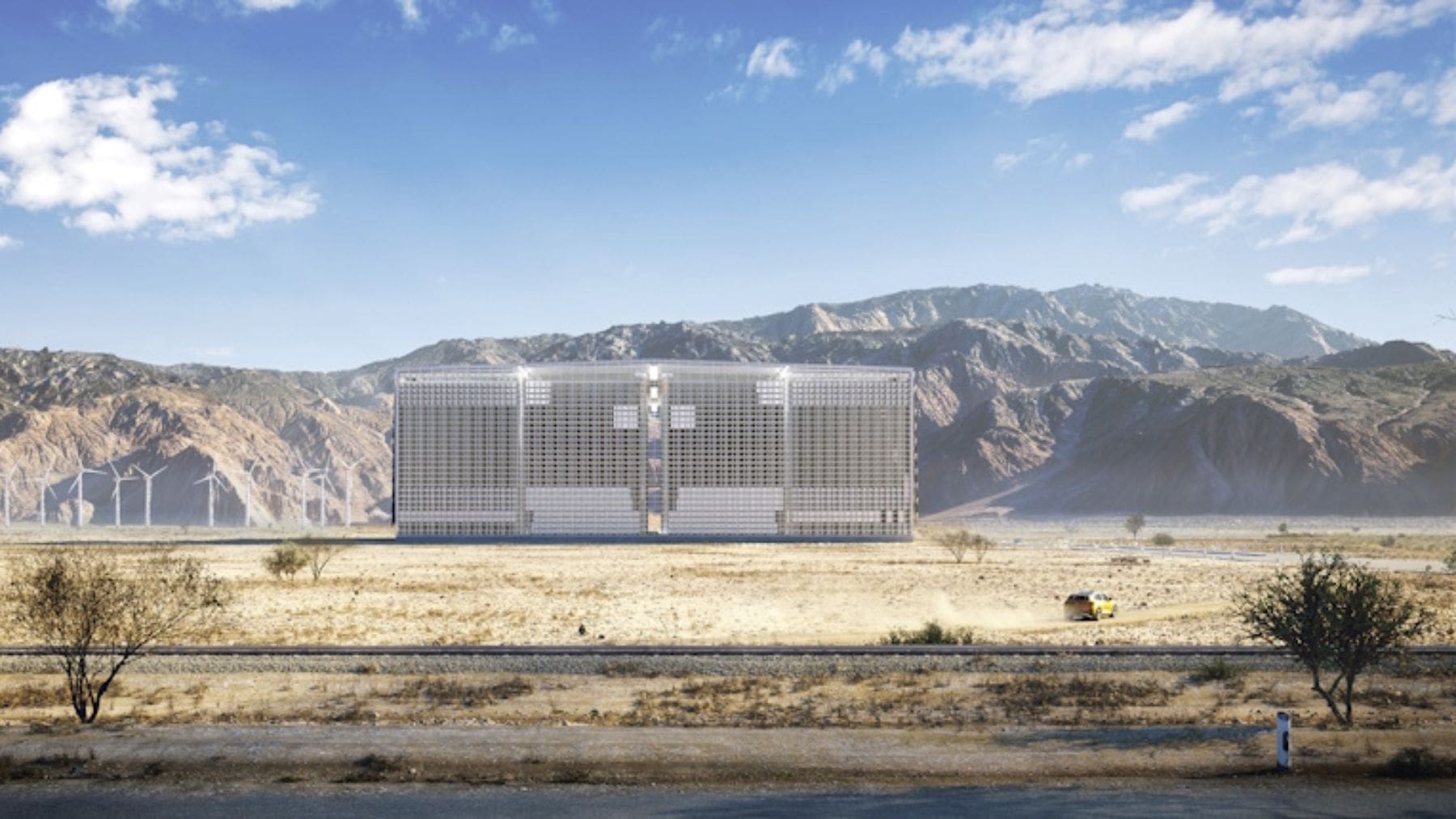
This is why China decided to invest in Energy Vault‘s alternative gravity battery.
Using a gravity battery to store green energy
Using gravity as a source to power giant batteries has piqued the interest of many for years.
Now, the world has officially received its first operational commercial-scale gravity battery.
Situated in Rudong, China, the structure is 485 feet tall and holds a storage capacity of 100 MWh.
Known as the G-Vault, the system can deliver up to 25 MW of uninterrupted electricity for four hours.
Alongside a massive local wind farm, it provides essential grid balancing.
The mechanics of lifting giant weights
During excess wind power generation, automated motors are activated.
35-ton composite blocks are lifted to the top of the tower along internal tracking rails.
Electrical energy is converted into gravitational potential energy.
The power is stored at height with zero degradation.
During high-demand periods, the blocks are lowered down the internal rails.
The motors spin in reverse, causing them to act as generators.
The motion is instantly converted back into electricity for the grid.
Using this mechanical system has led to operations with a round-trip efficiency surpassing 80 percent.
An additional benefit includes using locally sourced recycled materials and industrial waste for the internal weights.
Furthermore, it entirely avoids the risks of dangerous thermal runaway fires and is free from chemical degradation.
China’s concrete asset is ultimately designed to provide reliable, grid-scale power for over 35 years. Soon, gravity projects could be driving global electricity.
Anke Maree is a writer with a clear and engaging editorial style. Her work focuses on making complex topics accessible, informative, and relevant for readers across different areas of interest.
