
A Dutch startup built a battery from iron and rainwater and just signed a deal to store Europe’s excess wind for days at a time
 Credits: AI made
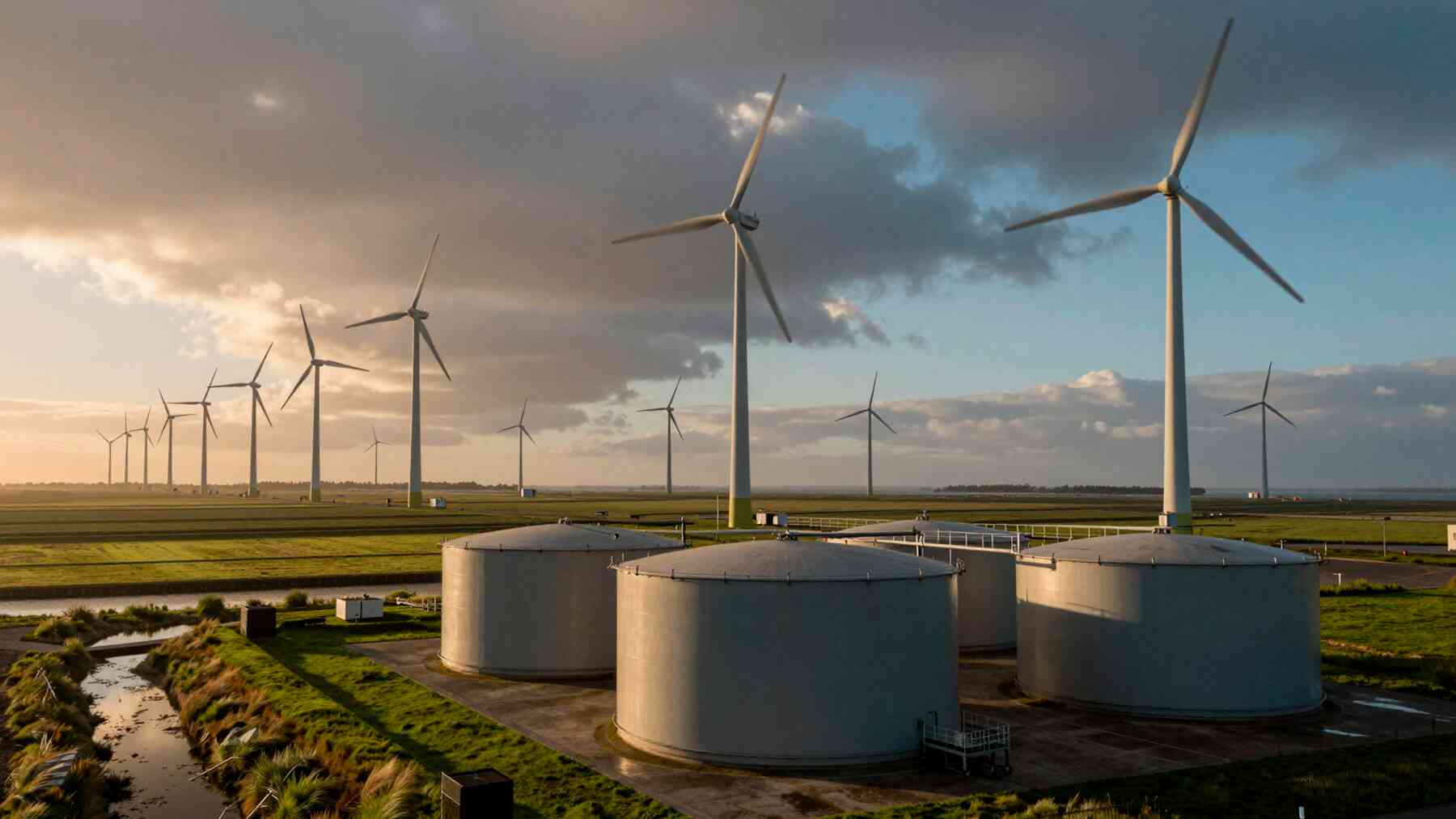
Excess wind energy can now be stored longer using an innovative battery.
Wind power has stepped up as a reliable, high-volume source of electricity to relieve pressure from global grids.
Yet, it remains inherently intermittent, creating a critical challenge for operators facing fluctuating demand.
Her work focuses on making complex topics accessible, informative, and relevant for readers across different areas of interest.
Conventional batteries can overcome this hurdle, but only in the short term.
How does the new Dutch battery work to provide long-duration energy storage while remaining cost-effective?
How erratic electricity demand is straining grids
Globally, energy consumption is surging at an unprecedented rate.
In 2026, a 26% year-on-year increase in electricity demand is expected.
The primary driver of this surge is the widespread adoption of generative AI and data centers.
Data center power consumption is projected to reach 565 TWh in 2026.
Industrial electrification is another contributor to the world’s rising electricity needs.
This is placing significant strain on existing power infrastructure.
Many grids were not originally designed to handle these highly concentrated loads.
Usually, demand peaks in the early morning and again in the evening.
This is when residential activities, commercial operations, and industrial processes typically overlap.
During these periods, grids often reach their maximum capacity.
To prevent potential blackouts, operators must rely on backup fossil fuel plants to close the gap.
Consequently, several nations are turning to large-scale wind infrastructure to replace these carbon-heavy facilities.
Unfortunately, this has led to further complications.
Wind energy as a global grid stabilizer
Global wind capacity has surged 40% in a single year.
Wind power has become a primary tool to modernize the world’s energy systems.
Years of advancements have made it cost-effective and highly scalable.
Additionally, it generates zero emissions during operation, making it ideal for climate targets.
Unlike thermal plants, wind energy has a near-zero marginal cost after installation.
Furthermore, it is essential in diversifying energy portfolios and lowering reliance on volatile fossil fuel imports.
Utility-scale wind farms can therefore support industrial growth with massive volumes of clean electricity.
However, wind power’s greatest challenge is its intermittent nature.
Weather and wind speeds dictate output efficiency.
This leads to a mismatch between electricity supply and consumption.
Unexpected drops in generation cause unstable voltage and frequency.
Conversely, high wind production that outpaces immediate demand is often curtailed and wasted.
Traditional batteries can only provide short-term relief, which is why another approach is needed.
Long-term battery energy storage system for wind
Traditional batteries typically comprise lithium-ion technology. They have limited discharge.
To overcome their short duration, the Amsterdam-based startup Ore Energy turned to the iron-air battery.
The company reached a landmark agreement with Dutch utility Budget Thuis to deploy 1 GWh across the Netherlands.
It marks a major step toward stabilizing wind-heavy European grids.
Releasing power days later when generation drops or demand peaks
Iron-air batteries are designed for multi-day discharge. This ranges from 24 to 100 hours.
The fundamental chemical process behind the technology is called “reversible rusting.”
During discharge, oxygen is absorbed from the air to convert iron into iron oxide, which releases energy.
When wind power is in excess, the process is reversed. Electricity turns iron oxide back into iron, “charging” the battery and releasing oxygen.
The system is highly cost-effective, using abundant, low-cost materials like iron, water, and air.
It has an estimated cost of $18.16 per kWh, making it a sustainable economic model for large-scale deployment.
Ore Energy and Budget Thuis are now moving toward large-scale deployment.
By integrating iron-air batteries, global green energy infrastructure can undergo a pivotal shift.
The reliable multiday iron-air technology effectively solves the intermittency of wind power.
This innovation promises to decouple European grid stability from fossil fuels. Wind-plus-storage developments serve as a sustainable foundation for the world’s rapidly electrifying future.
Anke Maree is a writer with a clear and engaging editorial style. Her work focuses on making complex topics accessible, informative, and relevant for readers across different areas of interest.
