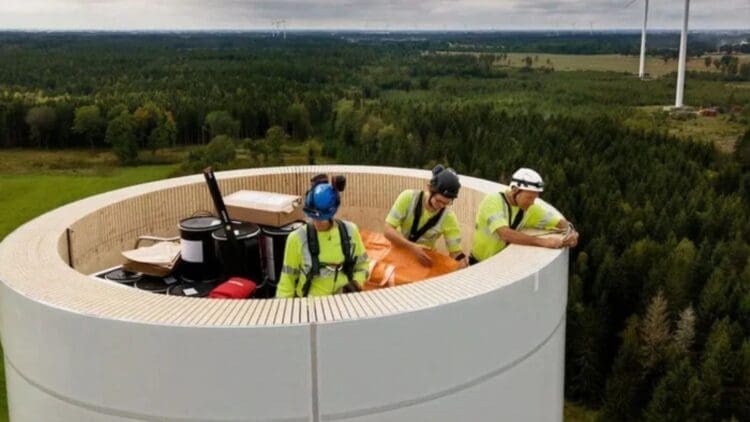

Wooden wind turbine towers offer a transformative solution to the world’s energy shift.
Globally, high-volume electricity demand and international climate targets are clashing.
To ensure that the renewable energy transition stays on track, wind infrastructure must scale substantially to capture stronger winds.

However, traditional tower materials face significant obstacles, raising the need for alternative approaches.
How will using wood instead of steel help overcome conventional barriers to meet international climate goals?
How the conflict between scale and demand continues
Electricity demand is surging globally.
Consumption is predicted to increase at an average annual rate of 3.6% through 2030.
This rate is 50% faster than the average growth seen over the previous decade.
Swift industrialization of emerging economies is one of the key contributors to this rising pressure.
The expansion of electric vehicles, AI-enabled data centers, and modern cooling systems also plays a role.
These concentrated energy needs are straining power grids, threatening nations’ commitments to climate targets.
Goals such as limiting temperature rise to 2.7°F require decoupling economic growth from fossil fuel reliance.
This central barrier lies in speed and capacity.
Renewable energy capacity is accelerating, but the infrastructure needed to supply the power is struggling to keep pace.
Project backlogs are growing, while aging transmission networks and insufficient storage represent significant bottlenecks.
Bridging this gap requires more efficient and rapidly deployable technologies.
The logistical wall of steel towers
One of the primary strategies for meeting global climate targets is scaling wind infrastructure.
Taller turbines have access to stronger and more consistent winds at higher altitudes.
This significantly boosts electricity yield and project efficiency.
Yet, utilizing steel towers presents structural and logistical challenges.
Towers over 500 feet need significant steel reinforcement to maintain stability.
Not only does this add immense weight, but it also demands deeper, costlier welds.
Furthermore, the weight and massive diameter of tower bases make transportation more complex and costly.
Additionally, manufacturing steel towers is extremely carbon-heavy.
The production phase is responsible for over 90% of a wind turbine’s total lifecycle carbon footprint.
These limitations restrict where tall turbines can be deployed while driving up the capital costs of wind projects.
Swedish company Modvion is now overcoming these physical and logistical obstacles of steel by utilizing an innovative material.
Using engineered wood to overcome wind turbine barriers
Wind turbines are becoming more sustainable.
Modvion swapped steel for laminated veneer lumber (LVL).
It is an engineered wood with a high strength-to-weight ratio ideal for towering structures.
The design has modular sections that easily fit on standard trucks, streamlining logistics.
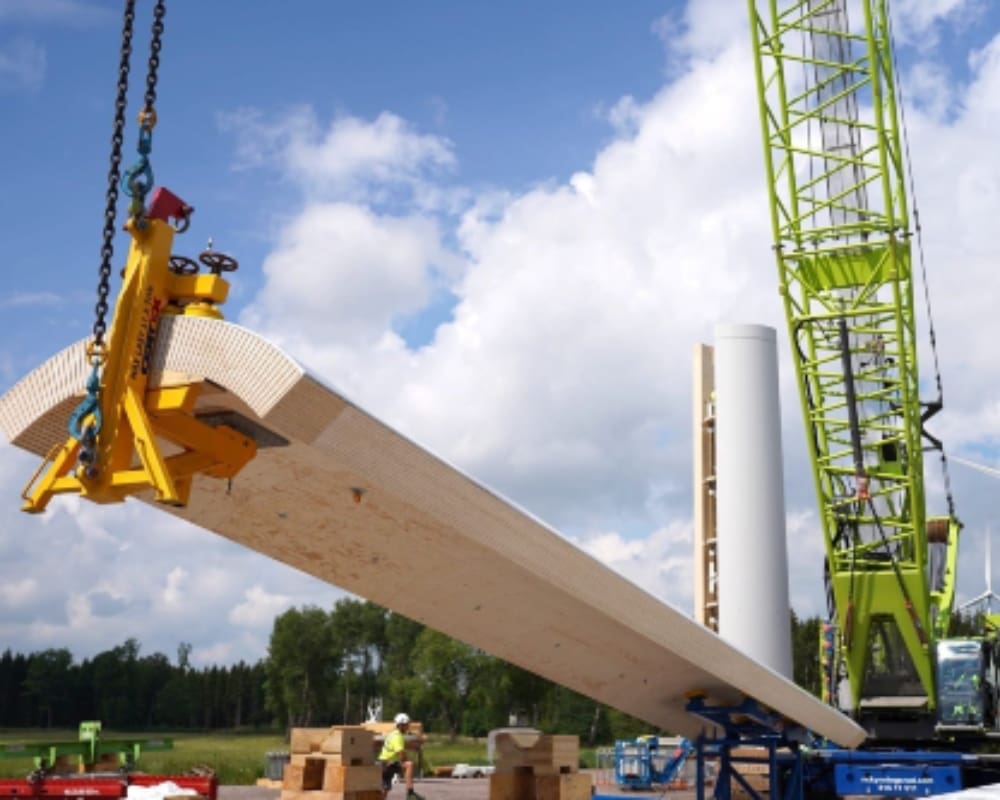
Using LVL instead of steel lowers manufacturing emissions by approximately 30%.
Wood stores carbon, making these towers act as permanent carbon sinks.
Furthermore, these wooden towers possess natural dampening properties.
Boosting durability while lowering acoustic noise
The natural composition of wood has high internal friction.
LVL dissipates the kinetic energy from aerodynamic loads or mechanical oscillations as heat.
Vibrations are more effectively absorbed compared to the rigid, crystalline structure of steel.
This significantly lowers mechanical noise during operation. This is especially advantageous for onshore wind projects located near residential areas.
Additionally, oscillation dampening reduces fatigue stress in turbine components.
This modular approach enables rapid, cost-effective assembly of taller, more efficient and sustainable turbines in diverse locations.
Modvion’s wooden wind turbine towers with their modular, carbon-negative design are a true breakthrough.
This alternative approach provides both speed and innovation for the transition to renewable energy.
As global electricity demand continues to surge, the gap can be more effectively closed.
Likewise, the enhanced durability, lowered acoustic noise, and simplified logistics pave the way for more economically feasible deployment.
These improvements highlight that reimagining the foundational materials of wind turbines is essential to secure a resilient energy future.
Anke Maree is a writer with a clear and engaging editorial style. Her work focuses on making complex topics accessible, informative, and relevant for readers across different areas of interest.