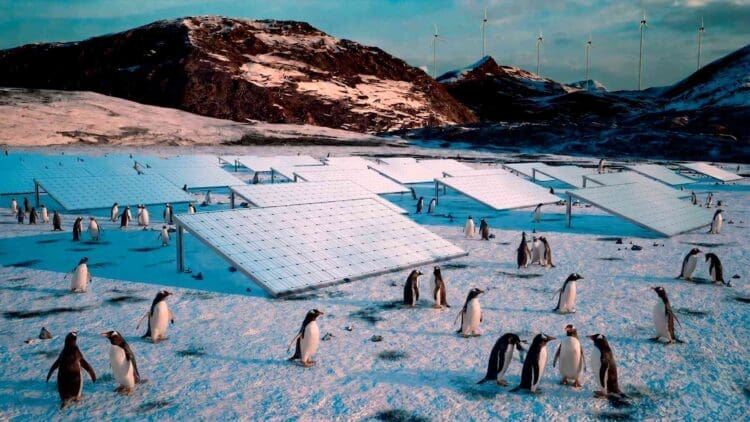

One of the most remote regions of the planet is going green and is crossing paths with penguins.
Researchers are exploring some of the most isolated and extreme environments worldwide.
As international research networks expand, deploying clean technology becomes essential to reduce fossil fuel consumption.




However, constructing large-scale facilities in secluded wilderness zones poses significant operational challenges.
Can eco-friendly infrastructure upgrades help protect fragile ecosystems while lowering carbon footprints?
How fossil fuels stubbornly remain needed at polar outposts
Research outposts in freezing polar regions demand absolutely reliable power.
The lowest temperature ever recorded on Earth was -128 degrees Fahrenheit in Antarctica.
In these extremely cold conditions, human exposure causes frostbite within minutes. Machinery fluids can instantly freeze.
This renders continuous heating and electricity as vital life-support systems rather than simple amenities.
Unfortunately, more than 70% of all Antarctic outposts remain completely reliant on fossil fuels to sustain operations.
Standard stations have historically required over 550,000 gallons of diesel annually for basic power and heating.
The constant burning emitted nearly 5,500 tons of carbon dioxide each year into the pristine polar atmosphere.
Despite the high emissions, fossil fuels remain the default choice due to continuous, high-density energy.
To solve this, green infrastructure must overcome its operational limits on the frozen continent.
This has been historically challenging, until now.
Solar is ideal in theory, but practically punishing
Solar power is highly feasible to secure energy independence in polar regions.
Antarctic regions experience continuous, 24-hour daylight during the summer. This offers an uninterrupted supply of clean energy for months.
Furthermore, solar panels operate more efficiently in cold temperatures than in hot climates.
Freezing temperatures prevent hardware from overheating, boosting electrical output.
Additionally, the vast, flat, snowy landscape reflects sunlight, increasing solar absorption.
However, traditional solar installations face immediate operational challenges in this harsh terrain.
Heavy snow accumulation on ground-mounted solar arrays renders them non-operational.
Frequent blizzards completely bury the panels under deep drifts within hours.
Likewise, standard ground mounting exposes hardware to catastrophic wind damage.
Blizzards generate freezing wind gusts that can surpass 180 mph.
Loose debris and high-velocity ice crystals carried by wind can scratch or shatter glass panels.
To overcome this, the Australian Antarctic Program took another approach to installing Antarctica’s first solar power plant.
A vertical solar power plant to beat the elements
Australia is playing a vital role in boosting solar capacity worldwide.
The Australian Antarctic Program reimagined solar design for increased survival at Casey Station.
Engineers mounted 105 solar panels vertically against the northern wall of the station’s green store building.
This orientation prevents snow accumulation and utilizes the low angle of the polar summer sun.
The solar power plant supplies 30 kW of clean electricity to the local power grid.
Soon, it also drew the attention of local wildlife.
Catching the attention of the local penguin “tourists”
A colony of Emperor penguins spotted the unusual structures from the sea ice.
The birds marched toward the station perimeter, driven entirely by natural curiosity.
They investigated the facility area just like tourists.
This prompted a group of local Adélie penguins to follow suit.
They waddled down and investigated the giant visitors alongside patient station expeditioners.
The unexpected encounter forced researchers to implement careful boundary management.
Integrating solar power at Casey Station marks a major milestone for global clean technology.
By using smart, adaptive engineering, renewable energy can withstand the planet’s harshest remote environments.
However, the unexpected attraction of local penguins serves as a vital reminder to developers and researchers.
Conservation must remain the top priority when deploying green infrastructure in pristine habitats.
Solar power plants can only be truly sustainable when they protect both the climate and curious native wildlife.
Anke Maree is a writer with a clear and engaging editorial style. Her work focuses on making complex topics accessible, informative, and relevant for readers across different areas of interest.