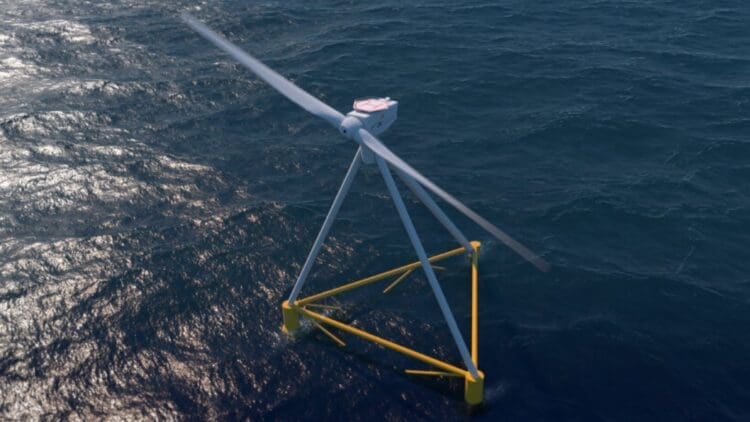

Expanding offshore wind capacity could now become more cost-effective and simpler by using a floating “wind pyramid.”
For years, wind power has proven to be fundamental to the global green energy transition.
Unfortunately, the sector has faced significant obstacles onshore, leaving it no choice but to seek beyond the horizon.


Will investing in innovative turbine designs help make the move to the ocean more viable, or is it all moot?
How the wind sector has been facing turbulence
Of all the renewable energy sources in the world, wind power is by far the most powerful and scalable.
Its role in the global effort to phase out fossil fuels, meet climate targets, and supply baseload power is integral.
As modern economies prepare to shift toward electrification to advance the global transition, a greater electricity supply will be needed.
This means scaling up turbines and their blades to increase the amount of wind captured and the output.
While it may seem straightforward, in reality, onshore installations have been facing more criticism by the day.
The bigger the design, the greater the view obstruction, and the more aggravated the “Not in my Backyard” movement becomes.
Production will necessitate greater volumes of rare earth elements and critical minerals, which require invasive extraction.
These are only a few of the many reasons why the industry opted to move to the ocean.
The impact of the offshore wind sector
The vast ocean with its stronger, steadier, and less turbulent wind became a suitable environment.
The large-scale power production without physical space constraints began to intrigue investors worldwide. Soon, major offshore wind development projects took off.
However, the hidden costs of these offshore installations became apparent soon thereafter.
The infrastructure requires specialized transportation and installation vessels, increasing capital expenditures significantly.
Long, expensive subsea cable transmission to the mainland was another complexity.
Furthermore, the harsh marine conditions made the infrastructure more vulnerable to accelerated wear and tear. This means more frequent and expensive maintenance is required.
Beyond the logistical and economic challenges, giant offshore wind farms are also altering bird migration routes.
With the increased risk to migratory species, it was high time to explore alternative wind solutions.
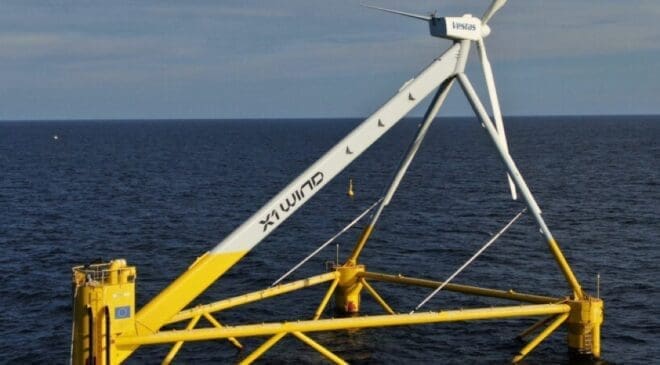
That is why the Spanish company, X1 Wind, created an innovative floating “wind pyramid” to address these obstacles.
A floating offshore wind system to power the world
Pyramid-shaped wind turbines are rising over the ocean, and they are reimagining conventional floating infrastructure to lower costs.
The PivotBuoy X1 Wind system is a lightweight platform engineered to harness deep-water wind resources.
It can support the latest 14- and 15-MW commercial turbines, which have the capacity to power 12,000 homes.
The PivotBuoy system engineering and operational benefits
A single connection point integrates the mooring, anchoring, and electrical cables. The single-point mooring enables the system to passively rotate to align with the wind.
The turbine rotor has a downwind configuration, lowering mechanical stress. It also ensures efficient power production in light and highly variable wind conditions.
Its lightweight design enables rapid quayside assembly and requires standard towing and installation vessels. This significantly lowers specialized vessel rates and the constraints of port infrastructure.
With the push for global clean energy accelerating, innovative systems such as X1 Wind’s PivotBuoy are leading the charge.
2026 marked a major milestone for the X100 platform, which has achieved Basic Design certification from DNV. It validates the design engineering integrity for real-world deployment.
The next step is to provide data from the upcoming pilot installation in the Mediterranean Sea. Soon, the world could benefit from cost-effective deep-water sustainable wind power.
Anke Maree is a writer with a clear and engaging editorial style. Her work focuses on making complex topics accessible, informative, and relevant for readers across different areas of interest.