
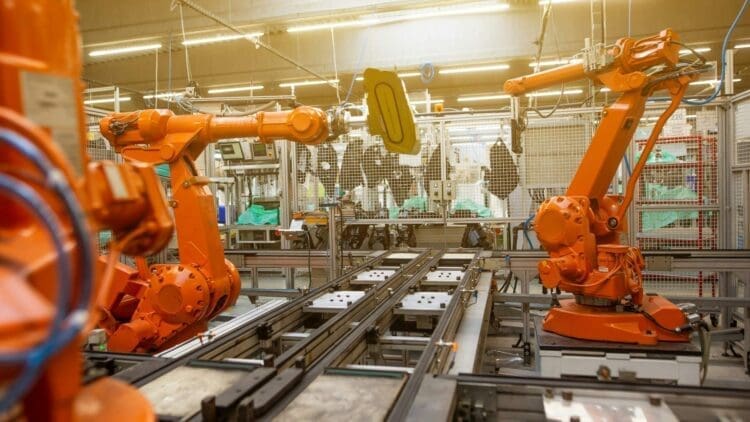

Industrial energy companies are under mounting pressure to automate manufacturing and supply chain operations at a scale the sector has rarely attempted before. GE Vernova — a global energy giant whose technology helps generate roughly 43% of Canada’s electricity — has decided this is the moment to act from the inside out.
On May 21, the company signed a deal to acquire Robotech Automation, a specialized robotics integrator based just outside Montreal with approximately 35 employees. The size gap between acquirer and acquired is stark — and may be precisely the point.
A focused bet on specialized talent
Robotech Automation isn’t a sprawling technology conglomerate. It’s a tight, 35-person shop near Montreal that builds customized automation solutions from the ground up — handling design, engineering, and integration in-house, backed by a network of manufacturing partners. That combination of compact scale and genuine depth appears to be what caught GE Vernova’s attention.




Co-founders Carl Thibault and Francis Bourbonnais were direct about what drove the deal: their people. “They are what made this company what it is today,” the two said in a joint statement, describing the acquisition as an opportunity for their team to grow — technically and personally — inside a larger organization.
GE Vernova CEO Scott Strazik echoed that framing. He cited “specialized talent, proprietary systems, and hands-on integration expertise” as the core drivers — language that signals this is less about acquiring a product line and more about securing a team with a hard-to-replicate skill set.
Already working together on the factory floor
One detail that sets this deal apart from a typical technology acquisition: the two companies are already collaborating. GE Vernova and Robotech have active supply chain projects underway together, including work at GE Vernova’s US factories in Schenectady, New York and Charleroi, Pennsylvania.
That existing relationship matters more than it might appear. Integration doesn’t begin with introductions — it begins with a track record. Both sides have already navigated real projects together, which reduces the uncertainty that frequently undermines post-acquisition execution.
Strazik framed the transaction accordingly, describing it as a move to “accelerate our organic programs” rather than build something from scratch. The strategic direction was already established; this deal is about moving faster along a path already under construction.
Where Robotech will land: the Advanced Research Center
Once the deal closes, Robotech’s team and capabilities will be embedded within GE Vernova’s Advanced Research Center — referred to internally as the ARC — the company’s hub for developing and deploying robotics and automation across its supply chain operations.
The goals tied to the ARC integration are concrete: measurable improvements in safety, quality, delivery timelines, and cost outcomes. Those four categories span the full operational range of a manufacturing supply chain, suggesting ambitions that extend well beyond a single pilot program.
Strazik described the intended outcome as establishing “a world-class robotics deployment capability” within the ARC. A high bar, and one that’ll take time to validate. Embedding a proven integration team directly into the research center is, at minimum, a logical structural choice for a company trying to scale automation internally rather than contracting it out indefinitely.
Strategic M&A in a company with deep Canadian roots
The Robotech acquisition fits within a broader capital allocation strategy GE Vernova has publicly outlined — one that pairs targeted mergers and acquisitions with organic investment. This deal looks like a deliberate expression of that approach: small in headcount, specific in focus, aimed at closing a capability gap rather than expanding market share.
GE Vernova has operated in Canada for more than 130 years, with over 2,400 employees across six manufacturing and office locations. Its Canadian work spans power generation, grid transmission, energy storage, and conversion — a broad portfolio that increasingly depends on efficient, automated supply chain operations. The Robotech deal sits squarely within that context.
Among its most prominent Canadian commitments is a project to build the Western world’s first Small Modular Reactor, in partnership with Ontario Power Generation in Toronto. That kind of infrastructure undertaking makes clear why supply chain reliability and manufacturing precision aren’t abstract priorities for GE Vernova — they’re operational necessities.
Financial terms were not disclosed. The transaction is expected to close in early Q3 2026, subject to standard closing conditions.
What to watch as the deal closes
The months ahead will reveal how well a 35-person robotics firm integrates into one of the world’s largest energy companies without losing the qualities that made it worth acquiring. Embedding specialized teams inside large organizations is notoriously difficult — bureaucratic friction, shifting priorities, and cultural mismatch can quietly erode the very expertise an acquirer set out to capture.
What GE Vernova has in its favor is the existing working relationship. The foundation isn’t theoretical; it’s been tested on factory floors in New York and Pennsylvania. Whether that head start translates into a genuinely scaled robotics capability within the ARC is the question worth tracking as 2026 progresses.

Carlos is an engineer with strong expertise in technical and industrial topics. He previously worked at international companies such as Siemens and speaks Spanish, German, English, and Italian.