
Engineers want to build giant underwater gates in the Atlantic that turn waves into electricity while creating a new home for mussels, oysters, and barnacles
 Credits: AW Energy
The untapped potential of the Atlantic’s waves could finally be harnessed using giant underwater gates.
Worldwide, electricity consumption is rising at an unprecedented pace, placing immense pressure on power grids.
Earth’s oceans are among the largest renewable sources, capable of meeting a significant portion of this demand.
Additionally, it will unlock a sustainable global blue economy, lowering energy costs while creating thousands of job opportunities.
Yet, existing infrastructure has historically struggled to capture this immense, highly predictable energy.
Will using a different approach prove to be a strategic pivot toward commercialization?
How global grids are continuously pushed to the brink
Long before AI, widespread digitization, and even the internet, electricity was limited to those who could afford it.
In the late 1870s and 1880s, only a few private homes had residential access, including Thomas Edison’s.
Only by the 1930s did urban regions begin adoption, with rural regions having to wait until almost the 1950s.
Today, electricity is a common and heavily relied-on energy carrier worldwide.
In fact, its consumption has risen to an unprecedented rate.
Consequently, existing power infrastructure is experiencing immense strain.
This is attributed to the digital age.
Digitization led to electricity demand growing by over 3.5 percent annually. This is almost three times higher than the overall energy usage.
To meet this high consumption without aggravating climate change, green infrastructure must expand.
However, intermittent sources such as wind and solar are no longer enough to prevent grid instability.
The industry urgently needs predictable, consistent green alternatives.
Turning to the ocean as an option
For years, experts have wanted to harness the dense, predictable power of the oceans.
Waves are consistent, making them more favorable than both solar and wind.
Water is nearly 800 times denser than air, meaning more energy can be captured with a smaller footprint than wind turbines.
Furthermore, long after the wind has stopped blowing or the sun has set, ocean swells continue to move.
Despite the promise of baseload grid power, wave energy has historically faced significant challenges.
The marine environment is exceptionally harsh, with saltwater corrosion and storms accelerating degradation.
Maintenance costs are significantly high, as specialized vessels and deep-sea divers are often needed.
Upfront engineering and installation expenditures are also high, raising the levelized cost of energy.
These drawbacks have made tapping into waves highly impractical, until now.
A major European initiative, the ONDEP Project, aims to make wave energy a reliable, commercial source.
Using underwater gates to generate clean electricity
Highly innovative wave energy converter designs are being explored to overcome these historic drawbacks.
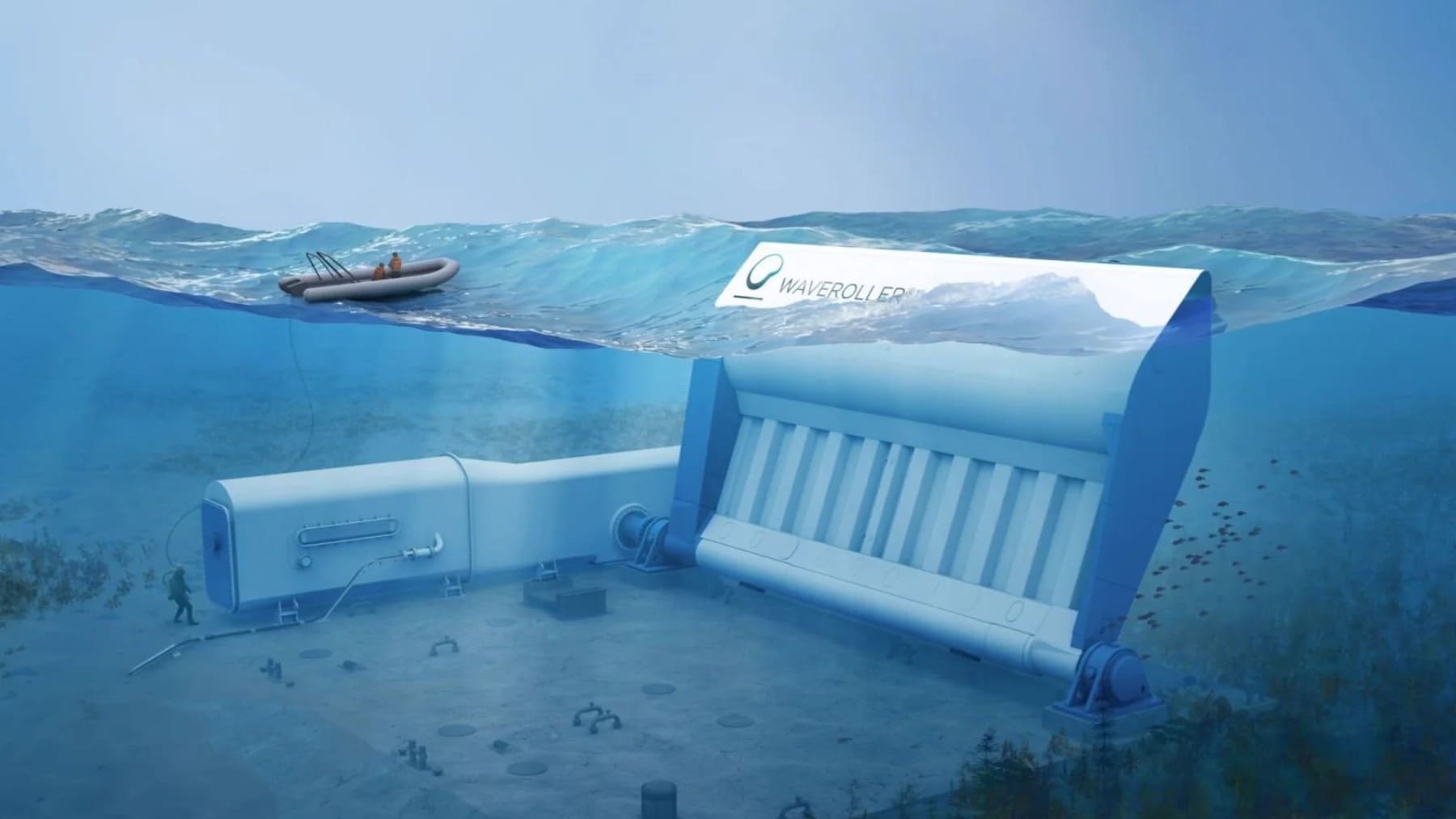
Off the shore of Portugal, the ONDEP project will deploy four WaveRoller units. They will have a combined 2 MW capacity.
Unlike floating surface devices, these units are anchored to the seabed and act as massive, heavy-duty underwater gates.
From a powerful pendulum motion to clean power
Each unit has a single movable panel fixed on a heavy foundation.
The panels are fully submerged, avoiding the destructive forces of surface storms.
Incoming waves create a horizontal back-and-forth subsurface surge.
This surge pushes the panel like a swinging gate.
The motion drives hydraulic piston pumps in a closed circuit.
High-pressure fluid is circulated to a hydraulic motor, which drives a generator.
The motion of the waves is then converted into clean electricity.
This power is immediately transmitted via subsea cables to the onshore utility grid.
The ONDEP project has ambitious targets, which entail reaching 83 MW across four continents by 2030.
The initiative, therefore, establishes a scalable model.
Additionally, it will unlock a sustainable global blue economy, lowering energy costs while creating thousands of job opportunities.
Beyond generating clean grid electricity, the seabed installations will also revitalize marine biodiversity. ONDEP will thus transform offshore energy by using destructive waves to generate predictable power.
Anke Maree is a writer with a clear and engaging editorial style. Her work focuses on making complex topics accessible, informative, and relevant for readers across different areas of interest.
