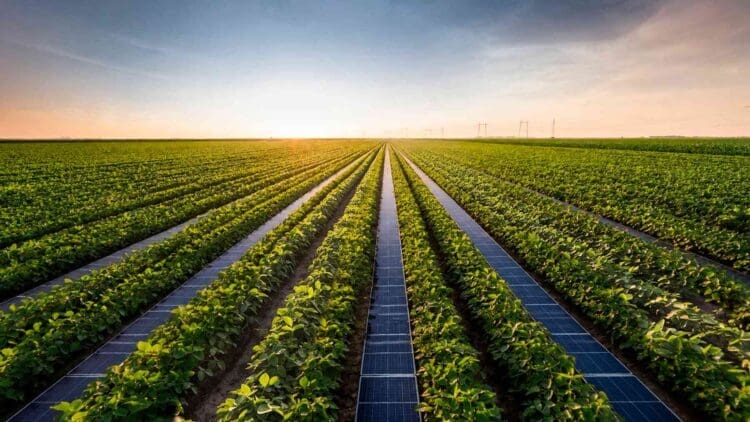

Planting soybeans under solar panels indicates that agrivoltaics does not have to be limited to hot, arid climates.
The global population has surged to billions, pushing food demand up by 50% by 2050.
Simultaneously, the need for high-volume clean electricity production is straining grids worldwide.

Now, Cornell engineers have combined the two sectors, leading to a major temperature drop.
Why did the surface temperature cool, and what does it mean?
How certain factors drive population trends
In modern society, people are living much longer than their ancestors.
In 1950, the global life expectancy was only 47 years.
Now, in the 21st century, life expectancy has risen to 73 years.
This is attributed to significant improvements in medicine, nutrition, and public health.
These advancements, along with major drops in infant and child mortality rates, enabled more citizens to reach reproductive age.
For these reasons, the global population numbers have reached billions.
However, demographers predict the total will reach nearly 10 billion by 2050.
Most of the growth will be concentrated in eight countries, primarily across sub-Saharan Africa and parts of South Asia.
This projection is driven by the current youthful population set to enter their childbearing years.
Furthermore, developing regions are experiencing high birth rates, despite a stall in population growth in high-income nations.
This raises concerns about global clean energy and food security.
Greater land-use conflict due to an AI boom
The quick rise of AI and advanced computing has made the world’s clean energy transition more challenging.
Data centers require high volumes of uninterrupted electricity for complex model training and operation.
As grids become more strained worldwide, utilities are pressured to increase capacity immediately.
This means renewable energy infrastructure must rapidly expand to adhere to strict international climate goals.
Solar power is the leading source of global green energy growth.
However, this expansion is facing significant land-use conflict with the agricultural sector.
Large-scale solar farm deployment often leads to clearing thousands of acres of fertile land.
This displaces food production at a time when the world’s demand is rising.
To overcome these long-standing tensions, Cornell University engineers conducted a study to prove that the two sectors can coexist.
The Cornell Chronicle highlights the surprising findings of their research.
Simulating the combination of soybeans and solar panels
Researchers are becoming increasingly interested in combining agriculture with solar panels.
This is referred to as agrivoltaics and is usually restricted to hot, arid regions.
The purpose of the Cornell study was to evaluate how crops can change the microclimate beneath solar panels.
The study “Growing crops at solar farms can boost panel performance, longevity” was published by Cornell University in Science Daily.
Computational fluid dynamics was used for evaluation.
The simulation entailed a dual-use system, with solar panels raised 13 feet above a soybean crop. The data was compared with standard layouts mounted 1.64 feet over bare dirt.
The changes to the solar panels’ microclimate
The soybeans led to an operational temperature drop of 18°F.
The passive cooling effect was driven by:
- Evapotranspiration of soy beans that cools the air;
- The green crop canopy and moist soil reflect and absorb solar energy more efficiently;
- The raised panels allow ambient wind to pass through freely
This cooled microclimate overcomes a major obstacle of solar panel engineering. Cooler solar cells operate at higher efficiency and have an extended operational life.
So far, the global population is set to increase at a fixed rate.
To ensure that energy and food security needs are met, agriculture and the energy sector must meet in the middle.
The Cornell study proves that food and clean power can be produced simultaneously. Not only that, but crops and vegetation improve solar output, making it easier to meet climate targets.
Anke Maree is a writer with a clear and engaging editorial style. Her work focuses on making complex topics accessible, informative, and relevant for readers across different areas of interest.