
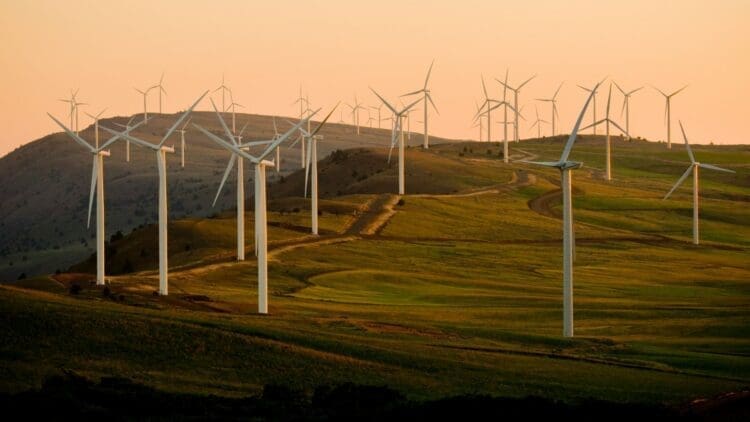

Twelve wind turbines, each rising 179 meters above the landscape, are set to take shape across three sites in the district of Höxter in North Rhine-Westphalia. Together, they’ll add 82 MW of capacity under a new agreement between Nordex Group and Westfälisch-Niedersächsische Energie (WNE).
The scale of the project, though, is only part of the story. For these two companies, the deal is less a new beginning than the latest step in a partnership that has been quietly expanding — order by order, site by site — as Germany pushes deeper into its energy transition.
A new order built on years of collaboration
The latest agreement covers three distinct sites within the Höxter district. Seven turbines will be installed at Dringenberg, three at Gehrden Ost, and two at the Gehrden Fölsen extension. That distribution spreads new capacity across the region rather than concentrating it in one place.
Each contract includes a 20-year Premium Service agreement, meaning Nordex will remain involved well beyond the installation phase. Long-term commitments like this reshape the economics of wind development — operators gain greater certainty over maintenance costs and turbine performance across the full lifespan of their assets, which matters considerably when planning at this scale. Construction is scheduled to begin in mid-2027.
The turbine at the center of the deal
The N175/6.X is Nordex’s flagship onshore turbine model, and it sits at the core of this agreement. Here, the turbines will be configured at a hub height of 179 meters — tall by most standards, but not the upper limit of what this platform can achieve.
That limit was extended just months earlier. In March 2026, WNE commissioned three N175/6.X turbines for the Marienmünster-Altenbergen wind farm at a hub height of 199 meters — the first time that height had been reached for the model. Moving from 179 to 199 meters across successive projects reflects something broader: as developers grow more familiar with the technology, specifications are being pushed upward. Nordex describes the N175/6.X as enabling customers to generate wind power reliably and efficiently, and the repeated selection of the same model across multiple WNE projects suggests that confidence in the platform is well-established.
A partnership that keeps deepening
The relationship between WNE and Nordex predates this order by some margin, and neither company frames it otherwise. The announcement explicitly describes WNE as “continuing its long-standing cooperation” with Nordex — language pointing to a history that stretches back further than recent headlines.
What recent months reveal is the pace at which that cooperation is advancing. The March 2026 Marienmünster-Altenbergen order was followed by the May 2026 Höxter agreement, with WNE returning to Nordex as its preferred supplier both times. Repeat orders at this frequency signal something beyond transactional convenience.
Both sides have expressed that confidence directly. Alexander Möhring, Managing Director of WNE, described the project as “another important contribution to the energy transition in Europe,” adding that it “underscores our successful partnership and our commitment to delivering innovative and sustainable energy projects.” Felipe Villalon Waldburg-Zeil, Director Sales Region Central at Nordex, echoed the sentiment, noting that the company “greatly values” the long-standing partnership and sees the new projects as a way to further advance the energy transition through innovative technology.
What this means for Germany’s energy transition
Germany’s Energiewende — its long-running shift away from fossil fuels toward renewable energy — has always depended on scaling up domestic wind capacity. Onshore wind remains central to that effort, and new orders like this one are part of the steady accumulation the transition requires.
North Rhine-Westphalia carries particular weight in this context. Historically one of Germany’s most industrialized regions and a center of coal-based power generation, it’s now an important site for demonstrating that the energy transition can take hold where it’s most needed. Adding 82 MW across three Höxter sites is a meaningful, if incremental, contribution to that shift. The 20-year service contracts attached to these turbines reinforce the point — projects structured around multi-decade commitments are built for stable, long-term generation, not short-term additions likely to be retired within a decade.
Looking ahead
With construction set for mid-2027, the Höxter projects are still a year or more from breaking ground. The trajectory they represent, however, is already visible. WNE has placed two significant orders with Nordex within months of each other, selecting the N175/6.X each time and extending the terms of the relationship further into the future.
Whether hub heights and turbine capacities in future orders continue to climb — and whether WNE’s pace of commitments accelerates alongside Germany’s push to meet its renewable energy targets — remains worth watching. If recent history offers any indication, neither company appears to be slowing down.

Carlos is an engineer with strong expertise in technical and industrial topics. He previously worked at international companies such as Siemens and speaks Spanish, German, English, and Italian.