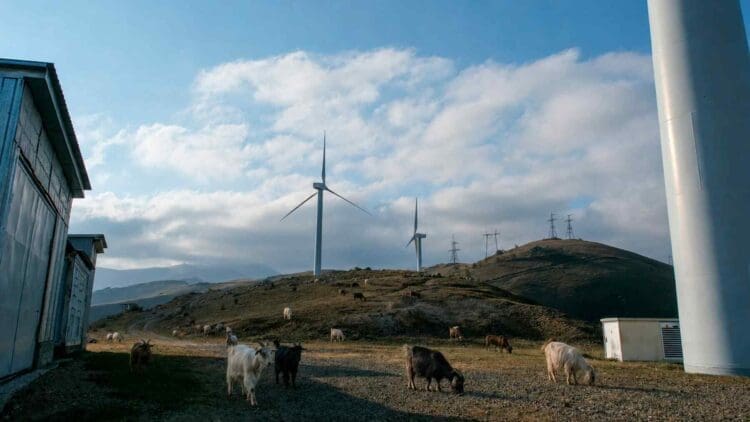

A tragic mystery regarding a wind energy project and the death of hundreds of goats caused significant disarray.
Many island nations have a heavy reliance on fossil fuel imports. This raises vulnerability to volatile global oil prices and supply chain issues.
To boost economic resilience and energy security, many are investing in renewable infrastructure.


Green energy projects may be key to meeting climate mandates, but what about the unprecedented impact on the surrounding wildlife?
How island communities still carry the heavy burden of fossil fuels
Worldwide, many nations have actively been working toward net-zero.
Global climate mandates have now become stricter. This is why many are rushing to expand green capacity at an exponential rate.
But some remote, faraway societies remain heavily dependent on fossil fuels.
This includes several small island nations.
In the Caribbean and the Pacific regions, 80% to 90% of island electricity is generated with imported diesel.
This reliance is a major economic drain. Many frequently spend 15% to 30% of their total Gross Domestic Product (GDP) on fuel imports.
This is because islands lack the broad resource portfolios of larger mainland regions.
These long-distance imports to isolated islands significantly increase electricity expenses. Many experience power prices up to ten times higher than on the mainland.
However, the total energy consumption is lower than that of major global economies.
Nonetheless, their per capita carbon footprint is surprisingly high.
The irony of island vulnerability
Global warming has been escalating at a dangerous pace.
The rise in greenhouse gas emissions is causing Earth’s average temperature to increase more than it should.
The severe consequences of climate change are now becoming more regular.
Small island communities collectively contribute under 1% of the world’s total.
Despite this, island nations are the most vulnerable to extreme weather events driven by climate change. Intense tropical storms and hurricanes destroy crucial coastal infrastructure and crops.
Rising ocean levels accelerate erosion and threaten to flood low-lying areas.
These disasters typically cost an average of 18% of GDP. This is much higher compared to the global average of 3%.
This unprotected exposure makes green infrastructure a vital lifeline.
Decentralizing grids with localized clean power improves resistance to natural disasters.
However, on a small Taiwanese island, a farmer suffered a significant loss. This loss was blamed on the nearby wind farm.
Death by a wind farm: The tragic loss of 400 goats
Taiwan has been investing in wind energy projects to expand regional capacity.
In the Penghu archipelago, a state-run company, Taipower, built eight giant wind turbines to produce clean power.
A goat farmer, Kuo Jin-Shan, kept his herd near the new turbines.
The farmer noticed his goats began behaving strangely soon after installation. Over three years, 400 goats died.
Discerning the cause of death
The blade rotation causes a constant, low-frequency sound. The farmer argues that this noise kept the goats awake.
They soon suffered from sleep deprivation and stopped eating. He blames exhaustion and starvation for the death.
Local agricultural officials stated that medical analysis told a different story.
The herd contracted “goat plague,” a highly contagious viral infection. It affects the immune system, lungs, and digestive tracts.
This underlying disease explained the sudden loss of appetite and the high death toll. The wind farm was therefore cleared of any responsibility.
In general, it is difficult to predict all the potential impacts on the surrounding wildlife.
Some environmental consequences have become clearer over the years. However, if a wind project is carefully planned and executed, these impacts can be minimal.
In some cases, it has become clear that wind farms can have a positive impact on some species. One thing is certain: Wind power is essential for island nations to achieve energy resilience.