
Australian engineers fired a modified speargun into the ocean floor and doubled the depth of seabed readings that offshore wind farms desperately need
 AI-made
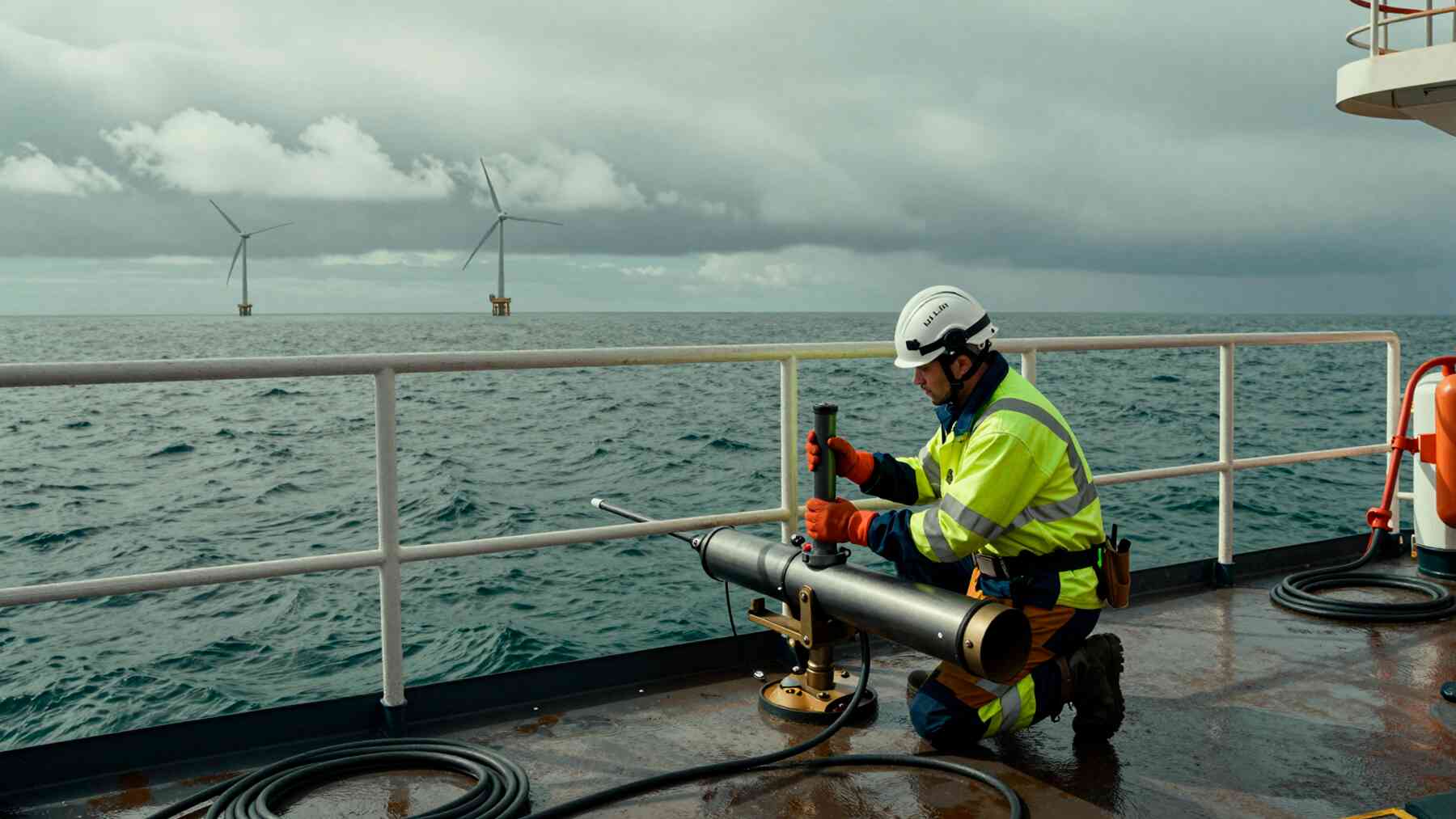
A modified speargun, fired not at fish but into the ocean floor, is at the center of a new engineering approach to one of offshore wind energy’s most stubborn logistical problems.
Before a single turbine can be anchored at sea, developers need precise data on what the seabed is made of — and getting that data reliably is slow and expensive. Engineers at RMIT University in Melbourne may have found a cheaper way in, using a device that fits on a support vessel but punches well above its weight.
The seabed problem holding back offshore wind
Offshore wind turbines are only as reliable as the ground beneath them. Before construction begins, developers need detailed soil data to design foundations capable of withstanding decades of wave and wind loading. Without accurate seabed readings, the entire project rests on guesswork.
The research was conducted alongside colleagues at the University of Melbourne and supported by the Australian Research Council through its Discovery Project scheme.
The standard approach involves lowering or dropping penetrometers — cylindrical probes that measure soil resistance — from a support vessel. In deeper water, these tools perform reasonably well. Shallow coastal zones are a different story.
Lightweight free-fall probes lose momentum quickly in sandy seabeds, failing to reach useful depths. The alternative — heavy-duty probes with enough force to penetrate dense sand — can cost up to AU$200,000 per day to operate. For developers working to bring offshore wind projects in on budget, that’s a significant constraint.
A speargun reimagined as a geotechnical tool
The RMIT team’s solution borrows its core mechanism from an unlikely source. By adapting a modified speargun, engineers created a launcher capable of driving a penetrometer tip into the seafloor with far greater force than a free-falling probe can achieve.
Practicality shaped the design from the outset. Rather than requiring entirely new equipment, the device is compatible with existing probe types — engineers can retrofit their current penetrometers, which keeps the barrier to adoption low. Once a probe has collected its data, it can be retrieved and reused. That “probe and go” approach limits seabed disturbance, a consideration that matters both ecologically and regulatorily in offshore environments.
Lab results: twice the penetration depth
To test the device, researchers set up experiments in a water tank at RMIT’s Heavy Structures Laboratory, running trials across various probe tip designs and sand densities. Performance was captured through an array of sensors and high-speed cameras.
The results were clear. In high-density sandy material — exactly the condition where lightweight free-fall probes struggle most — the speargun-launched device achieved penetration depths twice those of previously reported free-fall probes.
Study lead author and RMIT PhD candidate Junlin Rong described the outcome as showing “considerably greater penetration potential compared to free-falling probes on soil.” Those findings have since been published in the Canadian Geotechnical Journal.
Cost savings and practical implications for wind farm projects
The RMIT team is careful to frame their device as a complement to existing methods, not a replacement. Cone penetration testing — the industry standard for detailed geotechnical surveys — would remain the dominant tool on major projects. The speargun launcher isn’t positioned to displace it.
What it can do is reduce how often the expensive option is actually necessary. By providing reliable preliminary data in shallower zones, the device could help developers pinpoint where heavy-duty testing is genuinely needed and where it isn’t. Rong noted that this selective approach could result in substantial project savings.
The “probe and go” workflow adds a time advantage too — faster site investigation compresses project timelines, and in an industry where pipeline delays carry real financial consequences, that matters.
Next step: field trials and industry partnerships
Laboratory performance, however promising, only tells part of the story. Open-water conditions introduce variables a tank cannot fully replicate — currents, vessel movement, and natural seabed variability chief among them.
RMIT Professor of Geotechnical Engineering Majid Nazem acknowledged this directly. “Now that our experiments have demonstrated the device’s ability to achieve considerable embedment depth in dense sand,” he said, “we are keen to conduct field trials and collaborate with our potential industrial partners to further test its performance for offshore geotechnical engineering applications.”
The research was conducted alongside colleagues at the University of Melbourne and supported by the Australian Research Council through its Discovery Project scheme.
Real-world trials with industry partners will ultimately determine whether the lab numbers hold up at sea. If they do, a modified speargun could become a standard item on site investigation vessels — quietly reshaping how developers prepare to build in shallow coastal waters.

Carlos is an engineer with strong expertise in technical and industrial topics. He previously worked at international companies such as Siemens and is multilingual.
