
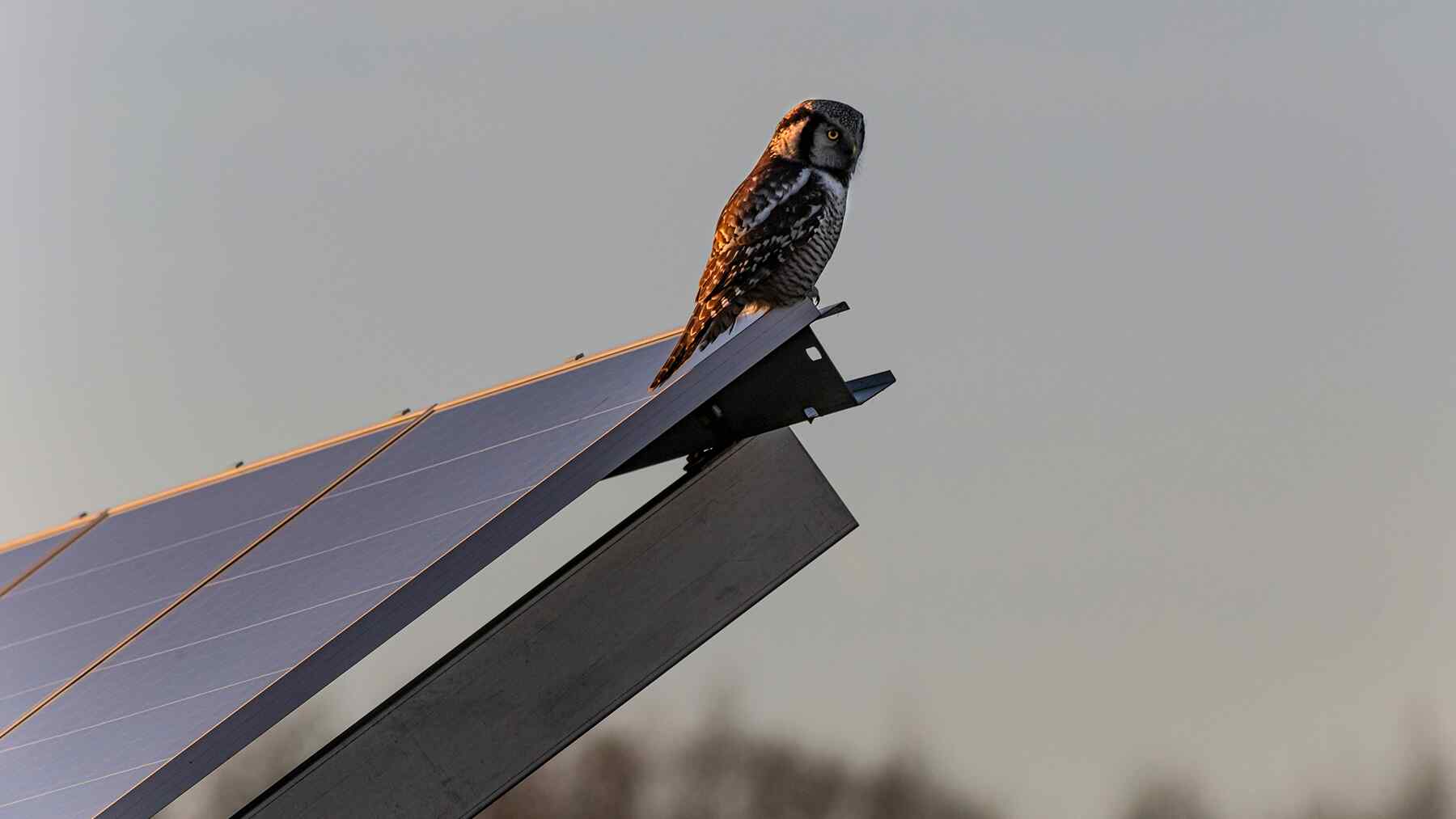
India built a solar plant expecting clean energy until it began attracting flocks of birds and quietly turning into a feeding ground for predators
 Credits: Energies Media Internal edition
Birds are gathering in great abundance at certain solar plants.
Solar plants are expanding at a significant rate, and experts predict that solar capacity will double every three years.
For years, this growth represented a profusion of clean power, but it also meant the loss of land and habitats.
“Mixed-habitat” solar farms with wildflowers, varied grass heights, and hedgerows had almost three times more birds than crop fields.
Now, these facilities are transforming into sanctuaries for some animals, but which species does this attraction truly benefit?
How solar energy can unlock security and economic resilience
The green energy transition began as the key approach to mitigate the effects of climate change.
However, embracing clean power is no longer just about a small carbon footprint.
For many nations, the rapid expansion of renewable energy is now of economic and geopolitical importance.
Today, solar infrastructure is the most abundant source of clean power globally. It is no longer considered a mere alternative source of electricity, but a modern-day strategy.
The International Energy Agency now recognizes utility-scale solar as one of the most affordable sources of electricity in history. This makes the source a very smart investment.
Nations such as the UK and India have historically relied on fossil fuel imports. This makes solar capacity expansion a promise of national energy security.
The risk of global supply chain issues can effectively be avoided, including the monopoly of great geopolitical tensions.
But no investment is ever without any risk.
Caught between a paradox and a hard place
The promise of sustainability and energy independence makes a strong case for solar power.
However, this is often trumped by its physical footprint, which turns solar energy into an industrial intrusion for nearby residents.
Some critics argue that energy security should not come at the expense of vital, versatile farmland, threatening food security.
In India, accessibility to the land is an issue. Large-scale solar parks are typically fenced, disrupting traditional grazing routes and livelihoods.
These “silicon forests” are also viewed as a threat to cultural heritage and tourism, due to the lower landscape value.
Construction noise levels and heavy traffic on narrow roadways also tend to tip the scales.
Others are concerned about the impact of solar panels on animals and their habitats. However, the latest research indicates that some solar plants can become havens for certain species.
The transformation of solar plants into sanctuaries
Field experts have discovered that solar panels attract birds and provide improved conditions.
The RSPB and the University of Cambridge confirmed in a study that intentional solar farm management increases this attraction.
The East Anglian Fens, a heavy agricultural region of England, was the study’s research site of interest. You can review the study “Solar farm management influences breeding bird responses in an arable-dominated landscape,” published in Taylor & Francis Online.
Using solar arrays as tools for nature recovery
At a solar plant, the land-use strategy utilized is directly linked to the biodiversity level of the plant.
“Mixed-habitat” solar farms with wildflowers, varied grass heights, and hedgerows had almost three times more birds than crop fields.
The carefully managed facilities not only attract common birds. They also became vital lifelines for Red and Amber-listed birds such as the Yellowhammer and Corn Bunting.
However, while these installations may help some birds to thrive, they also create a “predator buffet.”
Across several regions in India, the infrastructure also attracts birds of prey, including the apex raptor called the Black Kite. While smaller birds feed on a higher number of insects and seeds, they unknowingly become easy targets.
This makes careful ecological management of “man-made sanctuaries” key to maintaining balance. Furthermore, “mixed-habitat” solar farms also offer the potential to help reverse desertification in arid regions.
Anke Maree is a writer with a clear and engaging editorial style. Her work focuses on making complex topics accessible, informative, and relevant for readers across different areas of interest.
