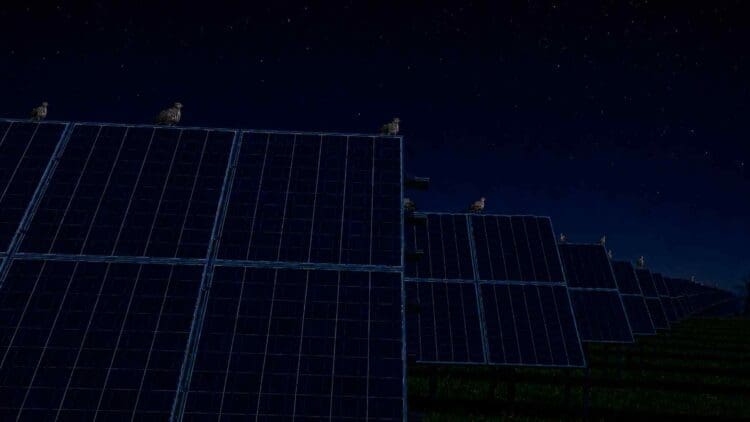

A solar plant demonstrates that true sustainability can be achieved day and night. A rare species is beginning to thrive as a result.
Global heating is dismantling ecosystems and pushing unique biodiversity toward a tipping point.
To address these effects, developers must start implementing a closed-cycle standard. This applies to all renewable energy projects.


But will a new “best practices benchmark” truly help revive the declining population of Europe’s rarest bird?
How climate change is threatening the planet’s ecosystems
The risks of the climate crisis have significantly intensified.
Globally, vulnerable habitats are now facing increased pressure due to every fractional increase in warming compounds.
Global temperatures have already breached the 2.7°F (1.5°C) safety limit set by the Paris Agreement.
This has led to a “new normal” worldwide. Weather patterns have become unpredictable and seasonal cycles are shifting.
The disruption of nature’s delicate timing has established climate change as an active driver of local extinctions.
This is because habitat loss from industrialization is exacerbated by climatic fragility.
It contributes to the inability of many species to adapt to or migrate in rapidly changing environments.
With one million species facing extinction, decarbonization is no longer optional—it is a survival mandate.
Replacing carbon-heavy fossil fuels with renewable sources seemed like the solution.
Yet, poorly planned green infrastructure often trades one environmental crisis for another.
The hidden environmental costs of solar plants
Several national and international climate mandates have highlighted the transition to solar energy as essential for decarbonization.
But replacing the world’s energy mix with green power sources is not as straightforward in reality.
The AI revolution is tripling data center power demands, forcing a reckless rush for new energy land.
Consequently, utility-scale projects have undergone rapid scaling and deployment.
It then became clear that “green” is not always synonymous with “low-impact.”
Utility-scale arrays can span thousands of acres, cleaving migration corridors and fragmenting vital habitats.
Furthermore, solar panel production is resource- and energy-intensive.
These processes contribute to nearly 0.15% of energy-related emissions.
The third obstacle is the end of solar panel lifespans.
Proper recycling is currently more expensive than dumping panel waste in landfills.
This ‘green’ footprint can be lethal for local wildlife.
Fortunately, Lightsource bp has designed a solar plant that promotes a closed-cycle approach to sustainability.
A guideline for nature-positive clean energy
Lightsource BP and SolarPower Europe teamed up to reconcile rapid infrastructure growth and ecological preservation.
This partnership led to the creation of the “Solar Sustainability Best Practices Benchmark.”
The framework mandates ‘Net Gain’ biodiversity, ensuring land is more life-dense after construction than before.
The Wilburton Solar Farm in Cambridgeshire, UK, served as the practical ground for this new benchmark model.
Managing a 110-acre site with a commitment to net-positive impact
Strategic engineering means 99% of the soil remains untouched by physical infrastructure.
Nearly 109 acres of soil are undisturbed and available for ecological restoration of native flora.
Chemical-free “pollinator havens” in the field margins have fostered a surge in insect biomass.
Native wildflower margins have triggered a 300% surge in insect biomass, creating an all-you-can-eat buffet for declining bird life.
A 40-year ‘custodianship’ clause prevents the land from being sold off or neglected. This ensures long-term habitat stability.
By day, 700,000 panels power 1,500 homes.
By night, the structure transforms.
The perimeter fencing blocks foxes. The tilted panels create a ‘roof’ that hides ground-nesting birds from owls and hawks.
This protection, together with increased food sources, has led breeding pairs to increase from five to over 20.
The new benchmark model proves that utility-scale solar projects can double as high-tech conservation cradles.
It presents a viable, clean future where even the most vulnerable species can begin to thrive.
If a single solar farm can bring a species back from the brink, why aren’t they all built this way?
Anke Maree is a writer with a clear and engaging editorial style. Her work focuses on making complex topics accessible, informative, and relevant for readers across different areas of interest.