
While New York prepares floating wind farms, Sweden wants to place a vertical turbine at sea that spins like a giant whisk
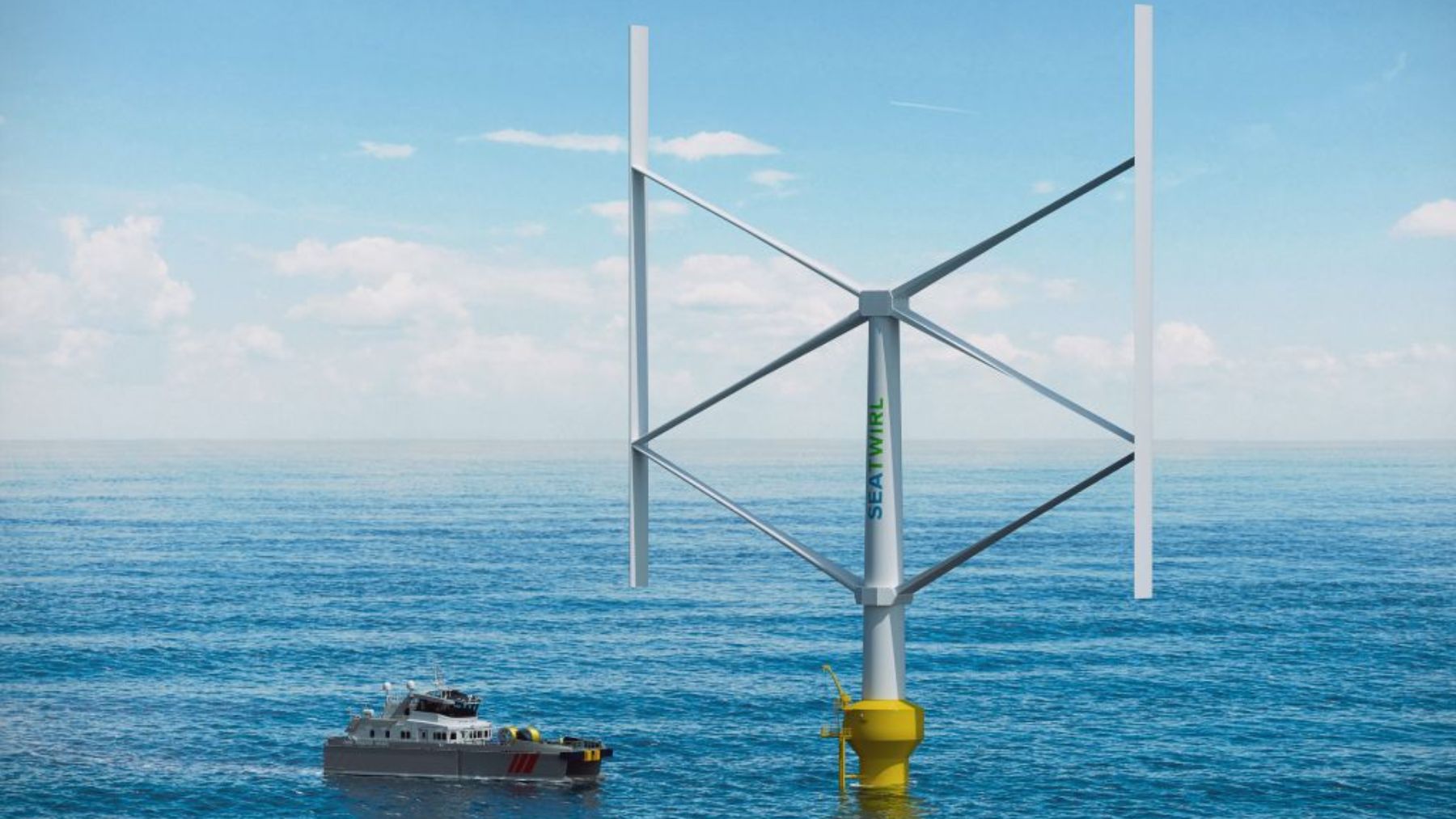 Credits: SeaTwirl
The Swedes are venturing into deeper waters using a vertical turbine to harness more power.
The need for clean energy generation is rapidly rising, driving a significant expansion in offshore wind.
Some nations are deploying floating wind farms, but these horizontal designs face significant obstacles off coastlines.
Ultimately, should the Verti-Go project deliver promising results, vertical floating wind could soon unlock deep-sea power at coastal hubs globally.
Developers are addressing this global challenge by testing alternative designs.
Will using a vertical-axis approach instead help unlock affordable, reliable green electricity in coastal regions worldwide?
How deep-sea wind power will meet growing consumption
The modern, digitized society has skyrocketed the world’s electricity demand.
Power grids are under immense strain due to data centers, electric transport, and industrial growth.
To relieve this pressure and lower the risk of complete blackouts, utilities switch on fossil-fuel plants as backup.
Since this directly conflicts with international climate goals, nations need to replace carbon-heavy sources with scalable, carbon-free energy.
Offshore wind presents distinct advantages that meet this energy deficit.
Ocean winds generate significantly more electricity per turbine, as they are more consistent and stronger.
These installations also overcome land-use conflicts, local zoning, and terrain complexity.
Furthermore, nearly 40% of the population lives in coastal cities. These regions will greatly benefit from clean power generation near urban centers.
However, suitable shallow coastal waters are rapidly filling up.
Since 80% of global marine wind resources are in deep waters, offshore infrastructure must expand deeper.
When floating innovation meets horizontal limitations
Floating wind farms are rising over the sea near coastal regions like New York.
The state’s goal is to achieve an offshore capacity of 9,000 MW by 2035.
Ambitious mandates such as this are driving the rapid move beyond shallow waters.
Floating platforms are highly beneficial as they bypass depth limits using cables for tethering.
Beyond harnessing the strongest, consistent winds, they also lower noise and visual impact on coastal communities.
However, these installations are traditionally horizontal-axis, which present severe engineering challenges.
The top structure is extremely heavy due to gearboxes and generators mounted hundreds of feet in the air.
This necessitates expensive giant floating foundations to prevent capsizing.
Furthermore, the tower and blades experience dynamic stress from incoming waves, accelerating mechanical breakdown.
The need for more frequent repairs increases downtime and operational costs.
Swedish company SeaTwirl is addressing these barriers by using a vertical floating turbine instead.
The vertical-axis turbine solution
SeaTwirl developed a floating vertical-axis turbine specifically for deep-sea conditions.
Instead of placing the heavy generator atop a tall tower, it is mounted near the waterline.
By lowering the center of gravity, the turbine can use a lighter spar floater, which reduces raw material expenses.
Furthermore, the vertical blades harness wind from all directions without complex mechanisms to turn or pivot blades.
Maintenance can be done on-site, eliminating the need for shore transport.
Another report from SeaTwirl indicates that the design is being scaled through the EU-supported Verti-Go project.
The status of the Verti-Go project
A prior 30 kW prototype will be scaled up to a 2 MW turbine.
The goal is to demonstrate its performance in real offshore conditions for 15 months.
The project officially launched on October 1, 2025. The launch followed the co-funding of Horizon Europe’s €15 million (approximately $17.1 million) grant.
SeaTwirl will act as technical lead alongside ten other European partners. University College Cork is the project coordinator.
Design will continue through late 2026. Manufacturing, deployment, and offshore testing will run through 2029.
Global power demand will continue to escalate.
This makes deep-ocean wind expansion essential to prevent catastrophic power outages.
Conventional horizontal floating turbine designs present significant hurdles. Fortunately, SeaTwirl’s alternative vertical turbine offers a compelling, low-cost solution.
Ultimately, should the Verti-Go project deliver promising results, vertical floating wind could soon unlock deep-sea power at coastal hubs globally.
Anke Maree is a writer with a clear and engaging editorial style. Her work focuses on making complex topics accessible, informative, and relevant for readers across different areas of interest.
