
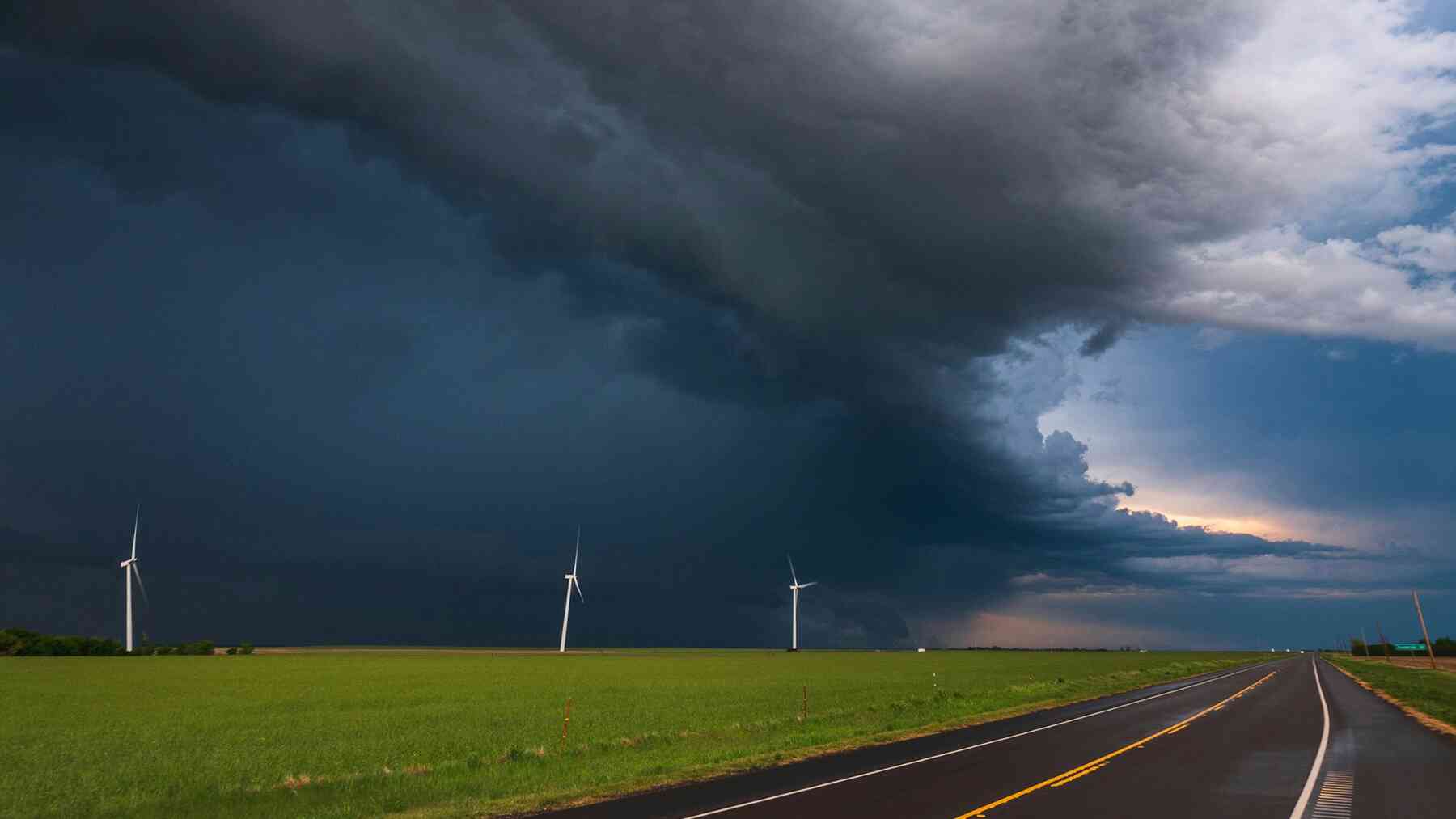
A Texas wind farm faced an approaching storm and ended up doing something no one expected: it slowed the storm itself
 Credits: Edited image
A wind farm can alter local weather patterns and manipulate incoming storms.
Globally, wind power is rapidly expanding to meet rising energy demand and fast-approaching climate targets.
Now, hundreds of thousands of turbines are generating clean electricity across the world’s landscapes.
Her work focuses on making complex topics accessible, informative, and relevant for readers across different areas of interest.
However, researchers have found that these giant installations do more than produce carbon-free power.
They physically interact with the atmosphere, but how do they use this effect to slow storms?
How wind farms are driving the global transition
The world is officially in the “Age of Electricity.”
Heavy industry and transportation are slowly but surely shifting to electric power.
This shift, along with the rise of massive AI data centers, is rapidly raising global electricity demand.
Consequently, year-on-year worldwide energy consumption has reached over 29,000 terawatt-hours.
The International Energy Agency projects that annual demand growth will be 50% higher over the next five years.
To meet this major surge while adhering to strict climate targets is monumentally challenging.
The result is a widening global energy gap.
Fossil fuels cannot be scaled without triggering an environmental disaster.
This reality renders large-scale wind farms an absolute necessity to the global energy grid.
This technology has proven versatility and scalability to sustain grids and secure energy.
Today, 138 countries use wind energy to power their economies.
Yet, there are significant concerns about the environmental impact of wind turbines.
From local footprints to atmospheric barriers
Wind turbines have well-documented environmental consequences.
Wind farm construction requires vast spaces of land, which leads to local ecosystem fragmentation.
The rotation of giant turbine blades directly impacts wildlife, especially migratory birds and bats.
Additional concerns include alteration of soil drainage and vegetation disruption.
These factors have led developers to map migration corridors and wildlife behaviors carefully.
This way, the wind farm planning phase becomes more responsible.
Modern green energy design has now adopted a “nature-first” philosophy, ensuring true sustainability.
Onshore, adaptations include custom wildlife passages and automated radar systems.
Offshore setups use specialized “bubble curtains” to damp underwater construction noise.
These interventions drastically lower the direct, physical footprint of a wind farm on the immediate environment.
However, research published by the European Academy of Wind Energy discovered this footprint has expanded into a new domain.
The true scale of a wind farm’s impact has now shifted to the sky.
The day a Texas wind farm slowed a thunderstorm
Sometimes, wind turbines can pose unexpected dangers, and sometimes, they present surprising benefits.
On June 18, 2019, the plains of West Texas were struck by a massive thunderstorm.
It created a powerful gust front, sending a dense boundary of cold air rushing ahead of the rainfall.
Once this atmospheric boundary reached a massive wind farm near Lubbock, something strange happened.
The approaching storm suddenly lost momentum. Atmospheric scientists Julie Lundquist and Jessica Tomaszewski investigated this anomaly.
Simulating a storm with and without turbines
High-powered weather research models were used for the simulation.
The data showed that the rotating blades served as giant barriers against the storm.
The wind farm extracted kinetic energy from the air. This lowered the storm’s speed by 12.4 mph.
This braking effect delayed the storm’s arrival at surface weather stations by up to six minutes.
Consequently, the turbines delayed drops in local temperatures and abrupt wind shifts.
The unique event in Texas proves that green infrastructure can impact the planet in unexpected ways.
This region is also home to Xcel Energy’s Hale Wind Project. The 478 MW facility is designed to provide clean power for 168,000 homes.
However, the wind farm’s physical presence will clearly reach beyond electricity generation.
As large-scale wind farms continue to expand globally, it is vital to understand how giant turbines interact with the sky.
Anke Maree is a writer with a clear and engaging editorial style. Her work focuses on making complex topics accessible, informative, and relevant for readers across different areas of interest.
