
Cornell engineers develop vibrating-beam device that stores and computes analog data for AI hardware
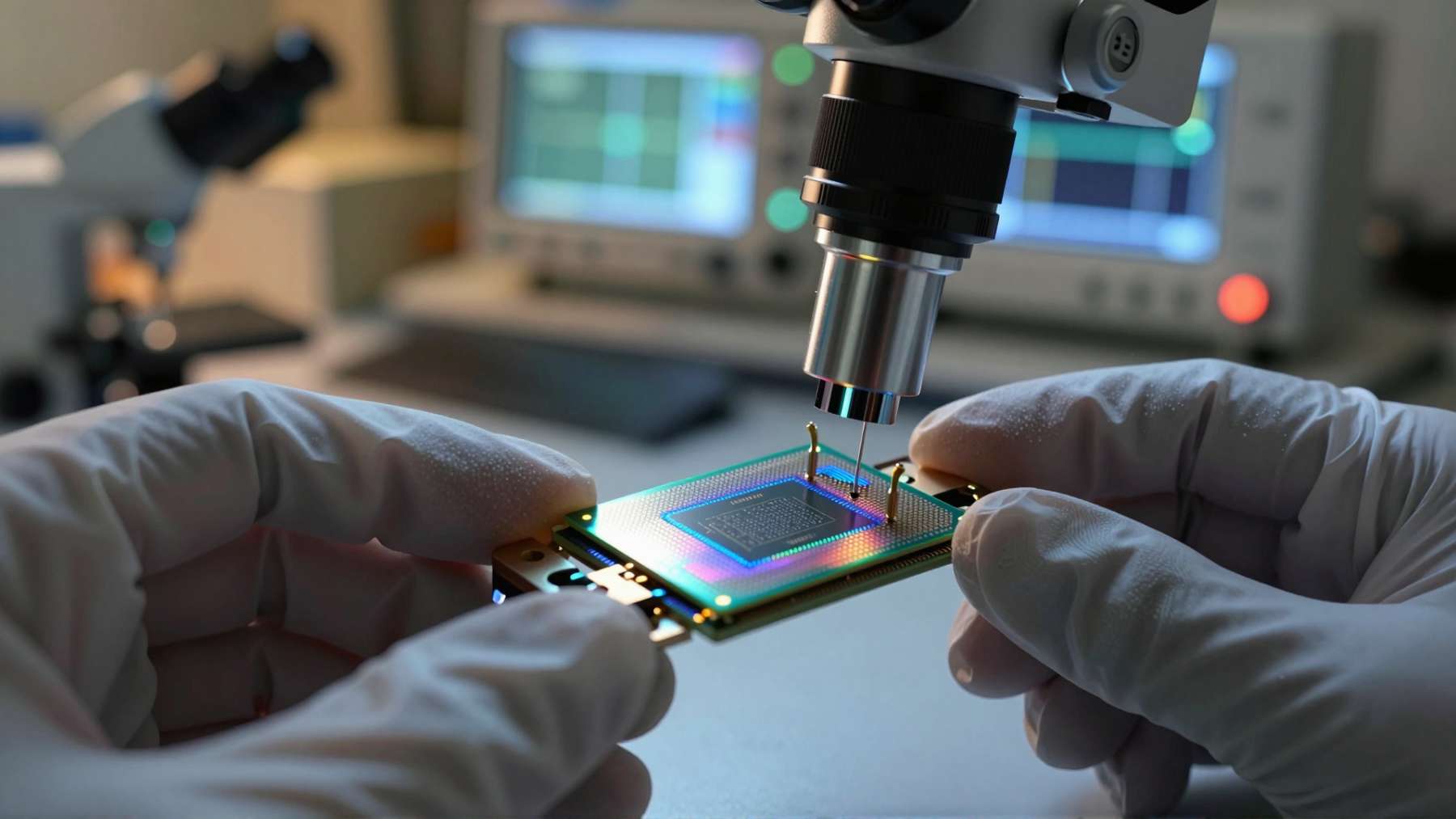
Cornell University engineers have built a computing device that stores information electrically but reads it through a tiny vibrating beam — an approach that sidesteps some of the energy costs associated with conventional AI hardware. The research, led by doctoral student Shubham Jadhav and professor Amit Lal, was published in Nano Letters in April.
The device combines ferroelectric materials with a microscopic suspended beam to create what the team calls a ferroelectric microelectromechanical system, or FeMEMS — designed to store and compute analog data in a single structure.
Cornell Team Publishes New Computing Device in Nano Letters
The paper targets two demanding computing paradigms: neuromorphic computing, which draws inspiration from how biological brains process information, and analog in-memory computing, where memory and computation are tightly integrated rather than separated. Both approaches are gaining relevance as AI workloads grow more complex and energy-hungry.
The FeMEMS device stores analog data in a ferroelectric thin film, reads it through mechanical vibration, and performs multiplication physically inside the beam.
Jadhav and Lal — who holds the Robert M. Scharf 1977 Professorship in the School of Electrical and Computer Engineering at Cornell’s Duffield College of Engineering — designed the FeMEMS device so that a material can store a value and participate in computation simultaneously, rather than simply holding data until it is fetched elsewhere.
Why the Team Separated Electrical Writing From Mechanical Readout
The energy problem in conventional computing is well understood. Processors and memory sit apart, and moving data between them consumes significant power. AI workloads feel that cost acutely, repeating billions of arithmetic operations in rapid succession.
Ferroelectric devices have long been explored as a way to bring memory and computation closer together. A persistent challenge, though, is that using the same electrical pathway to write, store, and read information can introduce unwanted current paths and disturb the stored state in the process.
The Cornell team kept the electrical channel for writing while shifting readout into a mechanical function entirely. Separating these two pathways allows the device to access stored information with reduced electrical interference and very low idle power consumption. The goal, as Jadhav described it, is for the material itself to store a value and help compute with it at the same time.
How the FeMEMS Device Works
At the heart of the device is a 20-nanometer layer of hafnium zirconium oxide embedded in a tiny suspended beam. Hafnium zirconium oxide is a ferroelectric material, meaning it contains microscopic regions called domains whose orientation can be switched by applying an electrical pulse.
Programming the device means reorienting those domains with targeted electrical pulses. To read the stored value, a small signal causes the beam to vibrate, and the character of that vibration — its amplitude and behavior — reveals what is stored inside. Because the incoming signal and the stored state interact physically within the vibrating structure, the beam’s motion performs an analog multiplication. Multiplication is one of the most fundamental operations in AI systems, repeated countless times when a neural network processes data. The team demonstrated approximately 200 distinguishable electromechanical states, far beyond the binary ones and zeros of conventional digital memory.
Potential Consequences for AI Hardware and Broader Applications
Those roughly 200 distinguishable states matter because analog computing is inherently approximate, and approximations compound across multi-step operations. “If each stored value is only approximate, those small errors can build up across many calculations,” Jadhav noted. More distinguishable states mean each value can be represented more precisely, reducing that accumulation.
The researchers also see applications well outside AI. Electrically programmable beam motion could serve as a research tool for studying emerging ferroelectric materials. The platform could also support adaptive microsystems that combine ferroelectricity with capacitive, optical, or mechanical sensing functions — four distinct directions that suggest the architecture’s reach extends beyond neural network acceleration.
Scaling up is the immediate next step. The team plans to build larger arrays of FeMEMS devices capable of performing the matrix operations that underpin real AI workloads, with integrated control and sensing circuitry included. The work has been funded by DARPA’s NanoWatt Platforms for Sensing, Analysis, and Computation program, and the devices were fabricated at the Cornell NanoScale Facility with support from the National Science Foundation.
Context: Revisiting Pre-CMOS Computing Concepts With Modern Materials
The FeMEMS work sits within a broader moment in computing history. For decades, CMOS transistor technology scaled reliably, doubling performance at predictable intervals — that scaling is now slowing, and researchers are revisiting physical computing approaches once set aside.
“Before CMOS became the dominant technology, computing was a much more open playground,” Jadhav said. Many approaches to storing and processing information were explored before CMOS proved so scalable that alternatives quietly faded. Modern nanoscale fabrication and multiphysics design now make it practical to revisit those ideas with far better materials and tools.
The FeMEMS device stores analog data in a ferroelectric thin film, reads it through mechanical vibration, and performs multiplication physically inside the beam. With roughly 200 analog states demonstrated and DARPA-backed funding in place, the Cornell team’s next target is arrays capable of real matrix computation — a step that would test whether this hybrid of electricity and motion can compete as practical AI hardware.

Carlos is an engineer with strong expertise in technical and industrial topics. He previously worked at international companies such as Siemens and is multilingual.
