
The Netherlands is looking beyond hydrogen and running a boiler that burns iron dust, then collects rust instead of releasing smoke
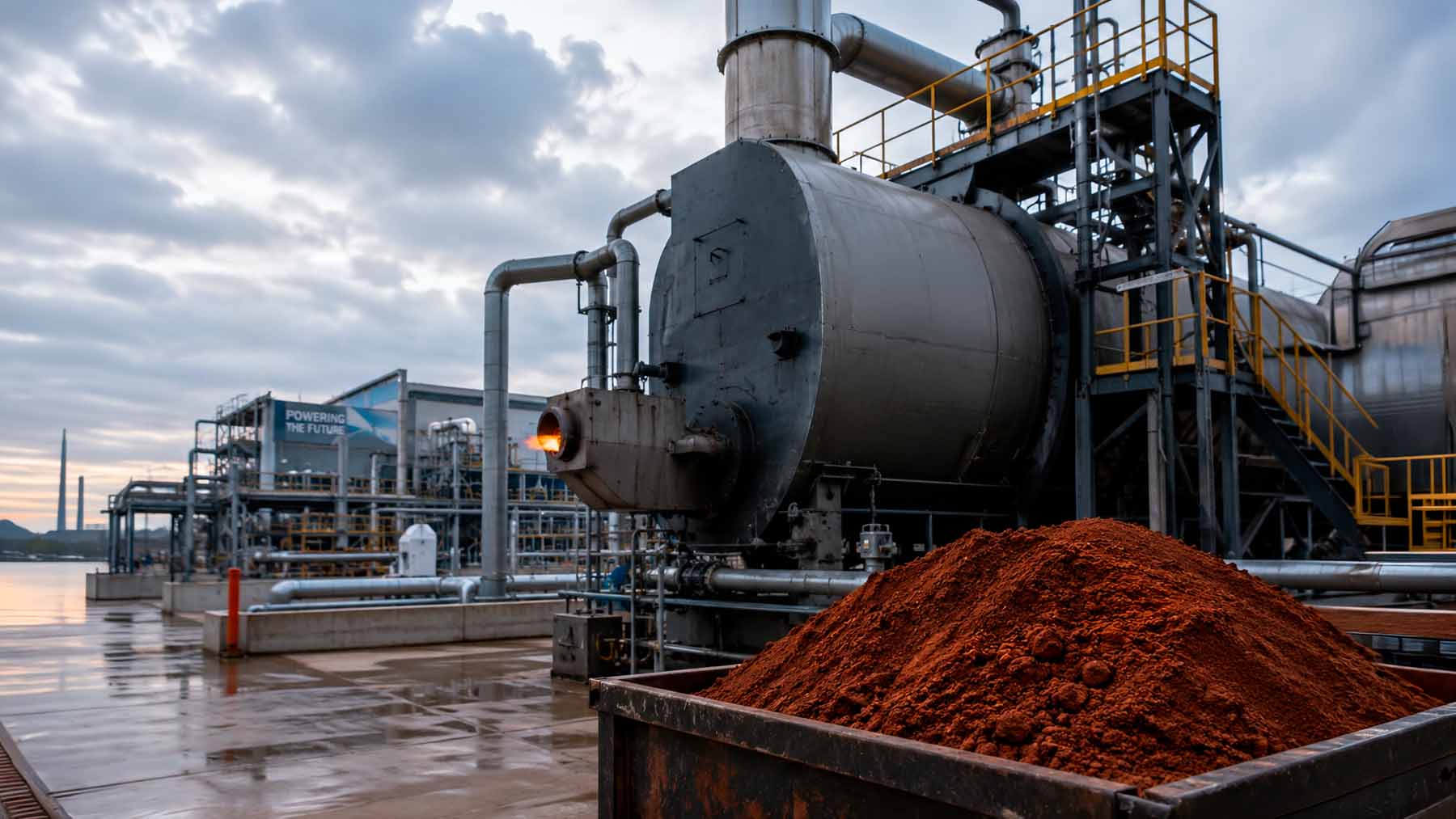 Image generated with artificial intelligence
A Dutch innovation shows how iron dust serves as an alternative clean fuel simply by burning it.
Globally, strict international climate targets are placing significant pressure on nations.
As these deadlines rapidly approach, several industries remain hard to abate due to heavy heating and long-term storage requirements.
However, digitization, rapid industrialization, and the need to electrify the world have accelerated global electricity consumption.
Green hydrogen and battery systems have received the most attention in recent years, but they present major bottlenecks.
Will metal fuels prove to be a circular solution?
How looming green deadlines add strenuous pressure
Modern problems require modern solutions, but this is often easier said than done.
The digital era has streamlined major operations worldwide, proving that the world now revolves around convenience.
However, digitization, rapid industrialization, and the need to electrify the world have accelerated global electricity consumption.
As a result, global power demand is projected to grow roughly 3.6% per year.
This significantly strains national power grids, despite the addition of renewable energy capacity.
Solar and wind power are intermittent and cannot sustain continuous baseline demands without backup infrastructure.
As renewable generation drops, utilities revert to coal and gas facilities to prevent blackouts.
Consequently, this significantly slows progress in achieving international climate mandates.
Global agreements such as the COP28 pledge legally require nations to triple renewable energy capacity by 2030.
Since electricity usage outpaces the new green deployment rate, countries are forced to seek alternative solutions.
Storage stars that fall short in heavy industry
Batteries and green hydrogen have taken the lead in clean energy storage solutions.
Despite major expansion of the respective facilities, neither technology meets the operational requirements of heavy industry.
Lithium-ion batteries are exceptional at balancing grids over short periods. However, scaling the battery systems for seasonal, long-term storage remains uneconomical.
Additionally, heavy industrial operations need uninterrupted thermal heat over 1,800°F.
The conversion of stored battery power into extreme heat rapidly drains energy.
This will increase the frequency at which batteries must be replaced, further raising costs.
Green hydrogen may reach these required high temperatures, but gas handling introduces logistical challenges.
To store hydrogen efficiently, the gas must be compressed or cryogenically cooled to -423°F.
The cooling process is highly energy-intensive.
Furthermore, storage and transportation require specialized, costly pressure vessels and retrofitted pipelines.
To address these limitations, Metalot is working with iron dust as an alternative high-density energy carrier.
Burning iron dust to meet heavy industry needs
Safe long-term energy storage solutions have proven difficult to establish commercially.
However, iron dust is a dense, safe alternative option.
Iron is an abundant element, making it cost-effective and accessible.
Solid iron dust can be stored at room temperature without the risk of leakage, unlike hydrogen.
Furthermore, its energy cycle operates as a circular system.
The closed-loop combustion cycle
Inside a specialized boiler, fine iron powder is mixed with air and ignited.
The particles burn quickly, producing intense industrial heat surpassing 3,200°F with zero carbon emissions.
As it burns, the powder is converted into rust.
The rust is captured by industrial dust collectors before smoke or ash escapes.
The rust is moved to a reduction facility powered by green hydrogen or off-peak clean electricity.
Hydrogen is pumped through the hot rust, stripping away oxygen. Water vapor and pure iron dust are left behind.
The new iron dust re-enters the storage cycle. This creates a continuous, carbon-free fuel loop.
In the Netherlands, the Holon 0 facility proves that the technology is ready for real-world usage.
The pilot plant uses a 1.4 MW burner to produce high-temperature heat for local industrial sites.
Operational data indicates the system achieved 90% energy independence for surrounding communities.
It established iron dust as a safe, scalable, clean fuel.
Ultimately, it will bridge the gap between intermittent green power generation and heavy industry heat requirements.
Anke Maree is a writer with a clear and engaging editorial style. Her work focuses on making complex topics accessible, informative, and relevant for readers across different areas of interest.
