
It’s 20x thinner than hair and flies — Austrian scientists develop first photovoltaic drone and show its potential
 Credits:
One of the most exciting aspects of the scientific world is the introduction of unique, and dare we say it, unimaginably cool, technologies. Over the years, we have observed a significant increase in innovative solar technology designs. Recently, Austrian scientists developed the first photovoltaic drone, and its potential is a game-changer. What’s more, this photovoltaic drone doesn’t just fly, but is also 20 times thinner than hair. Discover more about this innovative solar design below.
An increase in innovative solar technology designs
Innovative technologies do not happen overnight. Yet, the world has obtained a significant amount of new, innovative technology designs, particularly focused on solar. This should come as no surprise, as the global renewable energy demand has skyrocketed, especially since solar power has become more affordable, and governmental policies have become more supportive of renewable energies.
Beyond governmental incentives and the need for energy independence, there is a growing focus on making solar technology more aesthetic and on its integration potential. Austrian scientists, in particular, have been researching “sustainable aviation,” and as a result, have developed the first photovoltaic drone. This drone is powered by groundbreaking photovoltaics that also have great potential in other applications.
Austrian scientists develop first photovoltaic drone
The aviation industry is one of the most carbon-heavy industries in the world. According to the International Energy Agency, the aviation industry accounted for nearly 2.05% of global human-caused carbon dioxide emissions in 2023, emitting a shocking amount of 882 million tons of carbon dioxide. Now, while Johannes Kepler University Linz’s scientists’ photovoltaic drone may not immediately solve this issue, its design could be the first step in the right direction.
While developing their design, they had a main focus on self-sufficient power, which is vital for independent operation over extended periods. Their answer? The use of quasi-2D perovskite photovoltaic cells. Perovskite has been of great interest lately, and the use of perovskite in tandem solar panels has reached 25% efficiency in a commercial launch, proving its tremendous potential in the industry.
Tremendous potential, as it’s 20x thinner than hair and flies
According to Christopher Putz, one of the authors of the study published in the scientific journal Nature Energy:
“Ultra-thin and lightweight solar cells not only have enormous potential to revolutionize the way energy is generated in the aerospace industry, there are also a wide range of applications that include wearable electronic, and the Internet of Things, that can benefit from this new technology.”
The scientists’ perovskite photovoltaic design has achieved a maximum power output of 44 watts per gram while maintaining high levels of stability. The latter is attributed to a transparent aluminum oxide layer that was added to the film. The design is also 20 times thinner than hair, sporting a thickness of under 2.5 micrometers. Furthermore, they are highly flexible, and their efficiency is an astounding 20.1%.
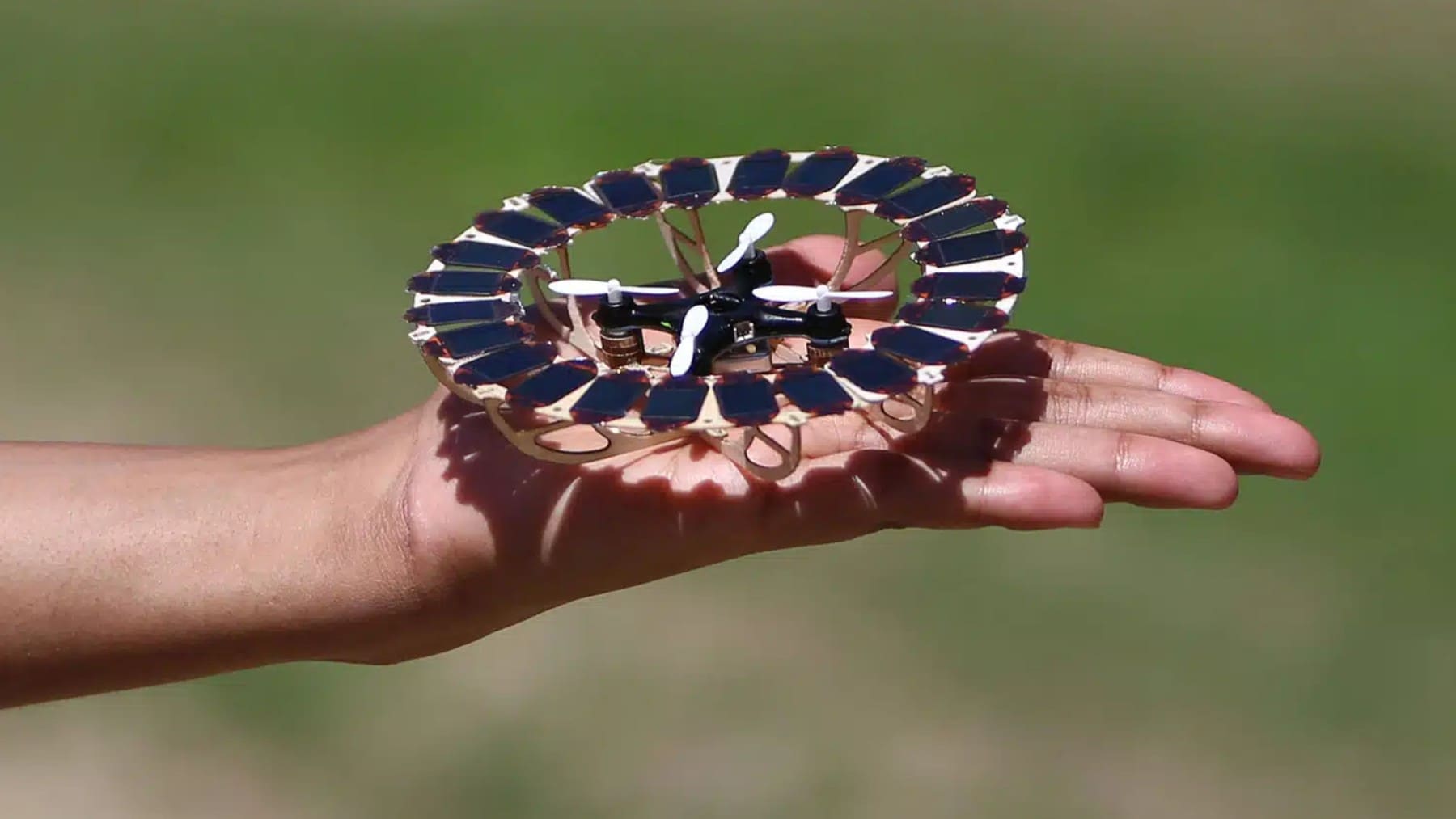
The scientists showcased their design’s potential by integrating it into a small, commercial drone, which became known as the “Solar Hopper.” They added 24 of these perovskite photovoltaic cells to the drone’s frame, which allowed it to operate independently without the need for wired charging. Potential applications include:
- Large-scale mapping
- Search and rescue operations
- Solar power production in space
- Solar system exploration
The Ingenuity Mars helicopter was actually the first to use solar power in aviation, and it self-sufficiently launched from Earth and landed on another planet. The Austrian scientists’ photovoltaic drone thus indicates the potential of perovskite photovoltaics in the aviation industry, giving renewed hope that the industry could soon become more sustainable. Other solar cells are also being researched and developed, and Australia may have discovered a great contender for perovskite as the solar game-changer material.
Anke Maree is a writer with a clear and engaging editorial style. Her work focuses on making complex topics accessible, informative, and relevant for readers across different areas of interest.
