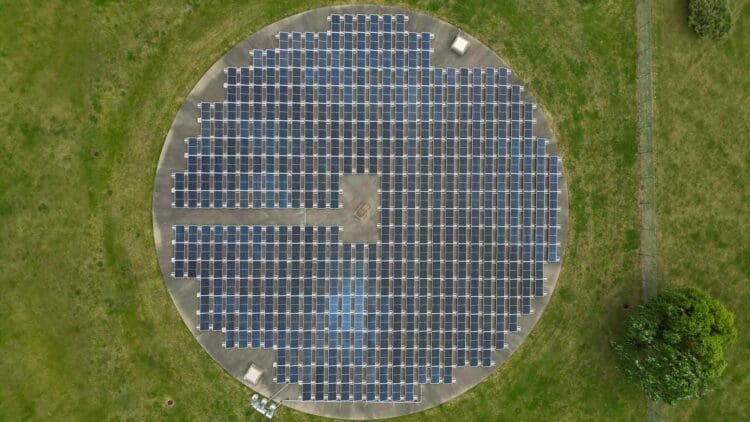

A solar panel park’s design is key to using its power for either good or bad.
Renewable energy technologies are not always as inherently clean as the world may have hoped for.
This is the case with solar power, which French engineers found could end life if not developed and managed properly.


So, which designs would then inevitably be the most ideal to sustain life in more ways than one?
How solar power’s global success is becoming short-lived
Over the last decade, solar energy surged to secure the top spot on the global capacity list.
This source’s role in the green energy transition has thus been fundamental.
When lower costs and quick scalability emerged, it became seamless to outpace fossil fuels.
Soon, glass-covered photovoltaic cells were rapidly expanding worldwide. Some installations were installed on rooftops, while others proliferated in bigger, commercial parks.
Solar power eventually became the primary source to meet energy needs while maintaining a low footprint.
But then a few hidden secrets came to light. Experts began to realize that solar could do a lot of damage, and not just environmentally.
As the world becomes more aware of the hidden footprint, does it mean solar panels have a bleak future ahead?
The dark side of the Sun: Solar’s hidden ecological cost
Paradoxically, it seems that for every solar answer experts found, another obstacle arose.
One of the earliest issues identified was that solar power output was limited to certain times of day. Additionally, peak production time was even more limited.
To overcome solar’s intermittency problems, large-scale hybrid solar and storage developments became a common sight. This introduced new complexities.
It was found that both photovoltaics and battery energy storage systems had a great environmental impact.
Both of their productions require critical minerals, something that resource-poor nations, such as the U.S., have to import.
The safe recycling of panels and batteries is also an issue. At the end of their life cycles, they often end up in landfills, creating a mountain of electronic waste.
But these disadvantages do not mean that solar energy cannot be used for good beyond clean power production.
Life, death, and design: A French discovery
One of the biggest social concerns regarding solar parks is their large physical footprint on land. The most worrisome is the habitat disruption and declining population of some species.
However, a collaborative study by French academic institutions and a private energy company uncovered something interesting. It turns out, solar panels can actually sustain the environment.
You can review the study “Effects of solar panels and management on soil mesofauna, respiration and plant traits in solar parks of two southern French regions” published in the Journal of Environmental Management.
The solar park’s design is the deciding factor for success and failure
The study analyzed 20 different solar sites across southern France.
Solar parks tend to fail the environment when a low-lying, conventional layout is used. Soil fauna, such as mites, that keep soil alive, rapidly decline.
Soil respiration also drops, essentially “suffocating” the earth. However, when panels are elevated and mowing is replaced by rotational grazing, the greenery becomes taller and healthier.
The study proves that a solar park’s environmental success fundamentally relies on its design layout and management.
It gives new meaning to “with great power comes great responsibility.” Yes, solar energy has disadvantages, but when carefully planned and managed, they become much less severe.
Solar power will remain viable, despite the obstacles that must still be overcome.
However, the future of solar could look a little different. This is to ensure that the environment is not compromised, but that nature and technology thrive together.
Anke Maree is a writer with a clear and engaging editorial style. Her work focuses on making complex topics accessible, informative, and relevant for readers across different areas of interest.