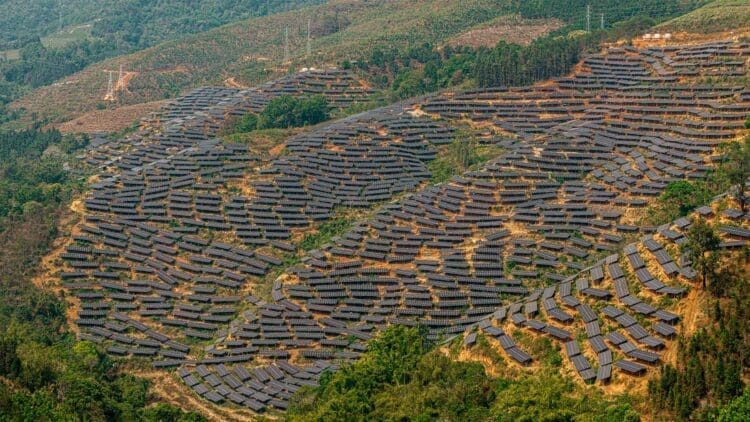

Solar energy is typically measured by output and carbon offset, but biodiversity restoration has become another factor.
When it comes to sustainability, mitigating the effects of climate change cannot be the sole purpose anymore.
Renewable energy sources do play an integral role in saving the climate, but they have been lacking in the environment.



Will changing how green utility-scale facilities are developed and managed finally help save nature as well?
How the role of solar energy has evolved in recent years
For many years, solar power was defined by a singular yet crucial metric: scale.
Globally, nations have set national climate targets in accordance with international mandates.
Soon, communities began to scramble to meet these rapidly approaching targets. It was then that the solar industry’s success became measured almost exclusively by the ability to replace fossil fuels.
By the 2010s, cost and efficiency were the primary challenges to address.
Fortunately, the levelized cost of energy (LCOE) suddenly plunged, causing an explosion in large-scale developments worldwide.
Massive industrial facilities covered thousands of acres to deliver as many gigawatts of clean power as possible.
Land was leveled, native vegetation cleared, and the ground kept bare or covered with gravel to make maintenance easier.
Unfortunately, achieving carbon neutrality did not always mean that nature-positivity was part of the equation.
It became evident that to achieve true sustainability, developers would have to re-evaluate their approaches.
When going green is not “green” enough
The bigger the solar plant, the greater the negative impact on nature usually is.
A vast array of installations often requires clearing and grubbing many acres, stripping away topsoil. This degrades the land and results in the loss of established habitats.
Furthermore, environmentally invasive maintenance methods, such as diesel-powered mowers and herbicides, form dead zones for local wildlife.
These “green” power plants inadvertently contribute to habitat fragmentation and the decline of local species populations.
However, a different management philosophy approach has proven that solar does not have to come at the cost of nature.
Solar parks should be viewed as integrated ecosystems and not isolated power plants.
In a nationwide field study in Germany, researchers have discovered that this will lead to a remarkable restoration of biodiversity.
The study “Biodiversity in the solar park – A nationwide field study” was published in Sonne Sammeln.
Solar plants that bring nature back to life
Biologist Dr. Tim Peschel led the study for the BNE (German Association of Energy Market Innovators).
The team analyzed 30 solar plants built on former farmland and uncovered that solar panels can create an “unusual microclimate.”
This phenomenon became the primary driver for ecological recovery.
The shadows cast by the panels prevent soil from drying out. They also offer a cooler refuge for species during hot summers.
These solar facilities serve as green corridors and support biodiversity at levels beyond the farmland they replaced.
Documented species as proof of restoration
In the audited areas, researchers found:
- 300 plant species, thriving in the chemical-free, undisturbed soil
- The recovered native vegetation attracted 36 butterfly species and 30 grasshopper species
- The parks became ideal hunting grounds and shelters for 13 dragonfly species
- 13 species of bats are attracted to the renewed abundance in insect life
The increase in species at these sites highlights that solar plants’ protected environments can drive nature revival.
The BNE’s study proves that the energy transition and nature conservation do not have to be mutually exclusive.
Adopting management approaches that are eco-conscious while leveraging unique microclimates will benefit both worlds.
The global climate can thus be stabilized while promoting nature-positivity. Maximum carbon offsets, power outputs, and biodiversity restoration at green facilities are key to achieving true sustainability.
Anke Maree is a writer with a clear and engaging editorial style. Her work focuses on making complex topics accessible, informative, and relevant for readers across different areas of interest.